





Related: Truck Crash Test Videos Highlight the Need to Keep Drivers Safe
FMCSA Prepping to Study Causes of Fatal Truck Crashes
The Federal Motor Carrier Safety Administration will launch a study of factors that contribute to highway crashes involving large trucks. Driving the study is concern over the rising number of fatalities incurred in truck crashes.
January 15, 2020
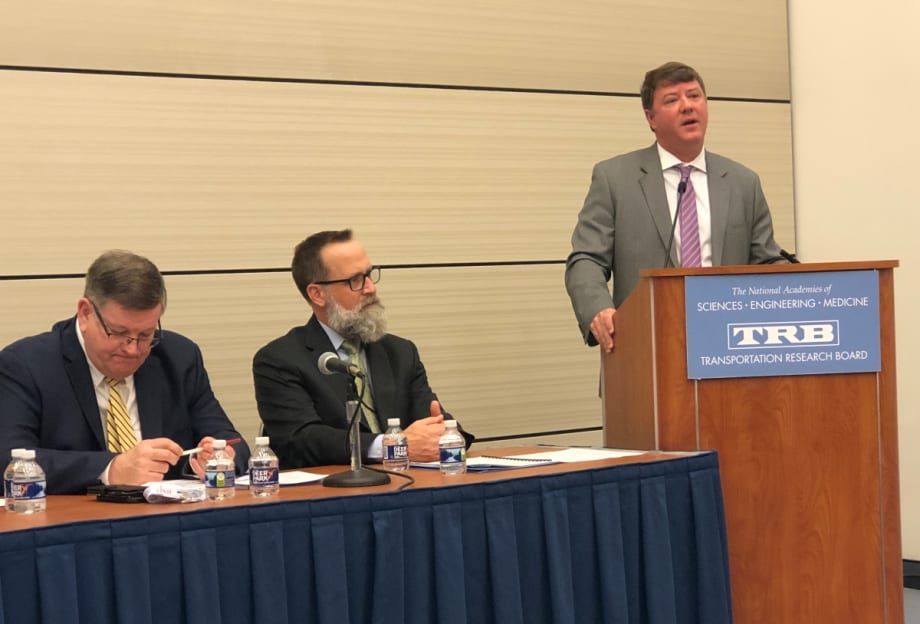
FMCSA Acting Administrator Jim Mullen (right) said the agency’s top priority in 2020 will be reversing the four-year upward trend in fatalities from large-truck crashes.
Photo: David Cullen
3 min to read
The Federal Motor Carrier Safety Administration has taken the first step toward launching a fresh study of factors that contribute to crashes involving large trucks. While the study will look at all collision categories (tow-away, injury and fatal), FMCSA Acting Administrator Jim Mullen indicated the driving force for the new study is concern over the rising number of fatalities from such crashes.
“When I assumed this role as acting administrator three months ago, I was asked my top priorities,” Mullen said in his keynote remarks at the start of the agency’s annual Analysis, Research, and Technology public sessions on Jan. 13 in Washington, DC.
“That to me was a no-brainer,” he continued. “The top priority is to reverse the four-year trend of increasing fatalities involved with large trucks.”
He noted that the agency last studied crash causation 15 years ago. In the years since, the data available to inform such studies has grown by leaps and bounds, including the reams of it now being captured by mandated electronic logging devices.
FMCSA took the first step toward launching a new crash study by publishing a Request for Information notice in the Federal Register for Jan. 15. The notice states that the agency is seeking input on how best to design and conduct a study to identify factors contributing to all FMCSA-reportable large truck crashes.
Perhaps reflecting some of the agency’s thinking going in, the notice says that the study methodology should address the use of onboard electronic systems, as they “can generate information about speeding, lane departure, and hard braking.”
More generally, the study aims to “yield information that will help FMCSA and the truck safety community to identify activities and other measures likely to lead to significant reductions in the frequency, severity, and crash rate involving commercial motor vehicles.”
Goals of New Study
The notice states that the study’s goal is to “help improve FMCSA and its state partners’ ability” to:
Evaluate crashes involving large trucks and identify emerging trends;
Monitor crash trends and identify causes and contributing factors; and
Develop effective safety improvement policies and programs.
FMCSA is seeking public comment on the Request for Information, which must be received on or before March 16.
Comments should indicate they are for Docket ID FMCSA-2019-0277 and may be submitted using any of these methods:
Federal eRulemaking Portal. Go to www.regulations.gov and follow online instructions for submitting comment
Mail to Docket Management Facility; U.S. Department of Transportation, 1200 New Jersey Avenue SE, West Building Ground Floor, Room W12-140, Washington, DC 20590-0001
Hand Deliver or Courier to West Building Ground Floor, Room W12-140, 1200 New Jersey Avenue SE, Washington, DC, between 9 a.m. and 5 p.m., EST, Monday through Friday, except Federal holidays
Fax via 1-202-493-2251
The most recent data revealed in a report released by the National Highway Traffic Safety Administration in October shows that fatalities in crashes involving large trucks increased by 0.9% from 2017 to 2018. That statistic stands out against the agency reporting that fatalities from all motor vehicle traffic crashes on U.S. roadways dropped 2.4% from 2017, which came after a 0.9% decrease from 2016 to 2017.
The NHTSA report also found that among fatalities in crashes involving large trucks in 2018:
Nonoccupants had 48 more fatalities, a 9.7% rise from 2017
Large-truck occupant fatalities in single-vehicle crashes increased by 10, a 1.9% increase from 2017
Large-truck occupant fatalities in multiple-vehicle crashes decreased by 3, a 0.8% decrease from 2017
Occupant fatalities in other vehicles decreased by 9, a 0.3% decrease from 2017
More Safety & Compliance

FMCSA Pauses Biennial-Update Enforcement Amid Motus Transition
Carriers whose updates were due on or after June 1 have more time, while FMCSA works to stabilize its new registration system and warns of phishing sites impersonating its new carrier registration system, Motus.
Read More →
ZF Expands Commercial Vehicle Push in North America
ZF is expanding its North American commercial-vehicle presence with new transmission applications, electrification, trailer technology and autonomous-driving systems.
Read More →
Truck Drivers Need More Than Another Alert
Fleets have more visibility into truck health, safety events, and driver activity than ever. The next challenge is turning all that information into useful guidance for the person who has to decide what to do next.
Read More →
Tesla Wants a Self-Driving Semi. Are Cameras Enough?
Could Tesla’s camera-only autonomous driving technology work on an 80,000-pound Semi? In this commentary, HDT's Deborah Lockridge takes a look at Tesla, Cybercab, and how autonomous trucks see the road.
Read More →
What DOT’s Automated Vehicle Strategy Means for Trucking
The U.S. Department of Transportation issued a new automated-vehicle strategy that outlines plans for driverless-truck regulations, cross-state freight corridors, and federal safety standards.
Read More →
NYC Expands Speed, Pedestrian Safety Tech Across Fleet
New York City is expanding intelligent speed assistance and pedestrian-alert systems across its municipal fleet, moving the technologies from pilot programs into vehicle procurement and retrofit requirements.
Read More →
FMCSA Removes 110 Truck Driver Training Schools from Certified ELDT List
Federal regulators also are targeting more than 160 additional training providers and launching a nationwide audit of third-party CDL skills testers as part of a broader crackdown on trucking fraud.
Read More →
Beyond DOT Compliance: What Makes a Trucking Fleet Truly Safe?
A trucking fleet can follow every rule and still make unsafe decisions. The real test comes when safety conflicts with freight, productivity, or cost.
Read More →
Hours of Service Pilot Programs: FMCSA Readies for 2027 Rollout
Two pilot programs could eventually reshape hours-of-service rules, giving truck drivers options to pause their 14-hour clock or use longer split sleeper rest periods.
Read More →
New Guide Offers Pet Safety Tips for Truck Drivers
Hundreds of thousands of pets travel in truck cabs. A new safety guide from Volvo Trucks and the Center for Pet Safety offers practical advice for truck drivers who bring dogs and cats along for the ride.
Read More →