





Related: Technology is Changing How Carriers, Shippers, and Brokers Connect
Trimble Aims to Transform Supply Chain with Latest Acquisition
Trimble Transportation says its latest acquisition will allow it to transform the supply chain – not by “uberizing” it, but by creating a single TMS that will allow true visibility and collaboration between shippers, carriers, and intermediaries.
January 9, 2020

Kuebix said it provides a transportation management system (TMS) that powers North America’s largest shipping community.
Photo: Trimble Transportation
5 min to read
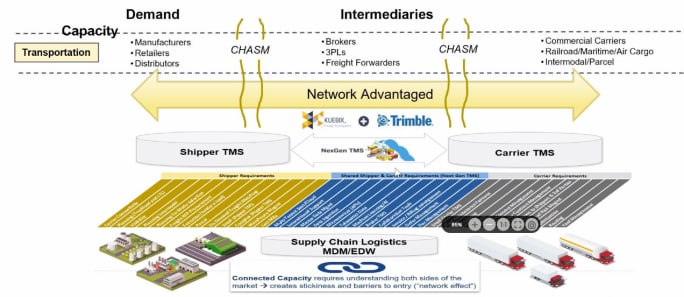
Trimble said its acquisition of Kuebix will allow it to break down the silos in the supply chain.
Graphic: Trimble Transportation
Trimble Transportation says its latest acquisition will allow it to transform the supply chain – not by “uberizing” it, but by creating a single TMS that will allow true visibility and collaboration between shippers, carriers, and intermediaries.
Trimble is acquiring Kuebix, a transportation management system (TMS) provider that has created a large connected shipping community. Trimble Transportation will bring together its network of fleet customers, which represent more than 1.3 million commercial trucks in North America, with Kuebix’s more than 21,000 shipping companies, into a new platform for planning, execution and freight demand-capacity matching.
“Our mission is to transform the way the world works,” said James Langley, senior vice president for Trimble Transportation, in a conference call with reporters. He pointed out the deep penetration the company has in the industry, with Trimble technology on more than 85% of the top 200 trucking companies in the U.S.
“We have high penetration, but really the end game is how we really fundamentally change the way real people do real work,” he said, by connecting the digital and the physical world.
Dan Clark, founder and president of Kuebix, explained that his company was founded on the vision of “transparent connectivity between the shipper and the carrier.
“We’ve been able to build a community of shippers of over 20,000 companies participating on our TMS, working with carriers on daily basis managing logistics operations.”
Bringing this large number of shippers, carriers, and intermediaries together in the same platform, company officials explained, will allow shippers to get better capacity, carriers to get more freight, accelerate the supply chain and reduce inefficiencies.
“We think it’s going to transform the industry over time,” Clark said.
Beyond Visibility
By extending the Kuebix multi-tenant, cloud TMS platform to carriers and intermediaries, Trimble said, it will enable a more connected experience to optimize the logistics process – from order management to financial settlement.
Plenty of money has been poured into efforts to transform the supply chain with technology, Langley pointed out. But it tends to be in silos, he said, with people trying to make one part of the supply chain more efficient, whether that be the carrier, the shipper, the warehouse manager, etc.
“Quite frankly, over $19 billion has been dumped into the transportation technology space in the last three years. Why? Because there’s a ton of inefficiency in this industry.” He pointed out that the average driver only uses about 7 hours of his 11-hour driving clock each day. Many trailers are still going down the road empty, or only three-quarters full. “How do you solve those problems if you can’t see outside of your four walls?” he asked.
Trimbe believes with the Kuebix acquisition, it can help everyone in the supply chain address those problems.
“A lot of people come in and say they want to Uberize the industry,” Langley said. “But you’re finding a lot of medium to large carriers are looking for a trusted technology partner that brings a value to them as well. There’s got to be a win-win. We just want to enable all parts of the supply chain to just do business more efficiently and effectively.”
This will go beyond the visibility offered by players such as 10-4 and Macropoint, he said, which have helped shippers know where their loads are and when trucks are going to arrive late – especially since the electronic logging device mandate forced more trucks to get connected.
“Shippers said, ‘I got a taste of this visibility, and I like it. But now I want actionability. I don’t want to just see the truck or where it’s going to be late; I want to dynamically change the supply chain to meet my customers’ needs.’”
Accelerating the Supply Chain
Among other things, the new TMS will change the way the bidding process works, Langley said.
“Quite frankly the way it works today is painful – 80% of business is done through an Excel spreadsheet for committed contract freight. We go through this process to make one or two year commitments and then 20 percent falls over to the spot market. The vision is as we have more deep granular data… I think you’ll see decision-making is going to accelerate. As opposed to two-year contracts in Excel spreadsheets, I think you’ll get a more seamless process. The supply chain now moves too fast, it’s hard to commit out two years in advance what you’re going to do. I think that procurement process will be much easier both on contract and spot market freight.”
In short, broad digital 'platforms' are becoming the place where supply chain business is conducted in the 2020s.
“We are seeing today good examples of the supply chain moving to the digital world,” Langley said. “The innovation here is we have access to all this data, we have access to very rich data, and we have it in almost real time. Decisions have to be made faster because of the velocity of the supply chain, because of the digital aspect of the supply chain. We need to make decisions faster and with more data,” he said, so both the physical movement of freight in the supply chain and the financial aspect, the transfer of money, happens faster.
“The agility of the supply chain has to accelerate, and the only way you’re going to do that is to connect and collaborate.”
The transaction is expected to close in the first quarter of 2020, subject to customary closing conditions. Financial terms were not disclosed.
More Fleet Management

Sponsored•September 16, 2026
Color Match Smarter: Tools That Restore & Perform
For fleet managers and collision repair professionals keeping heavy-duty trucks on the road, getting the color right the first time isn't just about appearance — it's about efficiency, turnaround time, and bottom-line results. Discover how today's digital color tools are transforming the repair process from guesswork to precision.
Read More →
FMCSA Pauses Biennial-Update Enforcement Amid Motus Transition
Carriers whose updates were due on or after June 1 have more time, while FMCSA works to stabilize its new registration system and warns of phishing sites impersonating its new carrier registration system, Motus.
Read More →
Sponsored•September 14, 2026
2026 Blueprint for Countering Smarter Supply Chain Theft
Cargo theft is no longer just the cost of doing business. It's a multi-billion-dollar criminal enterprise exploiting vulnerabilities across your fleet, drivers, and supply chain.
Read More →


Sponsored•September 1, 2026
How Telematics Improves Visibility, Control, and Performance in Refrigerated Fleets
Explore how telematics help refrigerated fleets improve visibility, uptime, efficiency, compliance, and cargo protection across connected cold chain operations.
Read More →
What the U.S.-Canada Trade War Means for Trucking
Escalating U.S.-Canada tariffs could disrupt cross-border freight, reduce truck volumes, raise costs, and create new uncertainty for carriers on both sides of the border.
Read More →
What Are Trucking’s Top Concerns for 2026?
The American Transportation Research Institute wants to know what's worrying trucking fleet managers, drivers, and other stakeholders in its annual Industry Issues survey.
Read More →
American Trucking Associations Looks for a New Leader
ATA President and CEO Chris Spear abruptly left his job at the association on August 21, at a pivotal time for the trucking industry.
Read More →
Public Wi-Fi Cybersecurity Risks: How Truck Drivers and Fleets Can Protect Their Data
Public Wi-Fi can expose truck drivers and fleets to credential theft, malware, and other cyber threats. Here’s how to reduce the risk on the road.
Read More →
For Nicky Cupp, Fleet Innovation Starts With Frustration
HDT Truck Fleet Innovator Nicky Cupp turns everyday pain points at Fraley & Schilling into opportunities for better technology and smarter processes.
Read More →
Adam Buttgenbach’s Approach to Electric Trucks: Start With Where They Fit
HDT Truck Fleet Innovator Adam Buttgenbach helped PepsiCo build one of North America’s largest EV fleets by focusing on where electric trucks make operational sense.
Read More →