





Related: Will Future Trucks Be Powered by Batteries or Fuel Cells?
Q&A: XOS' Gio Sordoni Talks Going Electric
HDT recently sat down with XOS COO and Co-Founder Gio Sordoni at the company’s North Hollywood facility to discuss the future of electric trucks in both the medium- and heavy-duty industries.
January 6, 2020
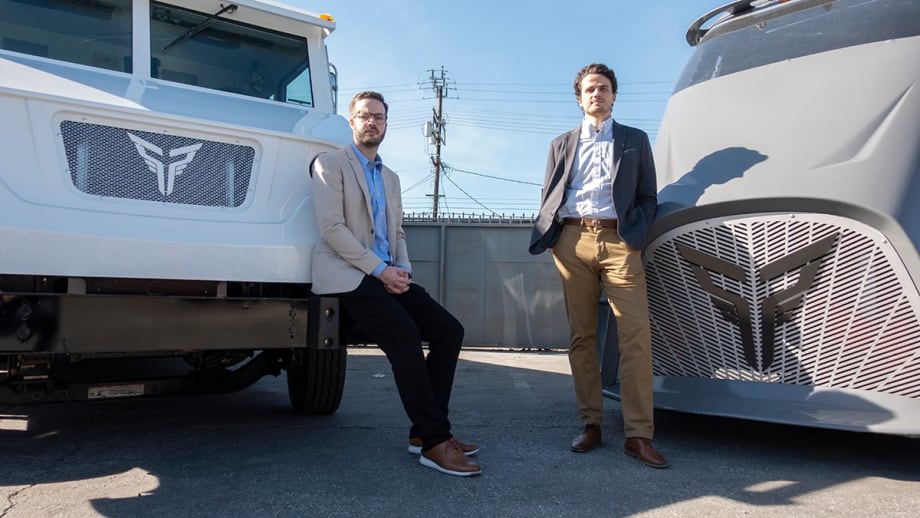
XOS CEO and Co-Founder Dakota Semler (left) and COO and Co-Founder Gio Sordoni.
Photo: Vince Taroc
7 min to read
HDT recently sat down with XOS COO and Co-Founder Gio Sordoni at the company’s North Hollywood facility to discuss the future of electric trucks in both the medium- and heavy-duty industries.
HDT: Readers may recognize your company's previous name, Thor. What does the name change symbolize for the company?
Sordoni: We changed the name of the company in April, to XOS, which is short for exosphere. We decided that we wanted to go beyond just providing a piece of hardware to a fleet and saying, "Hey, good luck, go figure it out." What we're doing now is a more comprehensive set of services that helps fleets think through their energy profile of their building, how to most efficiently get those electrons into their trucks and save on the overall operation.
HDT: How do you approach the infrastructure issues related to the transition to electric trucks?
Sordoni: Our main focus is the electric truck itself, but we realized that fleets need a lot more than that to get up and running. An electric vehicle is different from diesel in the way that it's maintained, in the way that it's refueled – it's charging. We help these fleets think through that whole process and help them get the infrastructure they need. We help them through that whole process in terms of coordinating it and getting the right products that they need to make the switch from diesel to electric.
HDT: How do you stand apart from the other, larger OEMs in terms of electric trucks?
Sordoni: We see it as a huge opportunity. We're extremely excited to see other OEMs getting into the space and taking electric vehicles seriously. XOS is a little different in that we focus in three key areas: We build our own chassis, so we're not an outfitter; and we build our own battery from scratch, rather than just integrate an existing battery from a passenger car, and that's really important. Then we do all the software and controls of our vehicles as well. Our batteries are air cooled, which makes them really good for commercial mobility. It allows for a safer, more energy dense battery that is also cheaper because we didn't design something that was designed to fit in the passenger car and in a really tight space, cramming cells so close together. That makes it very difficult to cool a battery pack, whereas ours is purpose-built for electric trucks.
HDT: Why did you decide to enter the Class 8 commercial truck market after starting with medium-duty vans?
Sordoni: Part of our focus in the medium-duty segment is due to the fact that an overwhelming amount of those trucks are only doing local hauls. A lot of people think of commercial mobility and they think about long-haul trucking and these long LA to New York trips. But the reality is that most commercial vehicle traffic is actually going shorter distances, about 150 miles or less in a day.
We started XOS because we were fleet operators beforehand. We had a fleet of about 40 medium-duty trucks, and before that, another business with a few hundred heavy-duty trucks. We were constantly battling with not only the maintenance that it takes to keep those trucks on the road and the opportunity cost of having a truck go down, the fuel costs of keeping those fleets fueled, and tracking ever-changing fuel prices, but also from a regulatory perspective – keeping up with more and more stringent regulations around emissions that we don't see as going anywhere. We started the company to build a product for ourselves, which happens to be useful for a lot of other fleets that are trying to solve that same last-mile mobility electrification challenge. Going electric provides an opportunity for them to save a lot on maintenance and fuel and some of those compliance costs.
HDT: How much does a single charge cost compared to filling up like a diesel delivery van?
Sordoni: One of the main benefits of switching to an electric powertrain or an electric truck is fuel savings, and this depends a lot on what the fleet is paying for fuel for diesel fuel and what they can buy electricity for. A lot of the industry uses an average of about 12 cents a kilowatt hour for charging. Fleets can save about half of their fuel costs by switching to electric. This fluctuates a little bit depending on where you're plugging in and what utility company you use, but overwhelmingly our fleets are saving at least half on that and as much as 80%.
HDT: Do you plan to build custom electric chassis on demand for customers?
Sordoni: Our main focus right now is the medium-duty truck. We build our own medium-duty platform, rather than starting with an existing product and outfitting. We're actually providing a whole chassis and a whole electrified chassis and working with different body suppliers depending on the industry. For example, the UPS parcel delivery body. We partnered with its partner to get that body on top of our chassis. Loomis is another customer of ours, and they share that exact same chassis platform, but with a bulletproof body on top.
We build the base platform – a lot of people would call it a skateboard that you can plug in different bodies. There are also cases where we provide a powertrain electrification service to other OEMs. A good example of this is an OEM that we're working with in the off-highway space called Wiggins. They make an interesting heavy-duty off-highway forklift, and we help them electrify that product by supplying a powertrain kit to them.
HDT: Are there any plans to work with any other OEMs?
Sordoni: Partnerships in this space are really core to what we do as a startup. We know that we can't be great at everything. We're really great at battery technology software and building a robust EV chassis, and we are absolutely open to partnerships as the space heats up, and there are more people entering different segments of the market.
HDT: When can fleets buy the heavy-duty Class 8 truck?
Sordoni: Medium-duty trucks are available for purchase today. We're in low volume production in 2019 and in early 2020 will be ramping up the serial production. The heavy-duty truck is a little further off but coming soon.
HDT: What's the current status of the UPS road testing with the medium-duty electrics in Los Angeles?
Sordoni: UPS is actively testing trucks in Los Angeles, driving around every day and delivering packages. The test is going really well so far. Working with UPS in the early days has been extremely beneficial because they are one of the most data-focused fleets in the world. They've been helpful in giving us product feedback, which is making it back into our engineering process so that we can have a more robust, more reliable product in the future.
HDT: Where do you believe the electric will catch fire first – in medium or heavy duty?
Sordoni: The markets that we see going electric first – markets that share these characteristics in common – are return-to-base operations where the vehicle has a place to come home and charge, where you don't need a public charging infrastructure or refueling network but gas stations, predictable routes, so fleets that know exactly where they're going every day within a reasonable margin. UPS is a great example. It has all of its routes mapped and UPS knows exactly where those trucks will go, which eliminates a lot of the range anxiety that might be involved. Today, a lot of fleets are looking for about 100 miles in their kind of last-mile operations, but as battery technology improves, that'll creep up into more than 200.
HDT: Do you think electric truck adoption will be helped much by government incentives now or in the future?
Sordoni: Our goal is to compete with diesel offerings on cost without incentives. Our goal at XOS is to have a product that we can offer that competes with diesel and cost today, and the incentives play a very key role in helping companies like us get to scale, where we can then compete with these.
Subscribe to Our Newsletter
More Fuel Smarts

How Volvo Updated Its D13 for EPA 2027 [Watch]
Volvo’s updated D13 promises lower emissions without sacrificing performance or fuel economy. Take a closer look at what changed inside the engine in this HDT Spotlight video.
Read More →
Diesel Price Spike Shortens Payback for Natural Gas Trucks, Report Says
Energy Vision estimates fleets could recover the higher purchase price of an RNG-fueled Class 8 tractor in 1.3 to 2.8 years under current fuel-price scenarios.
Read More →
Calstart Becomes Catalyst Mobility, Reflecting Broader Focus
Calstart is now Catalyst Mobility, reflecting the nonprofit’s growing national role in clean transportation, including zero-emission trucks, infrastructure and incentive programs.
Read More →

Record Diesel Prices Squeeze Trucking Fleets
Average U.S. diesel prices have climbed to nearly $6 a gallon, surpassing the 2022 record as tight refinery capacity and Middle East disruptions keep fuel costs elevated.
Read More →
Sponsored•September 9, 2026
How Fuel Delivery Shapes Engine Performance
Fuel delivery depends on more than what happens at the injector. For fleet, maintenance and technical professionals, looking at the full path from pump to injector can provide useful context for understanding engine performance.
Read More →
East Coast Port Launches $45M Electric Truck Push
The Port Authority of New York and New Jersey announced millions in incentives for zero-emission drayage trucks, yard tractors, and new charging hubs near the port.
Read More →
California Bill Could Shed Light on Electric Truck Prices
Why do battery-electric Class 8 trucks remain so expensive? A California bill headed to Gov. Gavin Newsom would give fleets and state agencies more visibility into what manufacturers charge.
Read More →
Detroit Opens Orders for EPA 2027 Engines
Detroit isn’t starting from scratch to meet EPA 2027 diesel emissions standards. Its Gen 6 DD13 and DD15 engines keep much of today’s platform while updating the fuel and aftertreatment systems.
Read More →
Zero-Emission Truck Corridor Planned for West Coast
California, Oregon, Washington, British Columbia and Baja California are coordinating plans for truck charging and hydrogen fueling from Canada to Mexico.
Read More →
A Closer Look at Kenworth’s Electric T880E Vocational Truck [Video]
Learn more about Kenworth's T880E battery-electric vocational truck at the Paccar Technical Center, including its range, applications, upfitting considerations, and PTO options, in this HDT Spotlight video.
Read More →