





Related: Avoiding Unplanned Downtime With Proper Air System and Brake Maintenance
Over 1,600 Trucks Placed Out of Service in Surprise Brake Inspection Event
More than 1,600 commercial vehicles were placed out of service for brake-related violations during an unannounced inspection blitz conducted by the CVSA's law enforcement members in the U.S. and Canada.
August 7, 2019
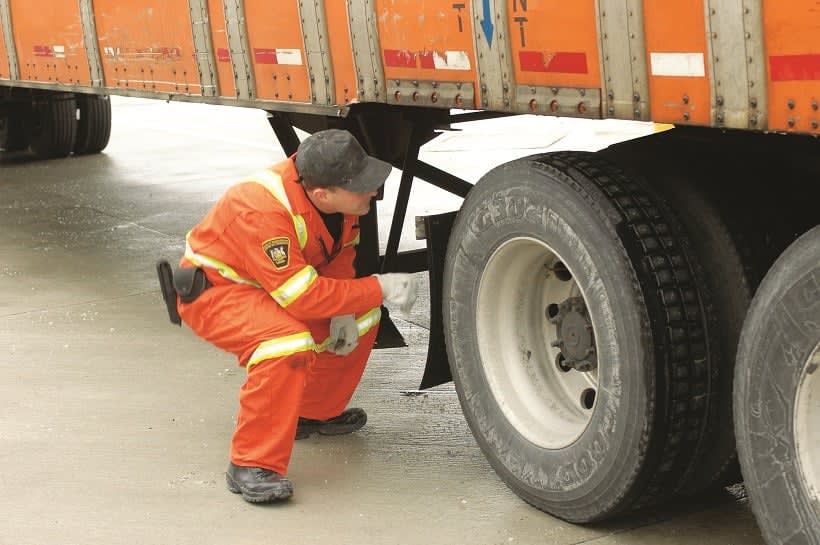
More than 1,600 commercial vehicles were placed out of service during an unannounced brake inspection blitz in May conducted by the CVSA's law enforcement members in the U.S. and Canada.
Photo: Jim Park
2 min to read
More than 1,600 commercial vehicles were placed out of service during an unannounced brake inspection blitz in May conducted by the Commercial Vehicle Safety Alliance’s law enforcement members.
On May 15, 2019, law enforcement personnel from 55 jurisdictions in the U.S. and Canada conducted 10,358 commercial motor vehicle inspections, focused on brake system violations. Of those inspections, 16.1% of vehicles (1,667) were found to have brake-related critical vehicle inspection items.
Inspectors paid particular attention to violations involving brake hoses and tubing. The event found 996 units with chafed rubber hoses and 185 units with chafed thermoplastic hoses. All told, there were 1,125 violations of 49 Code of Federal Regulations § 393.45 and Canadian equivalent violations that included chafed rubber hoses and 124 violations of 49 Code of Federal Regulations § 393.45 and Canadian equivalent violations that included kinked thermoplastic hoses.
"Brake hoses and tubing must be properly attached, undamaged, without leaks and appropriately flexible," said Chief Jay Thompson with the Arkansas Highway Police, CVSA president. "Because they are such an important part of the braking system, the failure of hoses or tubing can cause problems for the entire braking system."
In the U.S. 16.6% of commercial vehicles were placed out of service for brake violations compared to 14.5% in Canada.
According to FMCSA's Analysis and Information Online 2019 calendar year data snapshot as of June 28, 2019, out of 1.8 million inspections, the top five brake-related violations were:
Clamp or roto type brake out of adjustment (86,296)
CMV manufactured after Oct. 19, 1994, has an automatic brake adjustment system that fails to compensate for wear (45,594)
Brake hose or tubing chafing and/or kinking (37,737)
No or defective ABS malfunction indicator lamp for trailer manufactured after March 1, 1998 (37,343)
Inoperative/defective brakes (32,125)
CVSA conducts brake-focused enforcement events, such as Brake Safety Day, to identify and remove commercial motor vehicles with dangerous brake issues from our roadways to reduce the number of crashes caused by or made more severe by deficient braking system performance.
CVSA is holding another brake safety enforcement event this year, Brake Safety Week, which is scheduled for Sept.15-21, at participating jurisdictions throughout North America. The week is an annual outreach and enforcement campaign designed to improve commercial motor vehicle brake safety.
Brake Safety Day and Brake Safety Week are inspection, enforcement, education and awareness initiatives that are part of the Operation Airbrake Program sponsored by CVSA in partnership with FMCSA and the Canadian Council of Motor Transport Administrators.
More Safety & Compliance

Truck Drivers Need More Than Another Alert
Fleets have more visibility into truck health, safety events, and driver activity than ever. The next challenge is turning all that information into useful guidance for the person who has to decide what to do next.
Read More →
Tesla Wants a Self-Driving Semi. Are Cameras Enough?
Could Tesla’s camera-only autonomous driving technology work on an 80,000-pound Semi? In this commentary, HDT's Deborah Lockridge takes a look at Tesla, Cybercab, and how autonomous trucks see the road.
Read More →
What DOT’s Automated Vehicle Strategy Means for Trucking
The U.S. Department of Transportation issued a new automated-vehicle strategy that outlines plans for driverless-truck regulations, cross-state freight corridors, and federal safety standards.
Read More →
NYC Expands Speed, Pedestrian Safety Tech Across Fleet
New York City is expanding intelligent speed assistance and pedestrian-alert systems across its municipal fleet, moving the technologies from pilot programs into vehicle procurement and retrofit requirements.
Read More →
FMCSA Removes 110 Truck Driver Training Schools from Certified ELDT List
Federal regulators also are targeting more than 160 additional training providers and launching a nationwide audit of third-party CDL skills testers as part of a broader crackdown on trucking fraud.
Read More →
Beyond DOT Compliance: What Makes a Trucking Fleet Truly Safe?
A trucking fleet can follow every rule and still make unsafe decisions. The real test comes when safety conflicts with freight, productivity, or cost.
Read More →
Hours of Service Pilot Programs: FMCSA Readies for 2027 Rollout
Two pilot programs could eventually reshape hours-of-service rules, giving truck drivers options to pause their 14-hour clock or use longer split sleeper rest periods.
Read More →
New Guide Offers Pet Safety Tips for Truck Drivers
Hundreds of thousands of pets travel in truck cabs. A new safety guide from Volvo Trucks and the Center for Pet Safety offers practical advice for truck drivers who bring dogs and cats along for the ride.
Read More →
Medical Cards, English Proficiency Reshape Roadcheck Violations
Medical-card violations jumped to the top of the driver out-of-service list during CVSA’s 2026 International Roadcheck, while English-language proficiency violations appeared among the leading violations for the first time.
Read More →
How Lance Evans Turns Enforcement Experience Into Better Fleet Safety
HDT Truck Fleet Innovator Lance Evans brings lessons from law enforcement to K&B Transportation’s approach to safety technology, data, driver coaching, and compliance.
Read More →