





Related: The Fatal Uber Crash Revisited
NTSB Ends Investigation into Driverless Shuttle Accident
A unique case of miscommunication between a truck driver and a self-driving vehicle that led to a minor accident in Las Vegas may give us a glimpse into a future where autonomous vehicles and human driven vehicles share the road.
July 11, 2019
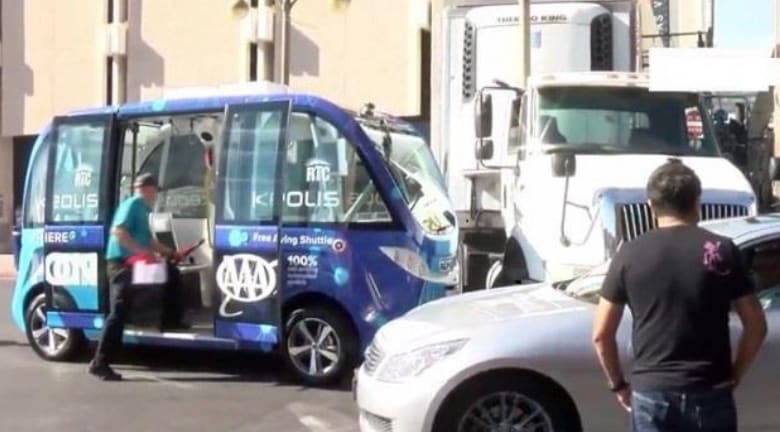
A unique case of miscommunication between a truck driver and a self-driving vehicle that led to a minor accident in Las Vegas may give us a glimpse into a future where autonomous vehicles and human driven vehicles share the road.
Photo via KSNV News 3 Las Vegas
3 min to read
A minor accident between an autonomous shuttle in Las Vegas and a commercial truck provided low-stakes glimpse into what could go wrong in a future where self-driving vehicles and human-driven vehicles share the road.
The National Transportation Safety Board concluded its investigation into the incident that occured in November 2017 and seemed to spread responsibility for the collision between the truck driver and autonomous vehicle. The collision was between a new autonomous shuttle carrying eight people and a tractor-trailer combination which was backing into an alley. There were no injuries and only minor damage to the shuttle's body and one of the commercial truck’s tires. In fact, both vehicles remained in service after the accident.
In its investigation NTSB said that the collision was ultimately a result of two main factors – the truck driver expecting the autonomous vehicle to behave in a way that it did not and the shuttle attendant not being in a position to take manual control of the vehicle in an emergency.
“The NTSB would normally not investigate a minor collision, but the involvement of a highly automated vehicle warranted having our investigators examine the circumstances surrounding the collision,” said Kris Poland, Deputy Director of the NTSB’s Office of Highway Safety. “We wanted to examine the process of introducing an autonomous shuttle onto public roads as well as the role of the operator, the vehicle manufacturer, and the city.”
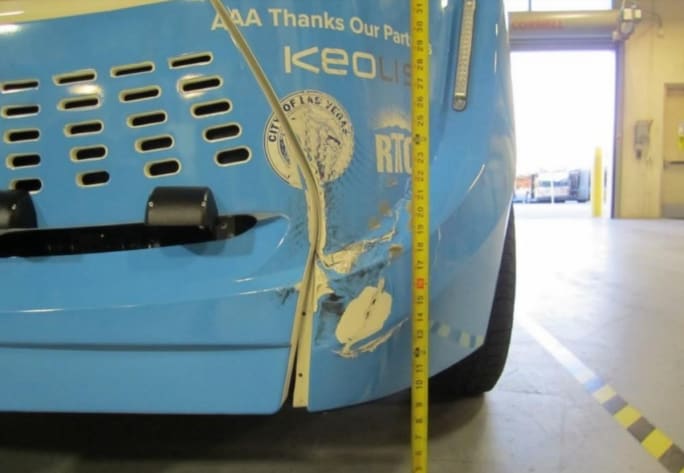
Both vehicles had only minor damages and no one was hurt. NTSB admitted that the only reason it investigated the incident was because of its implications for the future.
Photo via NTSB
The Incident
The battery-powered shuttle was designed to move along a predetermined route in Las Vegas and was fully equipped with a sensor suite that it used to navigate public roads with other vehicles. The shuttle was also manned by an attendant.
The truck driver was backing his vehicle into an alley and told investigators that he saw the shuttle approaching but expected the vehicle to stop a safe distance away. In what must have been a strange experience for the passengers self-driving shuttle, the autonomous vehicle continued to move toward the truck, closing the distance to 10 feet before the attendant pressed an emergency stop button.
The passengers began waiving at the truck to get the truck driver’s attention but were unable to before being hit. The truck driver said he was looking on the other side of his vehicle at parked cars so he wouldn’t hit them.
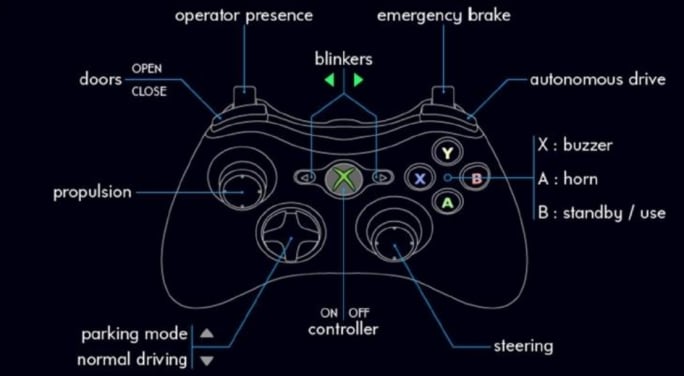
Driverless shuttle had a handheld controller to take control in an emergency and appears to be a repurposed Xbox video game controller based on this schematic.
Source: Navya operator training booklet
The shuttle’s sensors did see the truck and began slowing the vehicle at a distance of 98 feet from the collision. The shuttle was programmed to stop 9.8 feet from any obstacle automatically and was also equipped with a handheld controller which could be used for manual control.
Prior to the collision the handheld controller – that appears to be a repurposed Xbox video game controller in diagrams – was stored in an enclosure at one end of the passenger compartment but the attendant did not retrieve it during the event. After the accident, Kelois, the company that operates the autonomous shuttle, put in place a new policy that required attendants to keep the controller readily available at all times during a trip.
The full NTSB accident report is available online.
More Safety & Compliance

FMCSA Pauses Biennial-Update Enforcement Amid Motus Transition
Carriers whose updates were due on or after June 1 have more time, while FMCSA works to stabilize its new registration system and warns of phishing sites impersonating its new carrier registration system, Motus.
Read More →
ZF Expands Commercial Vehicle Push in North America
ZF is expanding its North American commercial-vehicle presence with new transmission applications, electrification, trailer technology and autonomous-driving systems.
Read More →
Truck Drivers Need More Than Another Alert
Fleets have more visibility into truck health, safety events, and driver activity than ever. The next challenge is turning all that information into useful guidance for the person who has to decide what to do next.
Read More →
Tesla Wants a Self-Driving Semi. Are Cameras Enough?
Could Tesla’s camera-only autonomous driving technology work on an 80,000-pound Semi? In this commentary, HDT's Deborah Lockridge takes a look at Tesla, Cybercab, and how autonomous trucks see the road.
Read More →
What DOT’s Automated Vehicle Strategy Means for Trucking
The U.S. Department of Transportation issued a new automated-vehicle strategy that outlines plans for driverless-truck regulations, cross-state freight corridors, and federal safety standards.
Read More →
NYC Expands Speed, Pedestrian Safety Tech Across Fleet
New York City is expanding intelligent speed assistance and pedestrian-alert systems across its municipal fleet, moving the technologies from pilot programs into vehicle procurement and retrofit requirements.
Read More →
FMCSA Removes 110 Truck Driver Training Schools from Certified ELDT List
Federal regulators also are targeting more than 160 additional training providers and launching a nationwide audit of third-party CDL skills testers as part of a broader crackdown on trucking fraud.
Read More →
Beyond DOT Compliance: What Makes a Trucking Fleet Truly Safe?
A trucking fleet can follow every rule and still make unsafe decisions. The real test comes when safety conflicts with freight, productivity, or cost.
Read More →
Hours of Service Pilot Programs: FMCSA Readies for 2027 Rollout
Two pilot programs could eventually reshape hours-of-service rules, giving truck drivers options to pause their 14-hour clock or use longer split sleeper rest periods.
Read More →
New Guide Offers Pet Safety Tips for Truck Drivers
Hundreds of thousands of pets travel in truck cabs. A new safety guide from Volvo Trucks and the Center for Pet Safety offers practical advice for truck drivers who bring dogs and cats along for the ride.
Read More →