




Don’t Overlook Trailer Anchor Points When Securing Open-Deck Freight
Open-deck trailers are actually part of a cargo securement system, so anchor points and permanent tie-down assemblies need to be inspected.

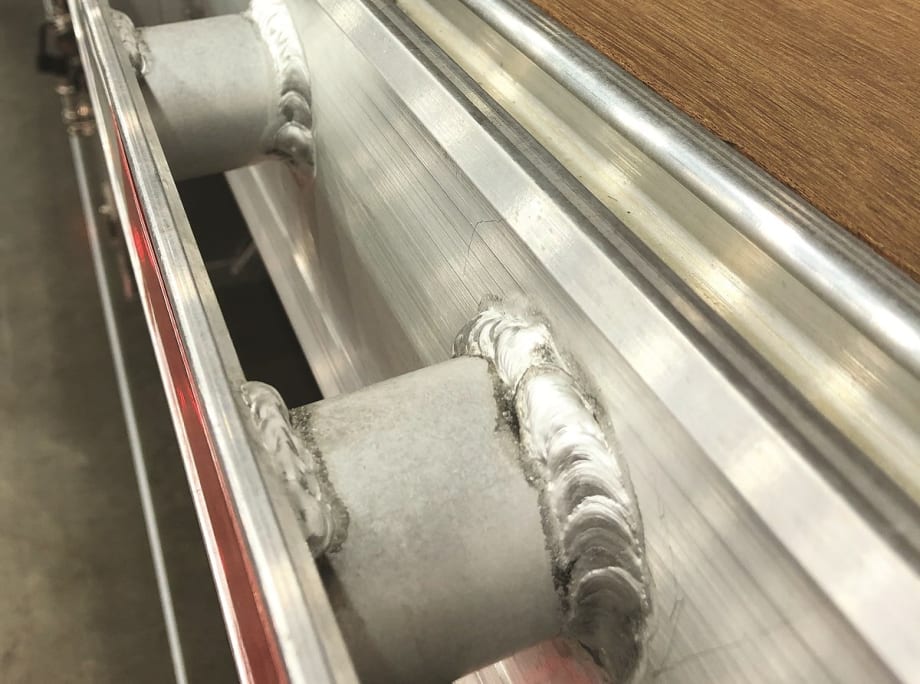
Open-deck trailer stake pockets and pipe spools are the main cargo securement anchor points. Keeping the freight where it belongs means keeping these structures in good condition.
Photos: Jim Park
Open-deck or platform trailers are a cargo conveyance. But because those trailers are also the device to which the cargo is secured for transport, they in fact become part of the cargo securement system. The stake pockets, pipe spools, winch rails, chain pockets, etc., are all considered anchor points to which other securement devices are attached, such as chains and straps.
While DOT officials say these trailer parts are seldom cited for violations, one can only imagine the risk and futility of chaining a steel coil to a cracked or damaged anchor point.
“Cargo securement violations are almost always insufficient or defective tie-downs vs. the actual trailers,” noted one trooper from North Dakota, relayed to us through Kerri Wirachowsky, director of roadside inspection programs at the Commercial Vehicle Safety Alliance.
A trooper from Wisconsin referred us to the North American Standard Out-of-Service Criteria handbook, which on page 38 of the 2018 edition refers to anchor points. Possible OOS conditions include broken or cracked side or pocket rails, supports or welds; bent or distorted rails where hooks or fittings attach; and floor rings nicked, gouged, worn, twisted, bent, stretched or with broken welds.
As with other components of a tie-down assembly, it’s up to the component manufacturer to design and then rate the product according to the DOT requirements with respect to in working load limits.
With cargo straps, for instance, the WLL (working load limit) is labeled or stenciled onto the product, while chains should be embossed with the manufacturer’s rating – Grade 7 Transport – in most cases where cargo securement is its purpose.
Trailers, however, usually have a stamp or a sticker somewhere on the chassis indicating the WLL rating of the pockets, spools, etc., for that trailer.
Typically, those fixtures are rated for a minimum of 5,400 pounds WLL, though some may be higher, especially on heavy-haul equipment. On those trailers, WLL ratings of D-rings and the like can go as high as 8,000 pounds. Components without ratings, including trailer fixtures, could be downrated by inspectors, and that could compromise the aggregate WLL calculations for your tie-downs.
Inspections and Repairs for Tie-Down Anchor Points on Trailers
Because they are engineered products and built to a standard, repairs should be left to qualified personnel with the proper equipment.
“Repairs should only be undertaken by authorized and certified repair shops,” says Mark Sabol, product manager-platform trailers at East Manufacturing. “Otherwise the ratings and/or the certified pull-testing that was done for that tie-down point could be jeopardized and/or rendered invalid.”
East recommends a monthly inspection of the pipe spools and stake pockets, because they can be damaged by overly tight chain binders or heavy loads that shift in transit.
Drivers will sometimes wrap a chain completely around a stake pocket or drop the chain into the pocket and pull it up along one side of the pocket. This can exert more stress on one side than the other.
Some drivers will simply hook the grab hook to the side of the stake pocket rather than passing it through or around the pocket and hooking back onto the chain. Again, this can cause undue stress to the welds.
“Pockets and spools will only fail if there has been a significant event,” Sabol says. “For instance, if a piece of cargo shifts, it will place additional load on the stake pocket. Drivers use the equipment every day and should be reporting damage or defects, but regular visual inspections are very important.”
Jeff Luick, Northeast account executive for cargo-securement provider Kinedyne, also does much of the company’s training.
“Technicians doing inspections should be looking for any bent or visibly deformed metal structure, any cracks or tears or broken welds,” he says.
“I have seen instances where the equipment was overwhelmed by the weight of a load, like a big excavator. I’ve seen where the D-rings actually bent, and the welds broke when one of those things came loose."
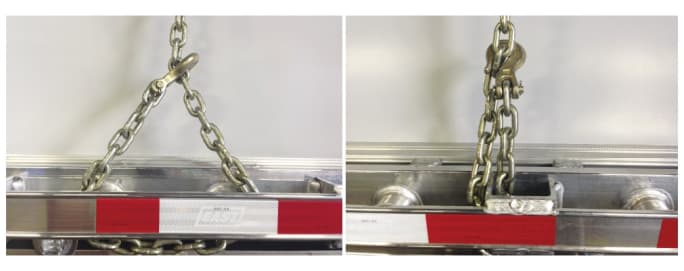
Drivers can spread out the load by looping chains around two spools rather than one, or around both sides of a stake pocket.
Rub Rails Aren't Cargo Securement Devices
One part of the trailer that’s more frequently damaged is the rub rail, or tarp bar as it’s sometimes called. It’s not considered an anchor point in most cases, yet some drivers insist on using it as such.
Securing cargo to the rub rail is not a recommended practice, Sabol adds.
“In fact, at East we do not even rate the rub rail, because it’s not a recognized tie-down point. Drivers are not supposed to connect hooks or straps directly to the rub rail.”
The rub rail is there to protect the tiedown equipment in the event the vehicle is scraped along the side in a sideswipe, or if it were to roll over and scrape along the ground. If a tie-down were damaged or ripped away, it would cause a loss of some or all of the cargo.
But since drivers insist on securing cargo directly to the rub rail, it’s probably in the fleet’s best interest to make sure they are intact, with no cracks or broken welds at the attachment points.
Inspecting Winches on Platform Trailers
Down underneath the deck on many platform trailers are winch tracks, used for sliding winch assemblies or as attachment points for flat hooks on synthetic webbing tiedown assemblies. These, too, should be inspected periodically.
The American Trucking Associations’ Technology & Maintenance Council Recommended Practice 739, Maintenance, Inspection and Operating Guidelines for Cargo Securement Systems of Flatbed Trailers, offers the following advice for inspecting winch tracks:
Tracks provided to allow sliding winch assemblies should be inspected to ensure secure mounting of the track to the trailer. Further, the track ends should provide positive stops to prevent unused winches from falling off.
Ratchet tie-downs (web strap ratchets) shall be inspected for cracked or deformed frames, damaged or missing pawls, ratchet teeth, and handle release cams. The ratchet and release should operate smoothly. The hook end of the ratchet assembly should not be cracked or deformed. The anchor end bolt shall extend through the lock nut at least 1-1/2 threads. If equipped, anchor endpins should have the cotter pin inserted and bent 180 degrees apart. Anchor end webbing should not be frayed or cut at the hook or anchor pin.
This guidance applies especially to permanently attached ratchet tie-downs, which may not get inspected as frequently as portable devices.
Luick suggests removing the strap from the winch occasionally to inspect the mandrel, or the roller upon which the strap is rolled.
“In addition to inspecting the winch itself for structural integrity and to ensure it’s not cracked, you should make sure the mandrel isn’t bent or deformed. If a heavy load shift were to shift, that is the part that could be damaged or weakened,” he advises.
Don't Forget Trailer Bulkheads or Header Boards
And finally, Fontaine Trailers recommends inspecting the condition and the mounting points for DOT bulkheads or header boards.
“The bulkhead must be secured to the trailer properly to obtain the full load rating shown on the bulkhead nameplate,” the operator’s manual suggests.
“The bulkhead assembly must be attached to the floor/skirt with bolts, washers and nuts across the front of the bulkhead and secured with fasteners installed one in the roadside stake pocket and the other in the curbside stake pocket.”
The manual offers hardware recommendation and torqueing specifications as well, which might vary from manufacturer to manufacturer.
Open-deck trailers require a little more attention because they are part of a cargo securement system. There’s little point in buying the best and strongest straps and chains in the world if the trailer’s anchor points aren’t up to the task.
More Equipment

How Volvo Updated Its D13 for EPA 2027 [Watch]
Volvo’s updated D13 promises lower emissions without sacrificing performance or fuel economy. Take a closer look at what changed inside the engine in this HDT Spotlight video.
Read More →
Michelin Tire Improves Efficiency and Durability for Regional Fleets
The Michelin X Multi Energy D2 is a regional haul drive tire engineered to help fleets improve fuel efficiency, durability and traction in demanding stop-and-go operations.
Read More →
ZF Expands Commercial Vehicle Push in North America
ZF is expanding its North American commercial-vehicle presence with new transmission applications, electrification, trailer technology and autonomous-driving systems.
Read More →
Tesla Wants a Self-Driving Semi. Are Cameras Enough?
Could Tesla’s camera-only autonomous driving technology work on an 80,000-pound Semi? In this commentary, HDT's Deborah Lockridge takes a look at Tesla, Cybercab, and how autonomous trucks see the road.
Read More →
Kodiak: Driverless Long-Haul Truck Launch on Track for 2026
Kodiak AI says its driverless long-haul safety case is 93% complete and it remains on track to begin commercial operations by year-end 2026.
Read More →
What DOT’s Automated Vehicle Strategy Means for Trucking
The U.S. Department of Transportation issued a new automated-vehicle strategy that outlines plans for driverless-truck regulations, cross-state freight corridors, and federal safety standards.
Read More →
East Coast Port Launches $45M Electric Truck Push
The Port Authority of New York and New Jersey announced millions in incentives for zero-emission drayage trucks, yard tractors, and new charging hubs near the port.
Read More →
PlusAI Going Public to Fund Autonomous Truck Launch
A SPAC deal could provide PlusAI with up to $300 million as it works toward a 2027 commercial launch of factory-built autonomous trucks.
Read More →
NHTSA Moves to Rewrite Truck Fuel-Economy Rules
The National Highway Traffic Safety Administration says it lacks authority to regulate medium- and heavy-duty truck engines separately from complete vehicles, but the existing standards have not yet been eliminated.
Read More →
Detroit Opens Orders for EPA 2027 Engines
Detroit isn’t starting from scratch to meet EPA 2027 diesel emissions standards. Its Gen 6 DD13 and DD15 engines keep much of today’s platform while updating the fuel and aftertreatment systems.
Read More →