




Challenging (Not Necessarily Bad) Year Predicted for Trucking Activity
This year should be challenging when it comes to truckable economic activity, according to economist Bob Dieli, speaking at the Heavy Duty Aftermarket Dialogue in Las Vegas on Jan. 28.

The economic activity affecting trucking could see a challenging year, according to Bob Dieli, president and founder of RDLB Inc., an economic research and management consulting firm, speaking at the Heavy Duty Aftermarket Dialogue in Las Vegas on Jan. 28.
But Dieli was quick to add that challenging does not necessarily mean bad.
Truckable Economic Activity is MacKay & Company’s proprietary measure of trucking activity, designed to measure all types of economic activity that move by truck, providing a more industry-applicable economic indicator than the broader Gross Domestic Product.
Dieli expects supply chain issues to dominate. in part because of trade and tariffs matters, but also because of structural issues that already exist inside the industry.
At this time last year, he pointed out, the one area of TEA that he had concerns about was the government piece. This year, he has concerns about the investment, export, and import sectors. He believes these factors could put as much as 50% of TEA at risk. The concern with exports is illustrated by what happened when the U.S. imposed a 10% tariff on steel from China. China then imposed a 25% retaliatory tariff on soybeans. China was a major market for U.S. soybean imports. On average, food exports account for 10% of total exports. In addition, imports of nonautomotive consumer goods account for 25% of truckable imports.
There is also a concern that a large inventory of imported goods has been built up. “How much is a prebuy because of tariffs? How much is unsold because of tariffs?” he asked.
Residential structures are another area of concern, and they represent 25% of truckable fixed investment.
Jobs and trucks are good economic forecasting tools, Dieli said. “Drivers are hired when there is freight to be hauled, with rise in freight volume is rise in transportation employment.” And, he added, “Trucks are purchased when there is freight to be hauled.”
Based on what he is seeing, Dieli also said we are we are in the boom phase of the business cycle. During the boom phase, the economy continues to expand. However often in the boom phase of an economic cycle, employment levels will fall. A typical economic cycle is expansion, boom, peak, trough, recovery, expansion.
He suggested that meeting attendees ask themselves these three questions during the boom phase:
Stability — How is your biggest customer doing? If they are having a problem, you, too, are going to have a problem.
Sustainability — How is your biggest supplier doing? Are they impacted by tariffs?
Hostility — How is your biggest competitor doing? He told attendees to figure out who their biggest competitors are, look at what they are doing, and make sure to understand the competitive environment.
“For 2019 TEA looks to be challenging, but not necessarily bad,” he said. Describing TEA as a five in 2018, Dieli said, it will not be a five in 2019. “It could be a three or a two."
Supply chain issues will also be a factor and will impact who moves freight, where it originates, and what it costs to ship it.
And the industry will also feel the impact of some structural issues like hours of service, the electronic logging device mandate, and a changing CSA program. “These are issues that have to do with how the industry works,” Dieli explains.
In closing, Dieli left the audience to ponder this quote by E. Hamilton Lewis: "There are old pilots and there are bold pilots. But there are no old bold pilots.” A quote that he says sums up what is in store for the industry in the next 12 months.
More Fleet Management

How Telematics Improves Visibility, Control, and Performance in Refrigerated Fleets
Explore how telematics help refrigerated fleets improve visibility, uptime, efficiency, compliance, and cargo protection across connected cold chain operations.
Read More →
What the U.S.-Canada Trade War Means for Trucking
Escalating U.S.-Canada tariffs could disrupt cross-border freight, reduce truck volumes, raise costs, and create new uncertainty for carriers on both sides of the border.
Read More →
What Are Trucking’s Top Concerns for 2026?
The American Transportation Research Institute wants to know what's worrying trucking fleet managers, drivers, and other stakeholders in its annual Industry Issues survey.
Read More →

American Trucking Associations Looks for a New Leader
ATA President and CEO Chris Spear abruptly left his job at the association on August 21, at a pivotal time for the trucking industry.
Read More →
Public Wi-Fi Cybersecurity Risks: How Truck Drivers and Fleets Can Protect Their Data
Public Wi-Fi can expose truck drivers and fleets to credential theft, malware, and other cyber threats. Here’s how to reduce the risk on the road.
Read More →
For Nicky Cupp, Fleet Innovation Starts With Frustration
HDT Truck Fleet Innovator Nicky Cupp turns everyday pain points at Fraley & Schilling into opportunities for better technology and smarter processes.
Read More →
Adam Buttgenbach’s Approach to Electric Trucks: Start With Where They Fit
HDT Truck Fleet Innovator Adam Buttgenbach helped PepsiCo build one of North America’s largest EV fleets by focusing on where electric trucks make operational sense.
Read More →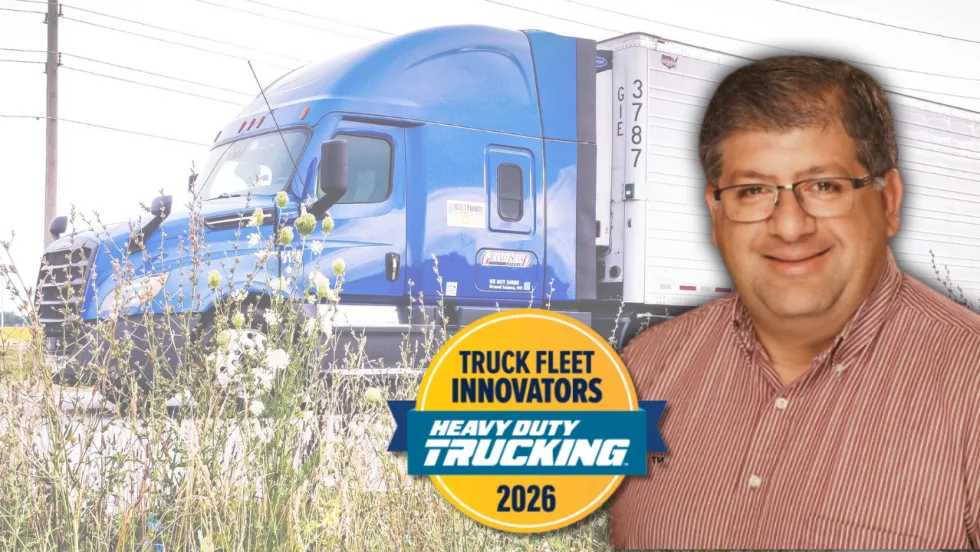
Deen Albert: Let Automation Do the Math, People Make the Decisions
HDT Truck Fleet Innovator Deen Albert makes sure people are still at the heart of operations at Grand Island Express, even while adopting artificial intelligence tools. AI-assisted dispatch helped boost revenue 25% with the same number of trucks.
Read More →
Trimble’s New AI Agent Takes Aim at Fleet Back-Office Busywork
Arc Agent works across Trimble TMS products to automate repetitive tasks such as freight orders, maintenance, invoices, fuel costs and more.
Read More →
How HDT’s 2026 Truck Fleet Innovators Are Rethinking Fleet Operations
Meet five trucking leaders who are challenging assumptions, solving operational problems, and putting innovative ideas to work.
Read More →