




Uber Shutters Autonomous Truck Business Division
In a statement, the technology company said it will focus its autonomous vehicle efforts on passenger cars for the foreseeable future.

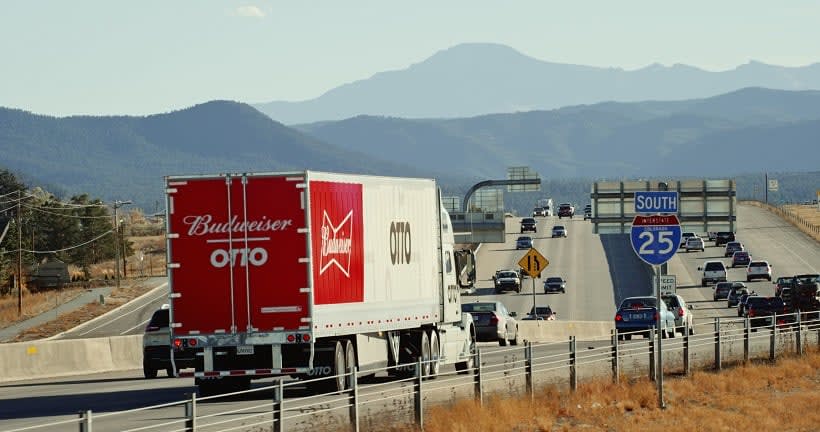
Uber is ending research on autonomous trucks in order to focus on self-driving cars. The company began its foray into autonomous trucks when it purchased the startup Otto (pictured).
Photo courtesy Uber
Uber is shuttering its autonomous truck research division.
At least for now.
That’s the word that came late on July 30 about the San Francisco-based tech company, which is ending research on autonomous trucks in order to focus on self-driving cars.
Uber acquired its autonomous truck business from startup Otto almost two years ago in a move that was widely considered controversial and, at times, proved to be contentious.
The story broke when online technology journal TechCrunch reported on an email from Eric Meyhofer, head of Uber Advanced Technologies group, which stated that, “We recently took the important step of returning to public roads in Pittsburgh, and as we look to continue that momentum, we believe having our entire team’s energy and expertise focused on this effort is the best path forward.
“Rather than having two groups working side by side, focused on different vehicle platforms, I want us instead collaborating as one team,” Meyhofer said in an email to employees reviewed by TechCrunch editors. “I know we’re all super proud of what the Trucks team has accomplished, and we continue to see the incredible promise of self-driving technology applied to moving freight across the country. But we believe delivering on self-driving for passenger applications first, and then bringing it to freight applications down the line, is the best path forward. For now, we need the focus of one team, with one clear objective.”
The move will not affect the Uber Freight business unit, which uses the company’s location-based, ride-location app technology to connect truckers with available freight.
According to TechCrunch, Uber will shut down its San Francisco operations and move employees to Pittsburgh, where its autonomous car research is located. The company said in a statement that it intends to continue to explore autonomous vehicle technology using passenger cars as foundational research units, but will maintain relationships with trucking OEMs as this technology matures.
Uber’s autonomous truck efforts have been hampered by controversy and legal battles since the company acquired the business unit from Otto in 2016. The acquisition later became the subject of an intellectual property lawsuit by Google, citing the role of Anthony Levandowski, the co-founder of Otto, who was a head engineer at Waymo, Google’s self-driving car spinoff, before leaving to concentrate on the new company. Waymo accused Levandowski of taking trade secrets, in the form of photos, schematics, and emails, with him and providing them to Uber. The lawsuit eventually contributed to the resignation of Travis Kalanick, co-founder of Uber, as CEO in 2017.
Uber denies that it ever possessed any of the intellectual property, however, it agreed to settle the suit in February by paying Waymo approximately $245 million, and by promising to never use any of Waymo’s confidential information in any of its products.
Lawsuits weren’t the only forces working against Uber’s autonomous truck research. In March, an Uber autonomous research vehicle was involved in a fatal accident in Tempe, Arizona., resulting in negative press coverage of autonomous vehicle research and a temporary suspension of tests on public roads pending a review of safety procedures.
The company’s decision to suspend research into autonomous vehicles comes a week after the company restarted testing its passenger cars on public roads in Pittsburgh. Currently, the company is running and evaluating self-driving Volvo XC90 vehicles. According to Uber, the vehicles are only being driven manually by humans and under a new set of safety standards that include real-time monitoring of its test drivers and efforts to beef up simulation.
Related: Uber Highlights Self-Driving Truck Hauling Goods Cross Country
More Equipment

ZF Expands Commercial Vehicle Push in North America
ZF is expanding its North American commercial-vehicle presence with new transmission applications, electrification, trailer technology and autonomous-driving systems.
Read More →
Tesla Wants a Self-Driving Semi. Are Cameras Enough?
Could Tesla’s camera-only autonomous driving technology work on an 80,000-pound Semi? In this commentary, HDT's Deborah Lockridge takes a look at Tesla, Cybercab, and how autonomous trucks see the road.
Read More →
Kodiak: Driverless Long-Haul Truck Launch on Track for 2026
Kodiak AI says its driverless long-haul safety case is 93% complete and it remains on track to begin commercial operations by year-end 2026.
Read More →
What DOT’s Automated Vehicle Strategy Means for Trucking
The U.S. Department of Transportation issued a new automated-vehicle strategy that outlines plans for driverless-truck regulations, cross-state freight corridors, and federal safety standards.
Read More →
East Coast Port Launches $45M Electric Truck Push
The Port Authority of New York and New Jersey announced millions in incentives for zero-emission drayage trucks, yard tractors, and new charging hubs near the port.
Read More →
PlusAI Going Public to Fund Autonomous Truck Launch
A SPAC deal could provide PlusAI with up to $300 million as it works toward a 2027 commercial launch of factory-built autonomous trucks.
Read More →
NHTSA Moves to Rewrite Truck Fuel-Economy Rules
The National Highway Traffic Safety Administration says it lacks authority to regulate medium- and heavy-duty truck engines separately from complete vehicles, but the existing standards have not yet been eliminated.
Read More →
Detroit Opens Orders for EPA 2027 Engines
Detroit isn’t starting from scratch to meet EPA 2027 diesel emissions standards. Its Gen 6 DD13 and DD15 engines keep much of today’s platform while updating the fuel and aftertreatment systems.
Read More →
Carrier Transicold Adds All-Electric TRU for Stationary Cold Storage
Carrier Transicold’s new Vector 8200 all-electric transport refrigeration unit gives fleets a diesel-free option for temporary refrigerated and frozen trailer storage.
Read More →
A Closer Look at Kenworth’s Electric T880E Vocational Truck [Video]
Learn more about Kenworth's T880E battery-electric vocational truck at the Paccar Technical Center, including its range, applications, upfitting considerations, and PTO options, in this HDT Spotlight video.
Read More →