




Daimler Testing Heavy-Duty Electric Actros Truck
A battery-electric heavy-duty hauler fitted with the Mercedes-Benz three-point star may be on the market in just three years.


Daimler has begun fleet-testing its Mercedes-Benz eActros fully electric heavy-duty truck as it nears full production, planned to begin in 2021. Photo: Daimler AG
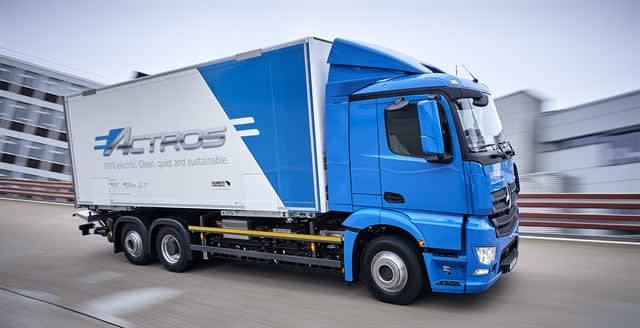
Daimler has begun fleet-testing its Mercedes-Benz eActros fully electric heavy-duty truck as it nears full production, planned to begin in 2021. Photo: Daimler AG
A battery-electric heavy-duty hauler fitted with the Mercedes-Benz three-point star may be on the market in just three years.
Taking the next step toward rolling out a fully electric heavy-duty hauler, Germany’s Daimler Ag will soon be placing its Mercedes-Benz eActros emissions-free trucks with some customers so that they can test “their everyday feasibility and economic efficiency under real-life conditions.”
According to Daimler, the electric truck “could go into” full production starting in 2021.
Operating solely on battery power, the eActros offers a range of up to 200 km (124 miles) yet offers the “customary level of performance and payload,” the OEM stated in a Feb. 21 news release.
The customer test fleet consists of 10 trucks in 2-axle and 3-axle variants, with GVWs of 18 or 25 metric tons. The field-testing will start in the next few weeks and will run until at least mid-2020. Its aim is to establish energy requirements for some specific applications as well as the economic efficiency of the electric trucks and to compare their environmental performance vs. diesel trucks.
“Initially the [fleet testing] focus will be on inner-city goods transport and delivery services – the ranges required here are well within the scope of our Mercedes-Benz eActros,” said Stefan Buchner, Head of Mercedes-Benz Trucks.
"We have developed a vehicle that has been configured from the outset for electric mobility,” he added. “Compared with our prototype, quite a few technical changes have been made: the power supply is now ensured by eleven [lithium-ion] battery packs in all – and wherever possible we have used already proven components that are ready, or very close to ready, for use in [full] series production.”
The road testing will help drive “ongoing optimization measures” and the results will be published, “giving potential users the opportunity to optimize their route planning or to develop new business models for their logistics processes.
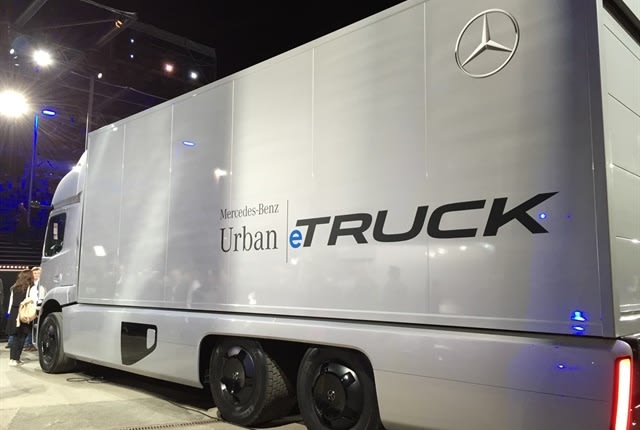
Mercedes-Benz "Urban eTruck" concept vehicle was displayed by Daimler at IAA Show in 2016. Photo: Deborah Lockridge
Back in 2016, at the IAA Commercial Vehicles show in Hanover, Germany, Mercedes-Benz displayed what it called an “Urban eTruck” as a concept for a heavy-duty electric-powered “distribution truck” aimed at urban use. The OEM said feedback to its presentation was “positive across the board,” including from customers as well as the general public and politicians, noting that in Germany alone, some 150 “very serious inquiries were received.”
Testing by Customers Seen as Key to Completing Development
“We now want to work together with our customers to move swiftly forward with the development of our Mercedes-Benz eActros to the point where it becomes a viable proposition in tough everyday operations - both technically and commercially,” Martin Daum, the Daimler AG Board Member responsible for Daimler Trucks and Buses, said in a statement.
“We are beginning this process by creating an ‘innovation fleet’ and will be supporting its testing in the day-to day logistics environment of our customers. This will enable us to establish just what remains to be done, in terms of technical matters, infrastructure and service, to make our Mercedes-Benz eActros competitive” as a full-production truck.
Daimler noted that “a number of technical and, above all, business-related issues remain outstanding” in the development of the eActros. Key among these are the truck’s range and the cost of batteries as well as the infrastructure required for use by fleets.
Related: How Much Does it Cost to Operate a Battery Electric Truck?
More Fuel Smarts

How Volvo Updated Its D13 for EPA 2027 [Watch]
Volvo’s updated D13 promises lower emissions without sacrificing performance or fuel economy. Take a closer look at what changed inside the engine in this HDT Spotlight video.
Read More →
Diesel Price Spike Shortens Payback for Natural Gas Trucks, Report Says
Energy Vision estimates fleets could recover the higher purchase price of an RNG-fueled Class 8 tractor in 1.3 to 2.8 years under current fuel-price scenarios.
Read More →
Calstart Becomes Catalyst Mobility, Reflecting Broader Focus
Calstart is now Catalyst Mobility, reflecting the nonprofit’s growing national role in clean transportation, including zero-emission trucks, infrastructure and incentive programs.
Read More →

Record Diesel Prices Squeeze Trucking Fleets
Average U.S. diesel prices have climbed to nearly $6 a gallon, surpassing the 2022 record as tight refinery capacity and Middle East disruptions keep fuel costs elevated.
Read More →
How Fuel Delivery Shapes Engine Performance
Fuel delivery depends on more than what happens at the injector. For fleet, maintenance and technical professionals, looking at the full path from pump to injector can provide useful context for understanding engine performance.
Read More →
East Coast Port Launches $45M Electric Truck Push
The Port Authority of New York and New Jersey announced millions in incentives for zero-emission drayage trucks, yard tractors, and new charging hubs near the port.
Read More →
California Bill Could Shed Light on Electric Truck Prices
Why do battery-electric Class 8 trucks remain so expensive? A California bill headed to Gov. Gavin Newsom would give fleets and state agencies more visibility into what manufacturers charge.
Read More →
Detroit Opens Orders for EPA 2027 Engines
Detroit isn’t starting from scratch to meet EPA 2027 diesel emissions standards. Its Gen 6 DD13 and DD15 engines keep much of today’s platform while updating the fuel and aftertreatment systems.
Read More →
Zero-Emission Truck Corridor Planned for West Coast
California, Oregon, Washington, British Columbia and Baja California are coordinating plans for truck charging and hydrogen fueling from Canada to Mexico.
Read More →
A Closer Look at Kenworth’s Electric T880E Vocational Truck [Video]
Learn more about Kenworth's T880E battery-electric vocational truck at the Paccar Technical Center, including its range, applications, upfitting considerations, and PTO options, in this HDT Spotlight video.
Read More →