




Daimler Shows Off Vision of Future at IAA Show
Daimler Trucks kicked off the IAA international Commercial Vehicle Show in Hanover, Germany, by focusing on the future of the urban city, with the unveiling of its Urban eTruck.

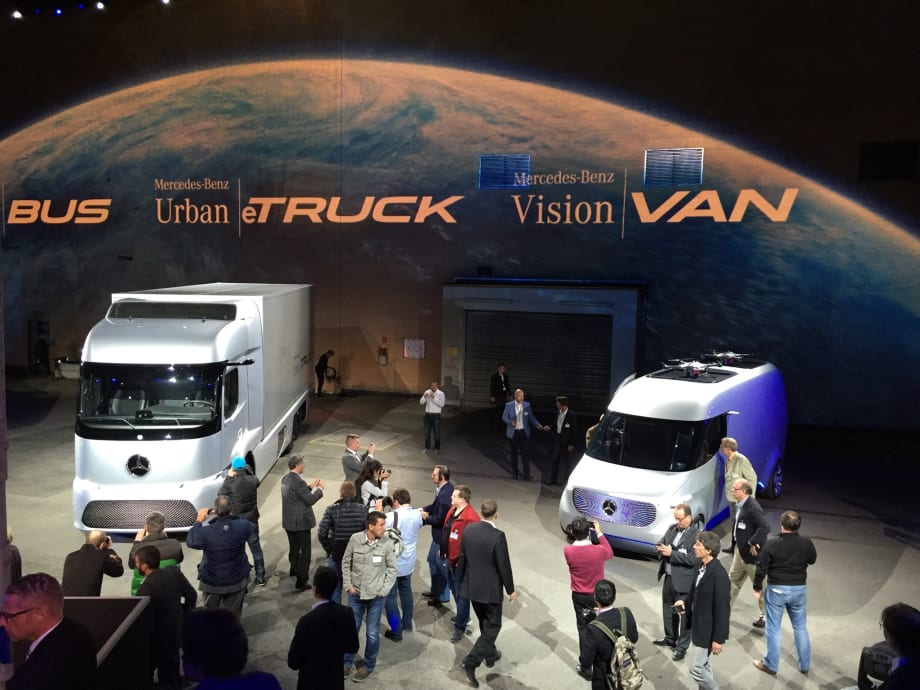
Daimler Trucks kicked off the IAA international Commercial Vehicle Show on Tuesday with the debut of its Urban eTruck. Photo: Deborah Lockridge

Wolfgang Bernhard answers reporter questions about the Urban eTruckPhoto: Deborah Lockridge
Hannover, Germany — Daimler Trucks kicked off the IAA international Commercial Vehicle Show by focusing on the future of the urban city, with the unveiling of its Urban eTruck.
It also highlighted and expanded upon its recent unveiling of concept vehicles, the semi-autonomous Mercedes-Benz Future Bus with CityPilot, and the Vision Van, an electrically powered, automated and connected van designed to change last-mile delivery services.
Welcoming a press audience of some 600 journalists from around the world, Wolfgang Bernhard, head of Daimler Truck and Bus, explained the symbolism of the power plant where the event was held, because “in the next era, electricity and transportation will meet.”
In addition to showing off its concept vehicles, Daimler officials announced they would be building commercially available fully electric Mercedes-Benz vans and the first all-electric city bus by 2018.
While it’s unlikely any of these vehicles will be seen in the U.S., especially in exactly this form, some of the technological advancements being tested out may well make their way to our shores.

Photo: Deborah Lockridge
And the urban challenges they are designed to address are global. By 2050, cities will be home to 70% of the world’s population, he noted. By that time, the additional amount of milk alone needed in cities around the world will require 50,000 additional truck deliveries every day. Made with conventional trucks, that could lead to problems with emissions, noise, congestion and infrastructure.
The Urban eTruck is driven by electric motors adjacent to the wheel hubs, while the power supply comes from a modular battery pack that can be charged in no more than two hours with the right equipment. This puts the Urban eTruck on a par with conventionally engined trucks when it comes to payload and suitability for everyday use, says Daimler. But at the same time, it is far more environmentally friendly, generates zero local emissions and makes barely any noise.
Urban eTruck can be configured for a wide range of different requirements. It comes standard with a basic lithium-ion battery pack of three modules with a total capacity of 212 kWh. This provides a range of up to 200 km, which is normally enough for a day's delivery round. The batteries are additionally charged during operation by regenerative braking, i.e. by converting the braking energy into electricity.
Daimler says standard-production vehicles of this type would be conceivable from the start of the next decade.
Bernhard explained that Daimler engineers have addressed the issue of range by adding connectivity and a tool called Intelligent Range Management. Using details such as the number of tons loaded and more, it plans the route, calculates the amount of electric energy needed to complete the route, and suggests the right driving mode.
The Urban eTruck can operate in three different modes. On a standard journey, the Urban eTruck is set to “auto.” The settings in this mode constantly change depending on the actual energy consumed. This ensures a balance between the range and the available power. The second mode is 'agile' and it is a 'power' setting. And an energy-saving 'eco' mode is selected if maximum range is required.
Wolfgang Bernhard answers reporter questions about the Urban eTruckPhoto: Deborah Lockridge
Once the truck is en route, a screen shows how the actual power being used compares to the amount calculated. If more power is needed, such as from getting stuck in an unexpected traffic jam, the system comes up with a solution, whether that be changing the driving mode or even scheduling an intermediate charging stop.
While acknowledging that the upfront cost of the Urban eTruck would be considerably higher than a conventional truck, Bernhard said costs will come down with economies of scale and as batteries become more affordable. Those costs will be offset by lower operating costs including cheaper electricity than fuel as well as less maintenance. And a new Truck2Grid management will help customers avoid expensive peak charging times with a smart charging strategy — and customers can use the truck’s battery while it’s parked to provide paid energy services.
More Fuel Smarts

Trucking’s Diesel Squeeze Isn’t Letting Up
With diesel topping $6 a gallon nationally, ATA's Bob Costello explains why fleets should prepare for continued pressure at the pump.
Read More →
FlowBelow Redesigns Trailer AeroSlider to Cut Fuel Use
The lighter trailer aerodynamic system installs in less than 45 minutes, according to the company, with potential payback in under a year depending on fuel prices and trailer mileage.
Read More →
Why Diesel Price Relief Efforts May Fall Short
Diesel prices have eased from September’s record high, but doubts about additional Russian supply and limits on dyed-diesel tax relief mean trucking fleets still face expensive fuel. And prices could go higher.
Read More →
Why Small Fuel Savings Matter in Trucking
Can better fuel economy help pay for driver raises? In this podcast, GP Transco explains how small efficiency gains create room to reinvest in its people.
Read More →
How GP Transco Cuts Trucking Fuel Costs, a Tenth of a Gallon at a Time
What’s another tenth of a mile per gallon worth? GP Transco shares how equipment upgrades and driver coaching turn small gains into meaningful fuel savings.
Read More →
Electric Yard Tractors Move Beyond Pilots
Operating-cost savings have overtaken sustainability goals as the leading reason surveyed fleets are adopting battery-electric terminal tractors, according to new NACFE research.
Read More →
Geotab Links Fleet Card to Vehicle Data
The new card combines fuel discounts with telematics-based purchase controls. Geotab’s analysis also points to potential savings from choosing lower-priced fuel stops.
Read More →
Fleet Economics Shape Electric Truck Outlook
ACT Research expects costs, charging infrastructure, and technology improvements to drive zero-emission commercial vehicle adoption as federal regulations and incentives retreat.
Read More →
Wex Adds Cardless Fuel Payments for Over-the-Road Customers
A new fuel card feature for Wex customers offers convenience and security.
Read More →
New California Law Could Shed Light on Electric Truck Prices
Why do battery-electric Class 8 trucks remain so expensive? A California bill signed by Gov. Gavin Newsom would give fleets and state agencies more visibility into what manufacturers charge.
Read More →