





Related: [Video] Using Crawler Gears on Volvo's I-Shift Transmission
Driving Volvo's I-Shift with Crawler Gears
Volvo’s new Crawler Gears option for the I-Shift automated manual transmission puts one or two extra-low ratios at the driver’s fingertips – or thumb tip, actually.
August 22, 2016
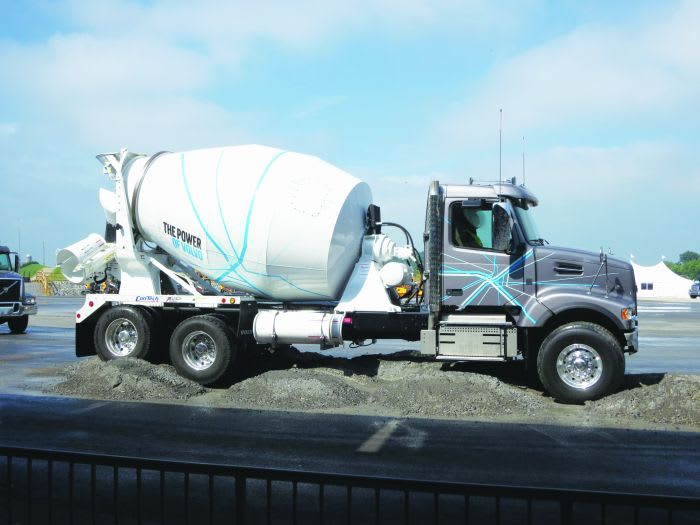
A mixer chassis sometimes needs to creep over uneven surfaces or while pouring concrete sidewalks or curbs. Depending on axle gearing, I-Shift crawler gears allow speeds as low as 0.6 mph.
3 min to read
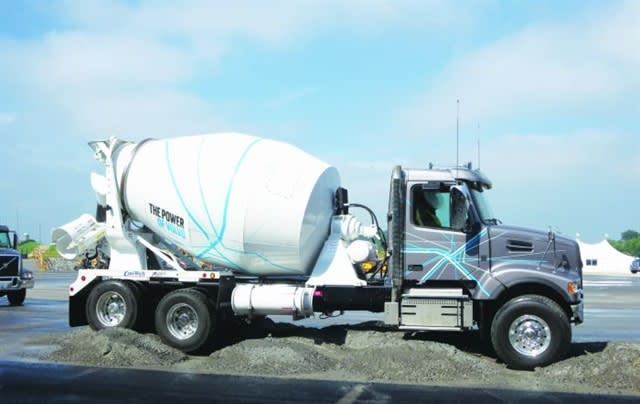
A mixer chassis sometimes needs to creep over uneven surfaces or while pouring concrete sidewalks or curbs. Depending on axle gearing, I-Shift crawler gears allow speeds as low as 0.6 mph.
Low-low gear ratios have been part of vocational truck equipment for many years, and now customers of Volvo Trucks’ VHD can get them with the builder’s own automated manual transmission. I-Shift with Crawler Gears is the name, and greater performance and productivity comprise the product’s claim.
One or two extra ratios added to the builder’s 12-speed I-Shift HD allows easy starting under heavy loads and on steep grades, said Wade Long, director of product marketing, during a recent demonstration at the North American headquarters of Volvo Construction Equipment in Shippensburg, Pa.
The low-low ratios also allow very slow movement for special jobs like concrete and asphalt paving for mixer and dump trucks. With the C-1 gear, a Volvo VHD with the 14-speed version of I-Shift crawled at 0.6 mph, compared to about 2 mph for a 12-speed gearbox in normal 1st gear, he said.
This is especially useful for curb pouring. A local contractor brought in a forming machine whose hopper was fed by a VHD-mounted mixer as the machine and vehicle crept along. Meanwhile, press reporters drove VHD dump trucks on an off-road course that included short but steep grades, where upgrade starts were easy when using C-1 or C-2.
A driver engages the crawler gears by thumbing a switch on the T-handle of an I-Shift’s selector. With a 13-speed in the transmission’s 1st gear, one click puts it into Crawler. With a 14-speed, the first click gets C-2 and another gets C-1, the lowest (highest numerical) ratio.
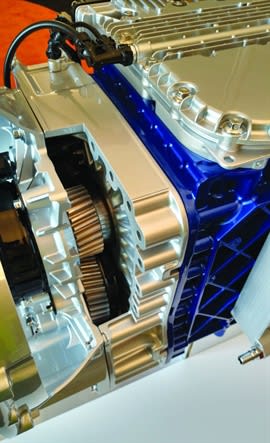
The gearbox added onto the front of an I-Shift adds one or two crawler gears.
The ratio of the lowest gear in a regular 12-speed I-Shift with direct-drive top gear is 15:1. In a 13-speed with one crawler gear, the ratio is 19:1 in a direct-drive transmission or 17:1 in an overdrive model. In direct-drive or overdrive gearboxes with two crawler gears, the lowest ratio is 32:1. The ratio of the lowest reverse gear is 37:1 in a direct-drive I-Shift.
Extreme startability also allows use in tractors pulling extra-heavy combination vehicles, Long said. The transmission will be approved for gross combination weights of up to 220,000 pounds, with prior application approval by Volvo engineers.
With overdrive top gears, a Volvo truck “can go down the highway at 1,330 rpm at 70 mph” depending on axle ratio and tire and wheel size, said Magnus Koeck, vice president, marketing and brand management. This saves fuel, speeds trip times and boosts productivity.
The I-Shift with Crawler Gears goes into production in October and can be ordered now. As with standard I-Shifts, they can only be had with Volvo D-11 or D-13 diesels.
Heavy-duty versions of the I-Shift, whether in 14-, 13- or 12-speed configurations, feature hardened gears and other hardware. The transmission received additional updates to improve shift performance and durability, including improved split synchronizer components, an updated engaging sleeve and main box parts made from reinforced material.
Although I-Shift penetration in highway applications reached 83% in May, only about 25% of construction-truck customers chose automated transmissions, Koeck said. The crawler-gear options are expected to increase that percentage.
Subscribe to Our Newsletter
More Equipment

How Volvo Updated Its D13 for EPA 2027 [Watch]
Volvo’s updated D13 promises lower emissions without sacrificing performance or fuel economy. Take a closer look at what changed inside the engine in this HDT Spotlight video.
Read More →
Michelin Tire Improves Efficiency and Durability for Regional Fleets
The Michelin X Multi Energy D2 is a regional haul drive tire engineered to help fleets improve fuel efficiency, durability and traction in demanding stop-and-go operations.
Read More →
ZF Expands Commercial Vehicle Push in North America
ZF is expanding its North American commercial-vehicle presence with new transmission applications, electrification, trailer technology and autonomous-driving systems.
Read More →
Tesla Wants a Self-Driving Semi. Are Cameras Enough?
Could Tesla’s camera-only autonomous driving technology work on an 80,000-pound Semi? In this commentary, HDT's Deborah Lockridge takes a look at Tesla, Cybercab, and how autonomous trucks see the road.
Read More →
Kodiak: Driverless Long-Haul Truck Launch on Track for 2026
Kodiak AI says its driverless long-haul safety case is 93% complete and it remains on track to begin commercial operations by year-end 2026.
Read More →
What DOT’s Automated Vehicle Strategy Means for Trucking
The U.S. Department of Transportation issued a new automated-vehicle strategy that outlines plans for driverless-truck regulations, cross-state freight corridors, and federal safety standards.
Read More →
East Coast Port Launches $45M Electric Truck Push
The Port Authority of New York and New Jersey announced millions in incentives for zero-emission drayage trucks, yard tractors, and new charging hubs near the port.
Read More →
PlusAI Going Public to Fund Autonomous Truck Launch
A SPAC deal could provide PlusAI with up to $300 million as it works toward a 2027 commercial launch of factory-built autonomous trucks.
Read More →
NHTSA Moves to Rewrite Truck Fuel-Economy Rules
The National Highway Traffic Safety Administration says it lacks authority to regulate medium- and heavy-duty truck engines separately from complete vehicles, but the existing standards have not yet been eliminated.
Read More →
Detroit Opens Orders for EPA 2027 Engines
Detroit isn’t starting from scratch to meet EPA 2027 diesel emissions standards. Its Gen 6 DD13 and DD15 engines keep much of today’s platform while updating the fuel and aftertreatment systems.
Read More →