




Test Drive: Paccar MX-11 Pulls Stronger Than Expected
The new diesel from Kenworth and Peterbilt’s parent makes impressive power and torque, and saves 400 pounds over larger diesels.

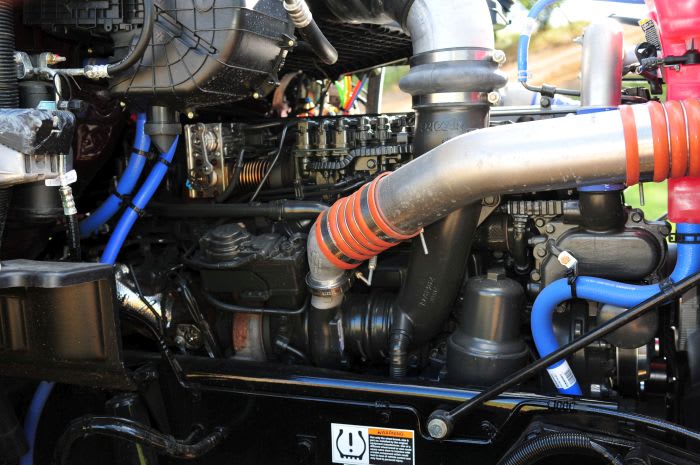
The MX-11 looks rather ordinary, but performs like a bigger diesel. Six ratings, from 355 to 430 hp and 1,250 to 1,550 lb-ft, will be available. Both test vehicles had the top rating. Photo: Tom Berg
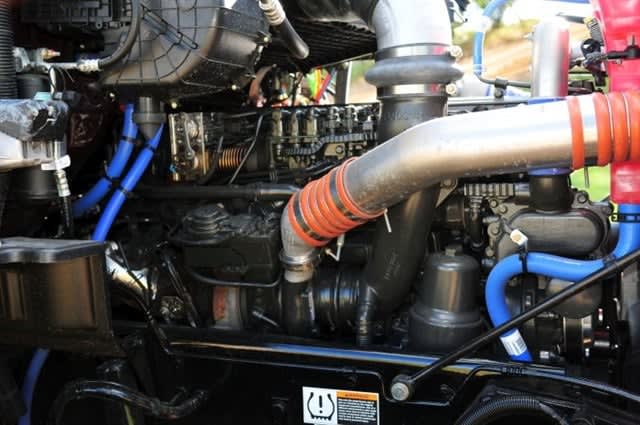
The MX-11 looks rather ordinary, but performs like a bigger diesel. Six ratings, from 355 to 430 hp and 1,250 to 1,550 lb-ft, will be available. Both test vehicles had the top rating. Photo: Tom Berg
Is smaller better? With diesel size it can be. Modern electronics and combustion technology have enabled engines to make far more power than was possible even a few years ago. The latest example is the just-introduced MX-11 from Paccar, the parent company of Kenworth and Peterbilt. Like its big brother, the MX-13, the new engine is based on a proven design from DAF, Paccar’s Dutch company, and was extensively tested before being committed to production.
Some key facts: Its displacement is 10.8 liters or 660 cubic inches. Its dry weight is 2,200 pounds, which is 400 pounds less than the MX-13 or the Cummins ISX12, which are both available in KWs and Petes. Of course, lower tare weight means more capacity for payload — a good tradeoff for anyone who can give up a little power.
Six ratings run from 355 to 430 hp with torque of 1,250 to 1,550 lb-ft. Most fleet managers would agree that the lower ratings would be fine for many vocational and regional-haul trucks and tractors, and the top ratings would be enough for most anything. But drivers want — and some applications require — more power, so there will continue to be a market for larger engines, up to the Cummins ISX15, also offered by Kenworth and Peterbilt (and most other Class 8 truck makers).
Sitting in an engine compartment, the MX-11 looks like almost any inline six-cylinder diesel. Like all Paccar engines, it’s painted a conservative dark gray. It might look like an MX-13, but few parts are interchangeable between the two engines. Compacted graphite iron forms the MX-11’s block, double overhead camshafts actuate the valves, a “lube module” consisting of two filters cleanse the motor oil, and a composite plastic material is used for the oil pan.
I drove two MX-11-powered vehicles: a four-axle T880 dumper configured for northeastern states with a single pusher-type lift axle ahead of the tandem; and a T680 tandem-rear-axle daycab tractor pulling a long semitrailer. Both had MX-11s with the top rating.
With 10 tons of sand in the box, the dumper grossed about 40,000 pounds. The truck accelerated well, but the Allison automatic transmission softened the engine’s feel.
The tractor and its trailer grossed about 70,000 pounds (the photo on p. 44 shows a flatbed, but we pulled a van). The Eaton Fuller 13-speed manual transmission gave a better sensation of the MX-11’s strong output, as power flowed through solid gears and out into the driveline, except of course while power flow paused for shifting. And the seat of my pants told me I was driving something bigger than it was.
My stint with the T680 was mainly along two-lane roads in the Cascade Mountains east of Seattle-Tacoma. One was Highway 18, which we followed southwest as it crossed several tall hills that required steep grades to traverse. Downhills were easily and safely handled by the engine brake, which produces as much as 430 retarding horsepower (in all ratings, even in the under-400 ones, our briefer said), and I seldom needed to use the service brakes.
The engine pulled strongly on the uphill portions and didn’t need high revs to do it. In the briefing, officials told us it was good at lugging, and they were right. On two hills I let it hammer away at 1,100-1,200 rpm and it didn’t falter. On the third such hill I decided to see if raising the revs would make for better performance. It didn’t. When the tach needle hovered at 1,100 (100 above the torque peak), I downshifted a full gear, from 7th-direct to 6th-direct, raising the needle by about 300 rpm.
But I lost some momentum while making the downshift and had to get on the accelerator to return us to the previous road speed, which as I recall was about 33 mph, and couldn’t accelerate beyond there. If I had left the shift lever alone, the engine would’ve kept pounding away, and rather smoothly, I should add. The lesson here: Let it lug.
With the larger MX-13 and some more power and torque, this rig might’ve climbed those hills a little faster, maybe by 5 or so mph. How much difference would that have made in running time? Perhaps 15-20 minutes over a full day’s driving. There are some runs where hills are a constant, but even on those, there’s some level pavement to cruise on, and a bigger engine won’t move a safe driver and his rig over those miles any faster.
Meanwhile, the MX-11’s weight advantage allows a rig to carry 400 pounds more payload. If you don’t need the extra payload, the engine must work less hard to drag itself and the truck around, so it uses less fuel.
Also, a smaller-displacement engine works harder and makes more heat than a bigger engine. Lots of heat is what the diesel particulate filter needs to efficiently burn out soot with few fuel-gulping regenerations, as was discussed at a recent Technology & Maintenance Council meeting. Worried about engine life? The MX-11’s B10 figure is said to be 1 million miles, meaning 90% of them should still be running at that mileage with few repairs.
The Paccar MX-11 seems to deliver more performance than its modest displacement would suggest. That and its lighter weight are likely to make it a popular choice among thoughtful Kenworth and Peterbilt customers.
Tom Berg is a CDL licensed driver who does Test Drives of all classes of trucks, while also specializing in maintenance, vocational, medium-duty trucks, trailers and bodies, and alternative fuels.
More Equipment

How Volvo Updated Its D13 for EPA 2027 [Watch]
Volvo’s updated D13 promises lower emissions without sacrificing performance or fuel economy. Take a closer look at what changed inside the engine in this HDT Spotlight video.
Read More →
Michelin Tire Improves Efficiency and Durability for Regional Fleets
The Michelin X Multi Energy D2 is a regional haul drive tire engineered to help fleets improve fuel efficiency, durability and traction in demanding stop-and-go operations.
Read More →
ZF Expands Commercial Vehicle Push in North America
ZF is expanding its North American commercial-vehicle presence with new transmission applications, electrification, trailer technology and autonomous-driving systems.
Read More →
Tesla Wants a Self-Driving Semi. Are Cameras Enough?
Could Tesla’s camera-only autonomous driving technology work on an 80,000-pound Semi? In this commentary, HDT's Deborah Lockridge takes a look at Tesla, Cybercab, and how autonomous trucks see the road.
Read More →
Kodiak: Driverless Long-Haul Truck Launch on Track for 2026
Kodiak AI says its driverless long-haul safety case is 93% complete and it remains on track to begin commercial operations by year-end 2026.
Read More →
What DOT’s Automated Vehicle Strategy Means for Trucking
The U.S. Department of Transportation issued a new automated-vehicle strategy that outlines plans for driverless-truck regulations, cross-state freight corridors, and federal safety standards.
Read More →
East Coast Port Launches $45M Electric Truck Push
The Port Authority of New York and New Jersey announced millions in incentives for zero-emission drayage trucks, yard tractors, and new charging hubs near the port.
Read More →
PlusAI Going Public to Fund Autonomous Truck Launch
A SPAC deal could provide PlusAI with up to $300 million as it works toward a 2027 commercial launch of factory-built autonomous trucks.
Read More →
NHTSA Moves to Rewrite Truck Fuel-Economy Rules
The National Highway Traffic Safety Administration says it lacks authority to regulate medium- and heavy-duty truck engines separately from complete vehicles, but the existing standards have not yet been eliminated.
Read More →
Detroit Opens Orders for EPA 2027 Engines
Detroit isn’t starting from scratch to meet EPA 2027 diesel emissions standards. Its Gen 6 DD13 and DD15 engines keep much of today’s platform while updating the fuel and aftertreatment systems.
Read More →