





Many fleets track trucks and communicate with drivers using mobile communications systems that also double as onboard computers. The systems provide satellite or terrestrial tracking and communications between the driver and dispatch as well as the ability to run mapping/routing applications or, when stopped, use e-mail and surf the Internet.
Other truck fleets opt for less feature-rich solutions - tracking-only systems, or handheld solutions that combine tracking and wireless communication.
For running mapping/routing or other similar applications, some fleets also equip their trucks or drivers with notebook computers.
The trucking life can be a tough environment for a notebook or any hand-held mobile device. But notebooks are available in durable and rugged configurations that can take a beating and still work, much like cell phones and tablet PCs, such as those used by package delivery companies.
Depending on the vendor, notebooks for mobile business work are generally described as being rugged, semi-rugged, or business rugged (also called durable).
Rugged, or "ruggedized," notebooks are those that can withstand drops from 3 to 4 feet, immersion in water, rain, extreme temperatures, bumps and vibrations. Most manufacturers test their rugged computers according to the military MIL-STD 810-F tests. A computer designed to function on the battlefield is probably more robust than the typical trucking company needs. But in some applications it might make sense.
Semi-rugged notebook computers can handle rough use but are not up to the standards of the fully rugged units.
Business-rugged or durable units are not always sealed from the elements; you can't use them in the rain and spilling a cup of coffee on the keyboard will probably not be good. But they do usually have shock-mounted hard drives and stronger cases. Dropping one of these from the cab of a truck would probably break the computer, as most business-rugged or durable computers are not designed to handle a drop of more than 18 inches or so.
Rugged notebooks in the upper price range may also offer solid-state hard drives - Flash-based memory storage. SSDs do not use spinning discs and read/write heads or any other moving part and are therefore sturdier than traditional hard drives. But upgrading to an SSD can cost $200 to $500 more, depending on the size of the drive.
Much depends upon how the computer is to be used. If it's permanently mounted in the truck, drops won't be an issue - but road vibration, dust and temperatures extremes might be. If drivers will be able to remove the computers from the truck, then drops become more of an issue. If the computer will be used outside of the truck on jobsites or at terminals, then the ability to withstand various weather conditions and provide a visible display in sunlight become important factors. Where your trucks travel is also a factor. If the trucks are often at construction sites or other areas with a lot of dust, a more rugged design might be warranted.
Even under the best of circumstances, notebook computers get dropped or banged up quite often. Panasonic sponsored a poll last year by Harris Interactive that found 42 percent of adult notebook users had reported some kind of a mishap with their computer, with 21 percent saying they had dropped their computer and 15 percent spilling something on it.
Of course, fully rugged notebook computers are not cheap. Most start at $2,500, and many price out closer to $4,000 for a computer that can pass the MIL-STD tests. Semi-rugged and business-rugged are less expensive, but still cost more than a standard consumer computer.
In some applications, a less rugged notebook works. Al Schostag, manager of information systems for Wessin Transport in Minneapolis, says the company equips each of its trucks with a notebook mounted in professionally installed, commercial-quality mounts from RAM Mount Co. Drivers remove the notebooks every night to prevent thefts.
"We use HP business notebooks, which are not fully ruggedized," Schostag says. "But we did go with a full, top-to-bottom aftermarket warranty on each unit. We felt for us, the ROI was better than going with rugged units."
What's Available
A number of vendors specialize in rugged and semi-rugged computers, offering a range of brands and products designed for specific applications. Many of these companies specialize in government and military sales, but others sell to a variety of industries. Some computer makers also specialize in rugged or semi-rugged products, such as Panasonic, General Dynamics-Itronix and Getac. Some consumer brands have introduced rugged or semi-rugged products recently.
Dell Computers
Dell Computers, Round Rock, Texas, introduced the Latitude ATG D620 last year. It is the company's first semi-rugged laptop computer designed for tough environments. The Latitude ATG meets military standards for vibration, humidity and altitude. It features a shock-mounted hard drive, spill-resistant keyboard, port covers and a 14.1-inch LCD display (see photo on page 74).
The laptop can be specified with up to 4 GB SDRAM and features Intel Core 2-Duo processors. Prices for the ATG start at $2,492.
Dell's Latitude XFR D630 is a fully rugged model that also has a 14.1-inch LCD display and Intel Core 2-Duo processors (see photo on page 75). It features a magnesium alloy chassis, shock protection for the hard drive and LCD and a sealed keyboard. Dell says the XFR D630 meets MIL-STD 810F for extreme temperatures, shock/drop, moisture and altitude. The D630 starts at about $3,900.
Dell also offers 32 GB and 64 GB solid-state drives as options, as opposed to a traditional hard drive. The solid-state, Flash-based drive has no moving parts and is more durable than traditional drives. The 32 GB is a $210 upgrade, while the 64 GB drive costs $500 more. For more, go to www.dell.com.
General Dynamics-Itronix
General Dynamics-Itronix, Falls Church, Va., introduced a semi-rugged notebook for mobile applications last June. The GoBook VR-2 features an Intel Core 2-Duo processor. DynaVue technology gives the 13.3-inch touch-screen display better daylight viewability. The GoBook meets military specifications for temperature, dust and humidity and can withstand a drop from 30 inches, the company says. The unit features integrated wireless and a variety of security features. Prices start at $3,500 and a custom vehicle dock is available for $499.
General Dynamics-Itronix also introduced a new fully rugged computer last year the company says is among the smallest, lightest weight rugged notebooks available. The GoBook MR-1 weighs in at 2 pounds and measures 4.3 inches by 6 inches - small enough to fit in a jacket pocket - but contains all the features of larger notebook computers. The MR-1 features a 5.6-inch SVGA display with the DynaVue touch-screen display offered as an option. The unit comes equipped with an Intel Core Solo processor and up to 1 GB of RAM. A 16 GB or 32 GB solid state hard drive is an option. Office docking and vehicle mounting options are also available. The MR-1 meets MIL-STD 801F for temperature, drop and vibration testing. Built-in wireless options include WLAN, PAN, GPS and WWAN. It's priced at about $4,500 for the base configuration.
The GoBook XR-1, introduced in 2006, is a fully rugged notebook featuring Intel's Core Duo processors, 40 GB hard drive, integrated Ethernet LAN, touch-screen display and vehicle and docking options. It weighs in at 6.8 pounds and meets military standard ratings for drop/shock and vibration. The notebook is watertight and the keyboard can withstand liquids, abrasive dust and dirt particles. For cold-weather applications, the unit can be specified with hard drive and display heaters. The XR-1 also offers several wireless capabilities and various security features such as an optional fingerprint scanner. The price for the base model is about $4,000.
For more, go to www.gd-itronix.com.
Getac
Getac Inc., Telford, England, manufactures a line of rugged computers that can be docked or mounted inside the vehicle and connected to input devices such as barcode scanners or magnetic card readers to collect data that can then be passed along via a wireless network. The computers can also be connected to the vehicle's GPS antennae for tracking and routing applications.
In February, Getac introduced the B300 fully rugged notebook featuring the latest in Sunlight Readable Technology to allow users to more easily see the screen under bright indoor lighting or outdoor light. Designed for military and other harsh uses, the B300 has a magnesium alloy case, and a shock-mounted hard drive sealed with I/O caps and doors to prevent dust, rain or spills from getting inside the unit. It also includes a variety of security features, a smart card reader and wireless capabilities. The basic B300 is equipped with an Intel Core 2-Duo processor, 512 MB RAM and 80 GB hard drive. Getac's 8212 is a new durable notebook designed to withstand everyday use, short drops and light spills. On the web at www.getac.com.
Panasonic
Panasonic Computer Solutions, Secaucus, N. J., unveiled three new business-rugged notebook computers in November. The 7-Series Toughbook models are drop- and spill-resistant and made with magnesium alloy cases and chassis, shock-mounted hard drives and internal flexible connectors. The new notebooks also offer various wireless options including 802.11, Bluetooth 2.0 and 3G-mobile broadband from AT&T, Sprint or Verizon.
The W7 notebook weighs only 3 pounds and features a 12.1 inch LCD screen, an 80-GB hard drive and 1 GB SDRAM. The Y7 has a 14.1-inch display and includes built-in DVD/CD drive. Both products use Intel Core 2-Duo processors. The 7 Series notebooks all feature data security features and Computrace theft protection. Prices start at $2,099 for the W7 and $2,449 for the Y7.
For more information, go to www.panasonic.com/toughbook.
Built For The Road And More: Rugged Laptops
Rugged and durable notebook computers can handle the rigors of life on the road.
More Fleet Management

Truck Crash Rates Are Down. So Why Do Insurance Costs Keep Rising?
ATRI’s latest research points to litigation, social inflation, and soaring claims costs as key drivers behind record-high liability premiums for trucking fleets. But there are things motor carriers can do.
Read More →
ATA Truck Tonnage Holds Steady in April at Highest Levels Since 2022
ATA’s For-Hire Truck Tonnage Index was unchanged in April after a strong March gain, with freight volumes remaining at their highest levels since late 2022.
Read More →
Fleetworthy Launches Connected Platform for Fleet Readiness Across Safety and Compliance, Toll Management, and Weigh Station Bypass
Fleetworthy has unveiled three major product launches it says mark a new era in fleet readiness.
Read More →
Behind the SCOTUS Broker Ruling Part 1
Transportation attorney Greg Feary breaks down the recent Supreme Court decision that brokers can be held liable for damages in truck accidents and what it means for the trucking industry going forward.
Read More →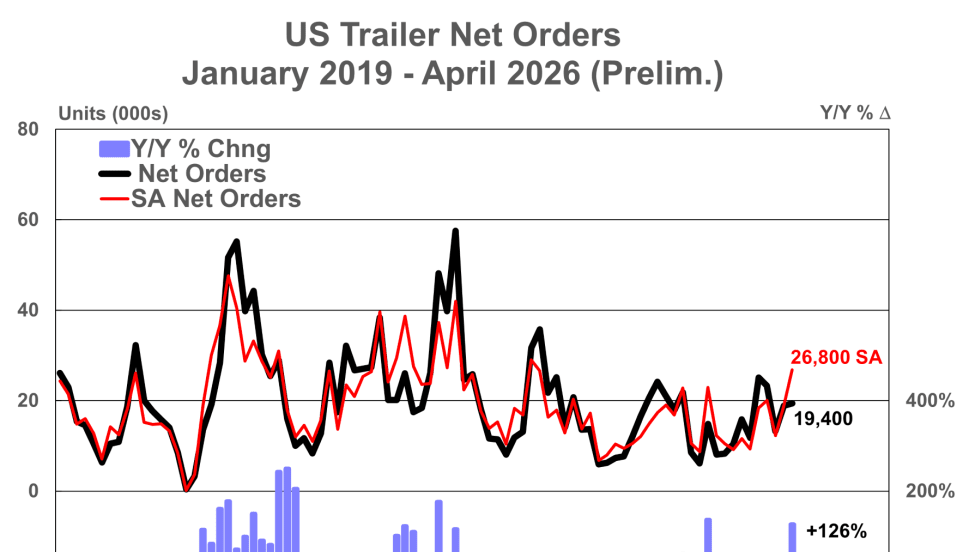
ACT Research: Trailer Orders Continue Upward Surprise in April
Preliminary net trailer orders rose 3% from March and jumped 126% year over year, signaling stronger-than-expected demand despite typical seasonal softness.
Read More →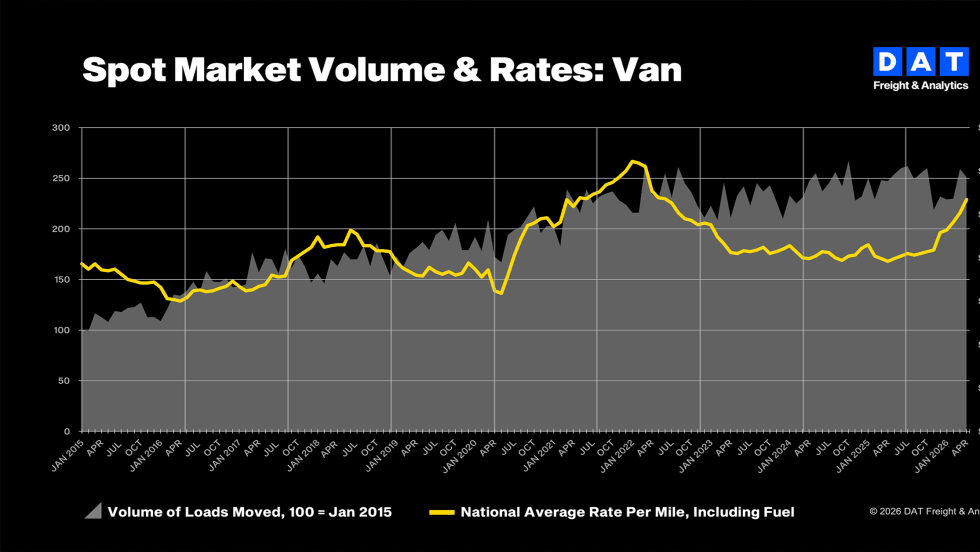
DAT: Fuel Surcharges Drive April Truckload Rate Gains as Freight Volumes Slip
Truckload spot and contract rates climbed in April. But DAT says higher fuel costs -- not stronger freight demand -- were behind most of the increase.
Read More →
Deadline Extended for HDT Truck Fleet Innovators Nominations
Heavy Duty Trucking has extended the deadline for nominations for its Truck Fleet Innovators awards. The deadline has been extended to May 22.
Read More →
Supreme Court Ruling Puts Freight Broker Vetting Practices in Spotlight
The unanimous SCOTUS ruling in the closely watched Montgomery v. Caribe case allows state negligence claims against freight brokers that hire unsafe motor carriers, raising new liability and vetting concerns among brokers.
Read More →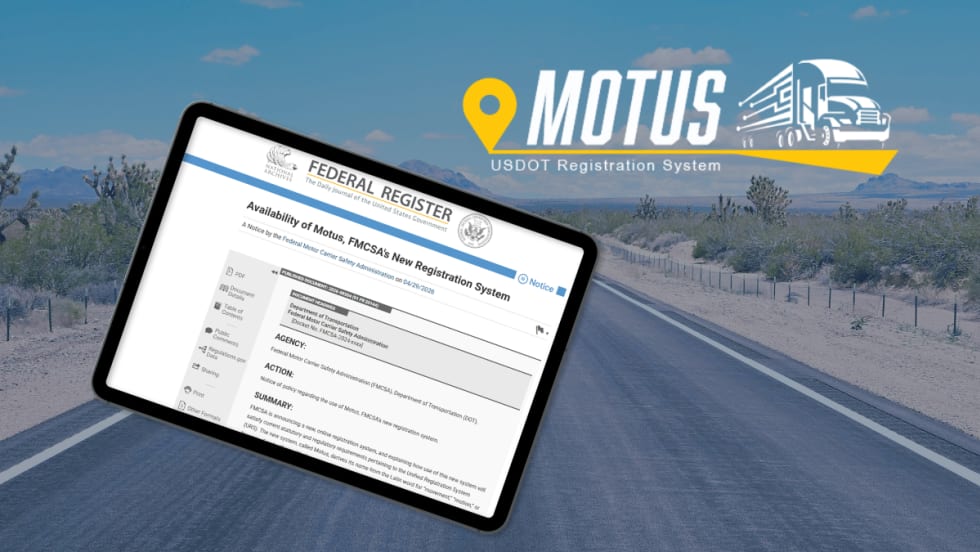
FMCSA’s Motus System Is Coming. What Fleets Need to Know Now
FMCSA's long-awaited registration system promises a single portal — and tighter fraud controls. And there are steps you need to take by May 14.
Read More →
Fleet Advantage: Fleets Embrace Generative AI, but Data Problems Limit Operational Gains
New Fleet Advantage research shows generative AI adoption has exploded among private fleets. But poor data integration and weak ROI tracking are preventing fleets from unlocking AI’s full operational and financial value.
Read More →