




CSA and the Maintenance BASIC
Seventy to 75 percent of all CSA points can be traced back to maintenance or unsafe driving violations, says Drew Anderson, director of sales for Vigillo, which provides CSA compliance services
Seventy to 75 percent of all CSA points can be traced back to maintenance or unsafe driving violations, says Drew Anderson, director of sales for Vigillo, which provides CSA compliance services.
Vigillo put together an analysis of the Maintenance BASIC under the Federal Motor Carrier Safety Administration's new Compliance, Safety and Accountability program. It showed the greatest number of CSA violations are in the reflective lighting requirement, followed closely by broken lamps. Other top concerns are unsecured or chafed brake hoses, and wheel parts that need repair.
Under the old safety system, FMCSA limited its analysis of roadside inspection data to violations that result in out-of-service orders. But under CSA, all safety violations are included. This means violations that used to be statistically insignificant will now carry significant weight.
Frank Molodecki, president of Diversified Transportation and Storage in Billings, Mont., put it in down-to-earth terms.
"In the past we may have said, 'OK, it's just a missing mud flap. We're still legal to run, it's not an offense that will shut us down,'" he said. "But now it's something that gets taken care of immediately, because it's going to count against us."
Formerly, it was more of a don't-get-caught type of thing because you were focused only on the big, out-of-service defects, Molodecki said. "Now that they are looking at everything, you have to anticipate what can really happen in an inspection, and target training, education and communication with drivers, to see that you are focusing on those things."
Trucking companies also are learning that one of the most important elements of a successful CSA compliance program is a careful pre-trip and post-trip inspection by the driver, then following up by paying close attention to the Driver Vehicle Inspection Report.
Richard Jenkins, vice president of safety and loss prevention for James Brown Contracting, Lithonia, Ga., recalled having an FMCSA auditor reviewing a handful of DVIRs that showed no deficiencies. But then the auditor compared the DVIRs to reports from roadside inspections and found inconsistencies that could lead to citations.
"You need a way for drivers to report deficiencies in vehicle safety to you immediately," Jenkins said. "The rules require you to fix the safety defects on the DVIR. If you don't, the roadside inspector becomes the enforcer, and you run the risk of fines that exceed the cost of repair and being placed out of service, not to mention getting higher CSA scores."
The compliance experts at J.J. Keller emphasize that the maintenance BASIC is not just the maintenance department's responsibility.
The motor carrier itself is responsible to its employees and the public for providing safe vehicles to travel the highways. The safety department has the responsibility for ensuring that all records and requirements required by law are accurate and retained for the specified amount of time.
Drivers are responsible for their professionalism in all safety-related matters, including not only the operation of the equipment, but also pretrip and post-trip vehicle inspection reporting and documentation. Dispatchers and all operation supervisors are responsible for the accurate direction of all safety policies. They must have a full understanding of the severity of allowing sub-standard equipment to travel the highways without required maintenance.
From the May 2011 issue of HDT.
More Maintenance

Truck Drivers Need More Than Another Alert
Fleets have more visibility into truck health, safety events, and driver activity than ever. The next challenge is turning all that information into useful guidance for the person who has to decide what to do next.
Read More →
The Maintenance Checks Trucking Fleets Should Prioritize Before Fall Freight Picks Up
Making it through August isn’t the same as being ready for the next several months of operation. Find out what systems may have suffered from summer heat and need to be checked out before fall.
Read More →
What Three Fleets Are Doing Differently When Buying Truck Parts in 2026
With freight improving but costs still climbing, fleet maintenance executives explain how they're balancing price, quality, and supplier relationships.
Read More →
Paccar Recalls 2027 Trucks Built This Summer for Possible Electrical Problem
The nearly 6,000 Kenworth and Peterbilt trucks in the recall could potentially lose engine power, among other things.
Read More →
Will API PC-12 Oil Change Trucking Fleet Maintenance?
The new API PC-12 heavy-duty engine oil category reflects the changing demands of modern diesel engines. But fleets like Foodliner are looking to getting their own data before making decisions on adopting the new oils and questions such as extending oil drain intervals.
Read More →
Brake Safety Week to Focus on Drums and Rotors
Commercial vehicle inspectors are focusing on truck brakes during CVSA's Brake Safety Week, August 23-29.
Read More →
Possible Battery-Cable Fires Prompt Recall of 15,000+ International MV and HV Trucks
On the recalled vehicles, manufacturing variations can cause the battery interconnect cable to contact the auxiliary stud and hold down the bracket.
Read More →
Rush, MCT Team Up to Grow Refrigeration Service Network
The joint venture will operate MCT's network of Carrier Transicold dealerships and mobile service locations, with the companies promising greater service capacity and uptime for refrigerated fleets.
Read More →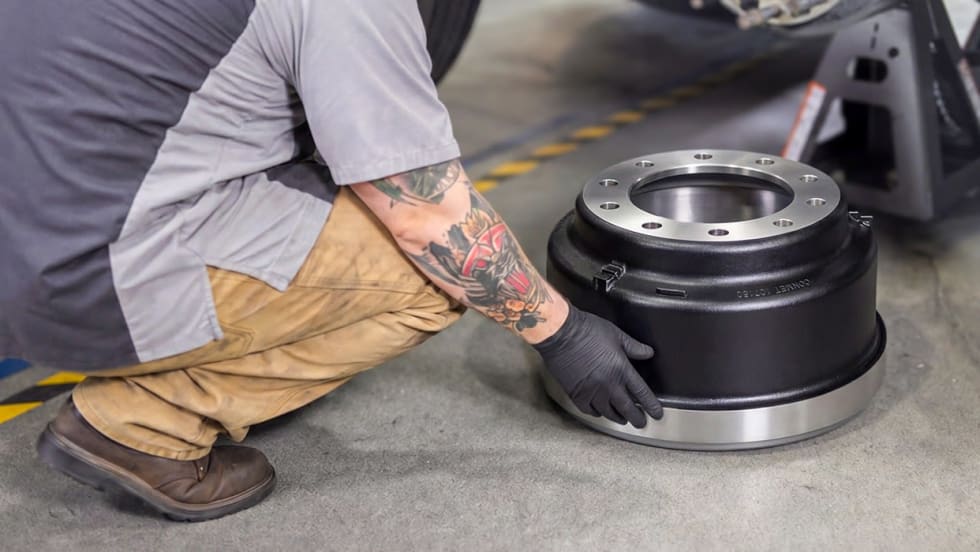
ConMet Expands Aftermarket Brake Drum Lineup With TruCast
A new heavy-duty truck brake drum option in the aftermarket gives customers more flexibility within the ConMet product family.
Read More →
Mack Expands Premium Service Contract Coverage to Medium-Duty MD
With a service contract, inspections, preventive maintenance and repairs can be handled in a single visit instead of multiple ones.
Read More →