





Perry Famularo, a longtime independent contractor for Dart Transit, was "one of those die-hards who said I would retire before I would use a computer for log purposes."
Electronic Logs: The End of the Comic Book?
Perry Famularo, a longtime independent contractor for Dart Transit, was "one of those die-hards who said I would retire before I would use a computer for log purposes.
December 18, 2009
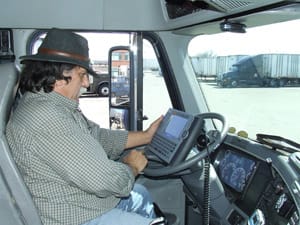
Dart contractor Perry Famularo was skeptical, but fell in love with electronic logs during the company's pilot program. (Photo by Kristin Ries)
6 min to read
But when Dart decided to do a pilot program to test electronic logs, they convinced him to give it a try. He was hooked.
"I'm here to tell you it's the smartest move I've ever made," he wrote in Dart's Advantage newsletter earlier this year. "I no longer worry about log violations. I plan my day better - that means better efficiency that translates to more $$$ in my pocket. In fact, at the end of my eight days I end up with more usable time than with the old paper logs."
Who says you can't teach an old dog new tricks? The pilot program was so successful, Dart announced this fall that it would implement PeopleNet's eDriver Logs across its entire fleet.
Dart's not alone. An increasing number of fleets are saying good-bye to paper log books.
There's an increasing belief in the industry that a "universal mandate" of electronic onboard recorders to track driver hours of service is no longer a matter of if, but a matter of when, as Washington Editor Oliver Patton examines here.
Let's face it, paper logs are inherently inaccurate. Even if it's not intentional, drivers can make mistakes in math, or in drawing the graph. A driver might "fudge" a bit for a good reason, say to get to that truckstop half an hour down the road instead of parking on an exit ramp. And then there are the small percentage of drivers - and carriers - who purposely flout hours of service regulations in the name of more miles and more revenue, the ones who keep two log books, the ones who earned paper logs the nickname of "comic books" - the ones the government is targeting with EOBR regulations.
Getting a head start
But forward-looking carriers are going ahead and adopting electronic logs - or at least looking into them - not only so they'll be prepared when a mandate comes, but also because they believe the technology can improve the bottom line.
Schneider National has completed a pilot program to evaluate electronic logs and is in the processing of installing them across the entire fleet via Qualcomm's new MCP200 onboard computer. Company officials are convinced that in addition to the safety and compliance benefits, the company will see increased productivity.
"The carriers we have benchmarked with who have transitioned to electronic logs say they've seen a 4 to 7 percent improvement in productivity," says Don Osterberg, Schneider's senior vice president of safety. Although the company didn't see that kind of improvement in its pilot program, he says, "it seems in the realm of achievable goals."
Since the government first started looking at electronic logs, technology in the cab has advanced by leaps and bounds. Today, you can cost-effectively add an electronic logging module on to an onboard computer/fleet management system that you're also using for everything from asset tracking and driver communication to mapping and navigation to scanning and sending delivery documents to reporting hard braking events or engine fault codes back to the home office. (We'll take a closer look at the specifics of electronic logging technology in a future issue.)
Ready for a mandate
"What I hear from a lot of fleets is they want to control their own destiny," says Tom Flies, senior vice president, product management at Xata. When the notice of proposed rulemaking on electronic onboard recorders came out in 2007, he says, some fleets realized changes were coming. They wanted to make sure they could have a system that not only helped them comply with hours of service regulations, but also helped them manage their business.
Norman Thomas, vice president of information services at CarrierWeb, says he's seeing "far greater interest by for-hire fleets than ever before," as they try to gear up for a future mandate.
At Schneider National, Osterberg says, "I've always embraced the 'change before you have to' mentality. We don't wait to be told to do the right thing, and this is one that was screaming at us" as the right thing to do. "What other vocation hand-writes records of work in 2009?" he asks. "It's unheard-of outside of the trucking industry."
Another company that recently announced the adoption of electronic logs is Southeastern Freight Lines, a regional less-than-truckload carrier based in Lexington, S.C. SEFL is implementing electronic logs from Innovative Software Engineering to use with the Xata hardware they already have in the trucks.
"In a few years, I think you're going to see this as a requirement for your vehicles in your fleet," says Braxton Vick, SEFL senior vice president. "That's one reason we're getting a jump on it. It's better to have a few years of experience with this before it's mandated," he says, rather than having to install a system without proper preparation or training.
"If you're starting from scratch with no experience with them, it's not as easy as just putting a box in the truck and thinking it's going to run," Vick says. "It's all the procedural stuff and integration you've got to do with your existing systems. That's what takes the time."
Schneider's Osterberg echoes that: "Companies spend a lot of time training their driver fleet, but you have to spend as much time training your non-driver associates we well - driver managers, customer service, they all need to understand the benefits and limitations of the system."
Werner Enterprises has been using electronic logs for more than 10 years. Dick Reiser, executive vice president and general counsel, remembers that it "required for some people a real paradigm shift in the way they looked at hours of service. We had to get people to understand that if a driver was two hours away from delivery and was out of hours that we were going to shut the driver down."
In the past, he says, that wasn't always the case - sometimes they'd tell the driver to go ahead and finish the load, even though it meant violating hours rules.
Improved compliance
When the Federal Motor Carrier Safety Administration's Comprehensive Safety Analysis 2010 program goes into effect next year, driver hours of service violations will more significantly affect your company's safety rating.
CSA 2010 "illustrates that FMCSA is planning more aggressive actions to find and correct chronic HOS violators - and may impose remedial directives for EOBR use," says Dave Kraft of Qualcomm (who's also chairman of the American Trucking Associations' EOBR Task Force).
Using electronic logs to help make sure drivers stay compliant can put you a step ahead of the game.
"Paper logs are just not as accurate, for fairly obvious reasons," says Drew Hamilton, executive vice president of Teletrac. "If people are looking for tools to help them adhere to the regulations and enhance the safety of their drivers, I think you'd have a tough time arguing that an e-log is not going to be an effective tool to achieve those goals."
Electronic logs can do this in two ways. They can in real time, proactively warn drivers when they are approaching a potential hours of service violation. And if a driver does violate the hours of service, you'll know much faster than the old system where a driver sends in his paper logs every week or two.
"Today it's about a week before you can get your logs in," explains SEFL's Vick of the paper system. "Even though we scan ours in and image them, they have to go out and be audited, so it can be several days before you know if you have a valid log or not."
Better insight into driver logs can allow you to work with drivers who are having compliance issues and identify problem drivers in your fleet. Systems can be set up for exception reporting, to notify safety personnel if a driver has
Subscribe to Our Newsletter
More Fleet Management
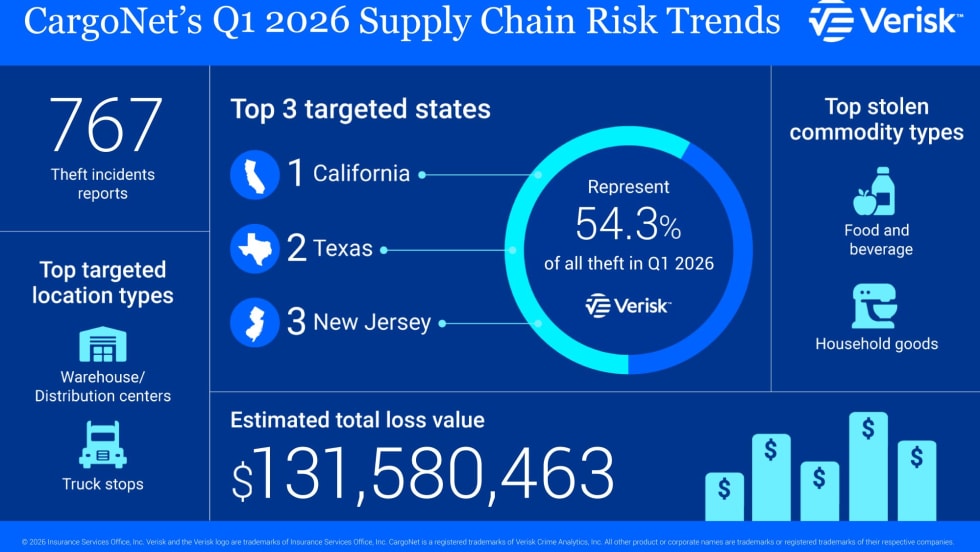
Cargo Theft Incidents Fall in Q1, but Organized Crime and Impersonation Drive New Risks
CargoNet reports fewer supply chain crime events to start 2026. But losses hold steady as organized crime shifts tactics toward impersonation schemes and high-value goods.
Read More →
Nominations Open for HDT Truck Fleet Innovators 2026
Heavy Duty Trucking is searching for forward-looking leaders at trucking fleets as nominations for HDT’s Truck Fleet Innovators 2026. Deadline is May 15.
Read More →
New Trojan Driver Cargo Theft Scam Bypasses Carrier Vetting Systems
Cargo theft rings plant operatives as drivers inside legitimate, fully vetted carriers, then execute coordinated thefts that look like a traditional straight theft from the outside.
Read More →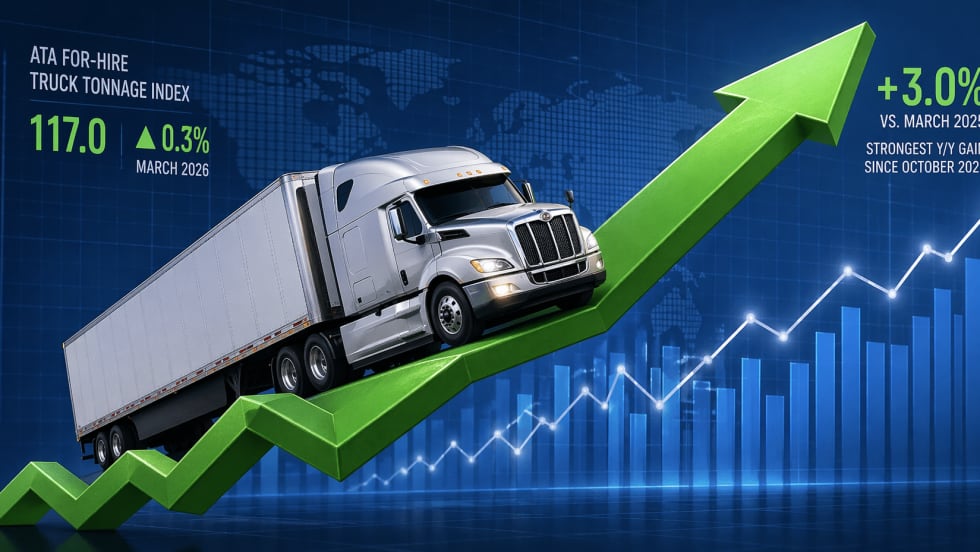
March Truck Tonnage Posts Strongest Annual Gain Since 2022
A modest sequential increase capped the strongest quarterly performance in years, signaling continued freight momentum in early 2026.
Read More →
Ohio Turnpike Targets $5.2 Million in Unpaid Tolls from Trucking Firms
More than 300 carriers across 26 states have been sent to collections as the Ohio Turnpike cracks down on toll evasion and delinquent payments.
Read More →
'Beyond Compliance,' Regulations, Driver Coaching on ATRI’s 2026 Research List
The American Transportation Research Institute will examine driver coaching, regulatory impacts — including the "Beyond Compliance" concept —and weather disruptions that shape trucking operations.
Read More →
Fleet Advantage's Brian Antonellis on the Growing Need to Replace Old Trucks
Fleet Advantage's Brian Antonellis says it's time for fleets to get back to the fundamentals of good maintenance practices. And that includes replacing older, inefficient equipment.
Read More →
Truckstop.com Adding to Open Deck, Heavy Haul Offerings
Load matching for flatbed, lowbed, oversize and overweight loads can't be automated like basic van freight, but Truckstop.com is adding more high-tech tools to help.
Read More →
Trucker Path, Truckstop.com Expand Load Access Partnership
An expanded Trucker Path and Truckstop.com integration brings more freight opportunities into the TruckLoads app while emphasizing security and network quality.
Read More →
Truckload Rates Hit Two-Year Highs as Diesel Costs Surge, DAT Says
Strong March freight demand combined with a spike in fuel costs pushed both spot and contract truckload rates to their highest levels in more than two years.
Read More →