Alcoa, Metalsa Offer 2,500 lbs in Future Weight Savings
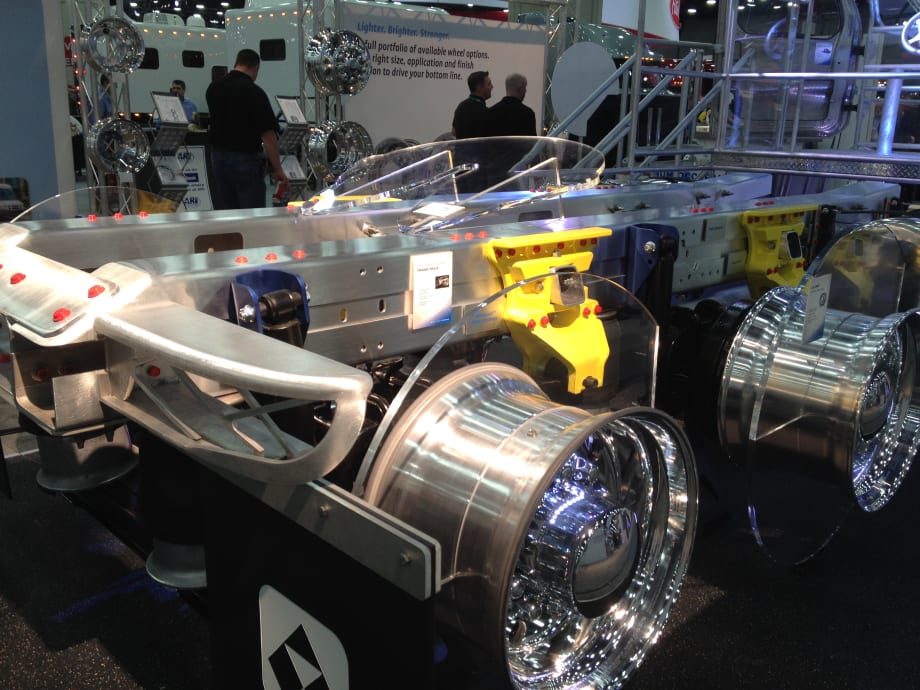
At the Mid-America Trucking Show, Alcoa showcased several vehicle components currently in development that could reduce the weight of a typical highway tractor by as much as 2,500 pounds.
Alcoa says aluminum frame rails could lighten trucks by up to 900 pounds.
3 min to read
Alcoa says aluminum frame rails could lighten trucks by up to 900 pounds.
Switching several major components from steel to aluminum could save up to 2,500 pounds on a typical class 8 truck. Speaking at the Mid-America Trucking Show, Alcoa VP & General Manager of Transportation Products Victor Marquez said the company has several products, either in service or development, that could clear the way for more than a ton of additional payload.
Ad Loading...
Alcoa, in collaboration with Metalsa, a global supplier of light and commercial vehicle and chassis structures, showcased several products currently in development, including aluminum frame rails, driveshaft tubes, suspension mounts, door skins and huck bolts.
Ad Loading...
Aluminum door skins and structural components can save about 60 pounds per cab.
Marquez says form-rolled aluminum frame rails can save 850 pounds over traditional steel frame rail.
"That's game-changing weight savings," he said. "On top of that, they do not rust so they will stay stronger longer with minimum maintenance."
According to Alcoa, the frame’s increased stiffness will double rigidity, enabling a smoother ride. The aluminum frame also offers superior corrosion resistance compared to steel, prolonging the vehicle’s life span.
Marquez says aluminum is about 45% of the weight of steel, so items like aluminum door skins and internal structures can save about 60 pounds per vehicle; an aluminum driveshaft can save about 100 pounds, an aluminum fifth wheel, currently offered by SAF Holland, saves about 100 pounds, and with about 250 huck bolts on a typical truck, count on weight savings of about 45% with no loss of structural integrity.
"How much is 2,500 pounds worth to a fleet? Different fleets value the weight savings differently," said Marquez. "Those that cube out before they weight out, probably not so much, but it's big bucks for reefer operators and fuel haulers. This miracle metal could help reshape the industry."
Ad Loading...
New alloy
In addition, Alcoa unveiled a new alloy, called VersaCast, which it says outperforms cast iron up to 94% and typical aluminum alloy alternatives by at least 40%, enabling it to be used for critical structural parts in commercial trucks, such as mounting brackets for suspension systems.
Components made with the lighter, stronger new alloy are resistant to corrosion and thermal fatigue, and allow trucks to carry heavier loads due to decreased overall truck weight. Alcoa says it has validated the benefits of the new alloy with the support of aluminum casting supplier Eck Industries.
“VersaCast enables commercial truck manufacturers to lightweight new and legacy structures traditionally made of iron, such as hanger brackets that attach the truck’s suspension system to the vehicle frame,” said Christine Keener, vice president, Commercial, Alcoa Casting. “It outperforms alternatives in the key areas of strength, corrosion resistance, thermal fatigue resistance and ease of casting across applications.”
VersaCast has two times less density than iron and offers differentiated material that can be produced in high0volume applications.
Alcoa is further expanding its presence on critical structural parts of automotive vehicles. VersaCast is currently in customer trials and has received positive feedback.
Hydrogen combustion engine trucks will be especially suitable over longer distances and in regions where there is limited charging infrastructure or time for recharging of battery-electric trucks, according to the company.
Trucking operators are slowing speeds, cutting empty miles, and declining unprofitable freight as diesel costs continue to rise due to conflict in the Middle East.
New guidance allows engine makers to replace problematic DEF sensors with NOx-based systems, aiming to reduce unnecessary derates and downtime caused by failures in the sensors designed to monitor diesel exhaust fluid on trucks.
Artificial intelligence, the software-defined vehicle, telematics, autonomous trucks, electric trucks and alternative fuels, and more in this HDT Talks Trucking interview
The company’s expanded EPEQ ecosystem includes flexible solar panels, lithium batteries, hydraulic power systems, and a portable fast charger for electric trucks.
Listen as Mike Roeth of the North American Council for Freight Efficiency shares insights into battery-electric trucks, natural gas, biofuels, and clean diesel on this episode of HDT Talks Trucking.