Since the summer, the price of oil has plummeted 50 percent, hitting its lowest level in more than five years about a week before Christmas. Diesel has fallen from a yearly high of $4.021 in March to $3.419 in mid-December.
Evan Lockridge・Former Business Contributing Editor
December 23, 2014
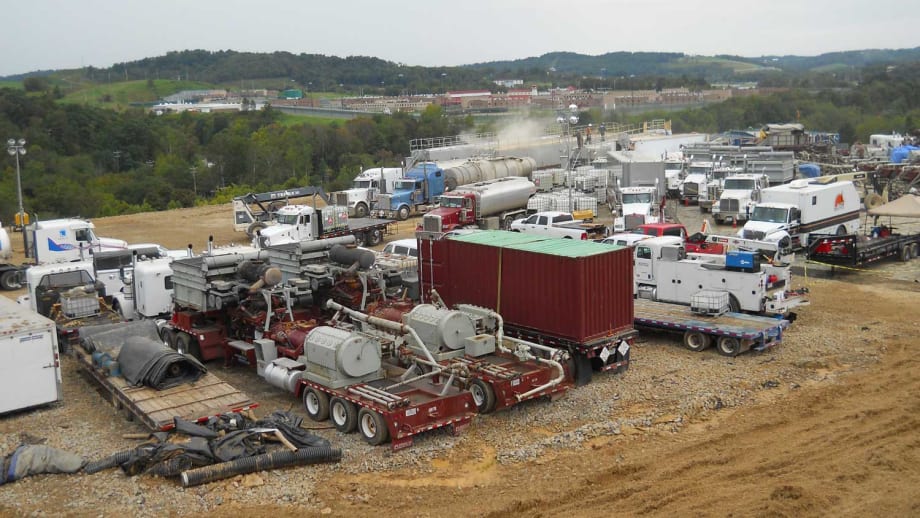
North American shale operations, like this hydraulic fracturing operation at a Marcellus Shale well, are one reason for a global glut of oil.
4 min to read
North American shale operations, like this hydraulic fracturing operation at a Marcellus Shale well, are one reason for a global glut of oil.
Since the summer, the price of oil has plummeted 50 percent, hitting its lowest level in more than five years about a week before Christmas. Riding along has been a drop in fuel costs, with diesel falling from the high of the year at $4.021 in March to $3.419 in mid-December, according to U.S. Energy Department figures.
Ad Loading...
The result has been billions of dollars in savings -- not just for the trucking industry ($350 million to $375 million annually for each one-cent decline, according to the American Trucking Associations), but also for consumers. They have seen gasoline prices fall by an even greater margin, translating into a “consumer windfall” totaling $125 billion, according to research from investment banking firm Goldman Sachs, which called the drop a “middle class tax cut.”
Ad Loading...
The global glut
One of the main factors behind all this is a worldwide glut of crude oil that’s expected to peak in the spring or summer of 2015, according to Tom Kloza, global head of energy analysis with the Oil Price Information Service. The glut is due in large part to Saudi Arabia and other OPEC member nations not cutting back on crude production.
“One theory is the Saudis would like to do as much collateral damage [as possible] to Iran, one of their main rivals in the region, and to Russia, which is one of the big meddlers in the region," Kloza says. "There [also] is the idea they maybe they want to make North American shale producers realize that finding shale oil is not necessarily a layup, and it’s certainly not a layup when prices are where they are right now.”
Kloza noted increasing U.S. production of oil from shale formations is another cause for the drop in prices, and that growth is expected to continue into 2015. “We are going to get to the highest U.S. crude production since 1973 when Richard Nixon was president,” he says, though growth in the new year could be slower than it was in 2014.
The third, and possibly biggest factor for these declines, has been an easing of worldwide demand for crude. This is due in part to some economies overseas throttling back, according to a U.S. Energy Department outlook issued in December, as well as some emerging economies not performing as strongly as earlier predicted, according to Kloza.
The outlook for fuel prices
“It also comes at a great time because fleets are paying drivers more, which they need to because they are in high demand, therefore this kind of helps with that as well."
He expects the ride of lower prices will continue well into 2015, though it will likely bottom out in mid-January. “We’ll see prices rebound nominally in the first quarter…but generally, without question, 2015 is going to see much deeper valleys for prices and much lower peaks, so it should be a good situation for everyone who is one the end user side.”
Ad Loading...
Kloza, however, said projections of actual prices into 2015, including a recent one from the U.S. Energy Department that on-highway diesel will retail for an average of $3.07 per gallon next year “is very difficult to say.”
For many trucking companies the decline in fuel prices has been a welcome development, even though the fuel surcharge of their rates has declined, according to Bob Costello, chief economist at the American Trucking Associations.
Winners and losers
“It’s a win not only for the trucking companies, because they don’t recapture 100% of the fuel spent, but it’s also a win for the shippers,” he said. “It also comes at a great time because fleets are paying drivers more, which they need to because they are in high demand, therefore this kind of helps with that as well."
According to Costello, the downside of lower diesel prices is trucking companies involved in oil field operations are not expected to see the kind of growth next year that they have seen over the last few years, because a lot of oil companies are slowing down the growth in fracking as a result of lower oil prices.
The best thing about lower oil and fuel prices, he said, may be for the overall consumer.
Ad Loading...
“There is the indirect benefit that you and I have more money in our pockets, because we are not spending as much at the gas pump and hopefully we are spending that somewhere else. And of course we know whatever we are buying, trucks are going to bring it."
Hydrogen combustion engine trucks will be especially suitable over longer distances and in regions where there is limited charging infrastructure or time for recharging of battery-electric trucks, according to the company.
Trucking operators are slowing speeds, cutting empty miles, and declining unprofitable freight as diesel costs continue to rise due to conflict in the Middle East.
New guidance allows engine makers to replace problematic DEF sensors with NOx-based systems, aiming to reduce unnecessary derates and downtime caused by failures in the sensors designed to monitor diesel exhaust fluid on trucks.
Artificial intelligence, the software-defined vehicle, telematics, autonomous trucks, electric trucks and alternative fuels, and more in this HDT Talks Trucking interview
The company’s expanded EPEQ ecosystem includes flexible solar panels, lithium batteries, hydraulic power systems, and a portable fast charger for electric trucks.
Listen as Mike Roeth of the North American Council for Freight Efficiency shares insights into battery-electric trucks, natural gas, biofuels, and clean diesel on this episode of HDT Talks Trucking.