




Long-Term Fuel Prices to Grow Slowly, Natural Gas Demand Weaker Than Earlier Forecast
Fuel prices in the future may not be as high as some earlier feared, according to updated projections for U.S. energy markets through 2040, but natural gas is expected to grow, just not as rapidly as earlier believed.

Fuel prices in the future may not be as high as some earlier feared, according to updated projections for U.S. energy markets through 2040, but natural gas is expected to grow, just not as rapidly as earlier believed.
A new report from U.S. Energy Department’s Energy Information Administration, known as the Annual Energy Outlook 2014 (AEO2014) Reference case, says with lower crude oil prices and lower gasoline demand projected, the real end-use price of gasoline in the U.S. declines to $3.03 per gallon (2012 dollars) in 2017, then rises to $3.90 per gallon in 2040, compared to $4.40 per gallon in 2040 from a projection a year ago.
The end-use price of diesel fuel in the transportation sector is forecast to follow a similar pattern dropping to $3.50 per gallon in 2017 and then rising to $4.73 per gallon in 2040, compared to $5.03 per gallon in last year’s outlook.
“The diesel share of total domestic petroleum and other liquids production rises, and the gasoline share falls, mostly as a result of the greenhouse gas and corporate fleet economy standards for light-duty vehicle beginning in model year 2017,” says the report. “Increasing demand for diesel puts pressure on refiners to increase diesel yields and results in a rising difference between diesel prices and gasoline prices from 2017 to 2025.”
While there is expected to be increased demand for the use of diesel in light-duty vehicles in the future, the hike is expected to be modest.
Heavy-duty energy demand is expected to be tempered somewhat by an average 0.5% annual increase in fuel economy from 2012 to 2040, as a result of greenhouse gas emission and fuel efficiency standards for medium and heavy-duty vehicles and engines.
"Competitive natural gas prices are significantly expected to increase the demand for liquefied natural gas and compressed natural gas, from an insignificant share in 2012, to 8% of heavy-duty vehicle energy consumption in 2040," says the report, "but that is far less than the 13% share projected last year because of the lower prices of competing fuels."
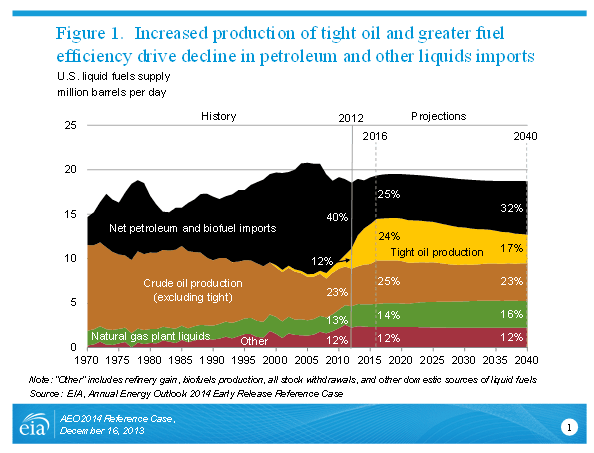
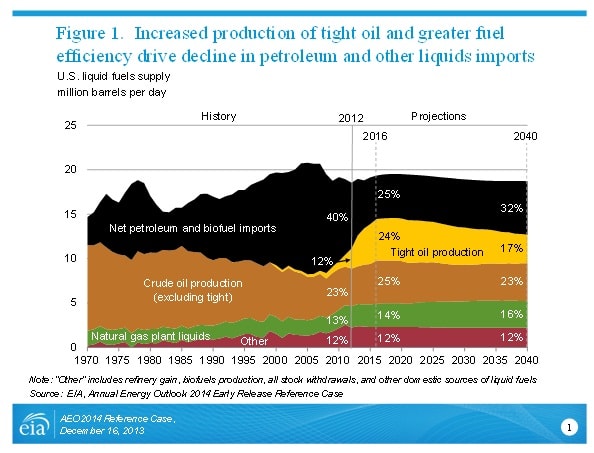
Domestic crude oil production increases sharply, with annual growth averaging 0.8 million barrels per day through 2016, when domestic production comes close to the historical high of 9.6 million barrels per day achieved in 1970.
“While domestic crude oil production is projected to level off and then slowly decline after 2020…natural gas production grows steadily, with a 56% increase between 2012 and 2040, when production reaches 37.6 trillion cubic feet,” says the report."
EIA's updated reference case shows that advanced technologies for crude oil and natural gas production are continuing to increase domestic supply and reshape the U.S. energy economy as well as expand the potential for U.S. natural gas exports," said EIA Administrator Adam Sieminski. "Growing domestic hydrocarbon production is also reducing our net dependence on imported oil and benefiting the U.S. economy as natural-gas-intensive industries boost their output.”
Some other findings:
Low natural gas prices boost natural gas-intensive industries. Industrial shipments grow at a 3% annual rate over the first 10 years of the projection and then slow to a 1.6% annual growth over the balance of the projection. Industrial natural gas consumption is projected to grow by 22% between 2012 and 2025.
Higher natural gas production also supports increased exports of both pipeline and liquefied natural gas.
Car and light trucks energy use declines sharply, reflecting slow growth in travel and accelerated vehicle efficiency improvements.
Natural gas overtakes coal to provide the largest share of U.S. electric power generation. Projected low prices for natural gas make it a very attractive fuel for new generating capacity. In some areas, natural-gas-fired generation replaces power formerly supplied by coal and nuclear plants. In 2040, natural gas accounts for 35% of total electricity generation, while coal accounts for 32%. Generation from renewable fuels, unlike coal and nuclear power, is higher in this new report than in the one from last year. Electric power generation from renewables is bolstered by legislation enacted at the beginning of 2013 extending tax credits for generation from wind and other renewable technologies.
Total U.S. primary energy consumption grows by just 12% between 2012 and 2040. The fossil fuel share of total primary energy demand falls from 82% of total U.S. energy consumption in 2012 to 80% in 2040 as consumption of petroleum-based liquid fuels falls, largely as a result of slower growth in light-duty vehicle miles traveled and increased vehicle efficiency.
The Reference case projections from the Early Release Overview of the AEO2014 are available at http://www.eia.gov/forecasts/aeo/er/. The full AEO2014 report, including projections based on differing assumptions regarding world oil prices, domestic hydrocarbon resources, the rate of economic growth, the characteristics of new technologies and alternative policy scenarios, will be released in early 2014, along with regional projections.
More Fuel Smarts

How Volvo Updated Its D13 for EPA 2027 [Watch]
Volvo’s updated D13 promises lower emissions without sacrificing performance or fuel economy. Take a closer look at what changed inside the engine in this HDT Spotlight video.
Read More →
Diesel Price Spike Shortens Payback for Natural Gas Trucks, Report Says
Energy Vision estimates fleets could recover the higher purchase price of an RNG-fueled Class 8 tractor in 1.3 to 2.8 years under current fuel-price scenarios.
Read More →
Calstart Becomes Catalyst Mobility, Reflecting Broader Focus
Calstart is now Catalyst Mobility, reflecting the nonprofit’s growing national role in clean transportation, including zero-emission trucks, infrastructure and incentive programs.
Read More →

Record Diesel Prices Squeeze Trucking Fleets
Average U.S. diesel prices have climbed to nearly $6 a gallon, surpassing the 2022 record as tight refinery capacity and Middle East disruptions keep fuel costs elevated.
Read More →
How Fuel Delivery Shapes Engine Performance
Fuel delivery depends on more than what happens at the injector. For fleet, maintenance and technical professionals, looking at the full path from pump to injector can provide useful context for understanding engine performance.
Read More →
East Coast Port Launches $45M Electric Truck Push
The Port Authority of New York and New Jersey announced millions in incentives for zero-emission drayage trucks, yard tractors, and new charging hubs near the port.
Read More →
California Bill Could Shed Light on Electric Truck Prices
Why do battery-electric Class 8 trucks remain so expensive? A California bill headed to Gov. Gavin Newsom would give fleets and state agencies more visibility into what manufacturers charge.
Read More →
Detroit Opens Orders for EPA 2027 Engines
Detroit isn’t starting from scratch to meet EPA 2027 diesel emissions standards. Its Gen 6 DD13 and DD15 engines keep much of today’s platform while updating the fuel and aftertreatment systems.
Read More →
Zero-Emission Truck Corridor Planned for West Coast
California, Oregon, Washington, British Columbia and Baja California are coordinating plans for truck charging and hydrogen fueling from Canada to Mexico.
Read More →
A Closer Look at Kenworth’s Electric T880E Vocational Truck [Video]
Learn more about Kenworth's T880E battery-electric vocational truck at the Paccar Technical Center, including its range, applications, upfitting considerations, and PTO options, in this HDT Spotlight video.
Read More →