




Ferro Discusses CSA Changes at MATS
LOUISVILLE, KY -- The Federal Motor Carrier Safety Administration is getting ready to roll out some revisions to the SMS database it uses in its CSA (Compliance, Safety, Accountability) program, including dropping the Cargo Securement BASIC and adding a Hazmat BASIC, Administrator Anne Ferro announced during the Mid-America Trucking Show Fleet Forum Wednesday
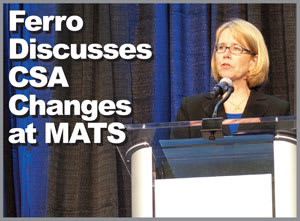
Anne Ferro speaks at the MATS Fleet Forum. (photo by Justin Miller)
LOUISVILLE, KY -- The Federal Motor Carrier Safety Administration is getting ready to roll out some revisions to the SMS database it uses in its CSA (Compliance, Safety, Accountability) program, including dropping the Cargo Securement BASIC and adding a Hazmat BASIC, Administrator Anne Ferro announced during the Mid-America Trucking Show Fleet Forum Wednesday.
CSA is "proving out the saying that what gets measured gets done - and what gets measured publicly really gets done," Ferro told the audience during the first-ever event, put on by Fleet Owner and Heavy Duty Trucking magazines and show management.
Starting sometime next week, carriers will get a chance to preview their data under the proposed changes to the SMS system. These enhancements come from discussions with enforcement, industry, FMCSA investigators and the agency's own in-depth analysis, Ferro said.
One of the biggest changes is the Cargo Securement BASIC. FMCSA has not made that available to the public. "We held back because we weren't altogether confident in its clear association with [safety] outcome," Ferro said. "So we have shifted many of the cargo to the Vehicle Maintenance BASIC and we're going to have a standalone hazmat BASIC."
Another change is designed to address the problem with enforcement officials performing a driver-only inspection yet nevertheless adding vehicle violations to the report, and vice versa. The agency will now be dropping that data from the system. If it's a driver-only inspection, then only the driver violations will be reflected in the CSA scores. If it's a vehicle-only inspection, driver violations will not be included.
The preview period will run for two or three months. The agency will then consider all the comments and decide what to do next, with the goal of making it final and public by mid July.
Crash Accountability
Ferro also addressed the issue of crash accountability. The FMCSA was close to publishing a proposal that would have adjusted how a carrier or driver was penalized for a crash based on who was at fault. When it decided to rethink that proposal, some in trucking accused the agency of caving in to pressure from special interest groups, namely the safety advocacy groups.
The administrator explained that as part of the process, it took the proposal, as it often does, to its Motor Carrier Safety Advisory Committee. This 19-member committee is made up of a cross-section of representatives from trucking companies, associations, safety advocates, victims of truck and bus crashes, labor and enforcement officials.
"Through that process last month, the advisory committee members individually raised some questions that I frankly found tough to answer," Ferro said. For instance, how do you make sure the police report you're relying on to make that determination is truly the "final" report? Is it fair to get a report from the trucking company but not from the individual affected by the crash?
Most importantly, Ferro said, the agency wants to make sure that this would actually result in improved safety. The hypothesis, she said, is that isolating the crash data to only preventable crashes would allow the agency to focus more on higher-risk carriers. However, she said, that's a hypothesis they have not been able to test. And will it improve safety enough to make it worth the large investment of the public's money that will be needed to put this in place?
"So we have pulled it back and when we've finished our analysis we'll share it with everyone."
CSA Success
So far, Ferro said, CSA is improving safety outcomes.
She noted that in addition to being an enforcement tool, CSA allows fleets access to data that helps them improve their own operations. "Through real-time performance measures and performance data, there's a much higher degree of awareness of what's happening to that equipment, what's happening with the driver, and what types of enforcement actions are occurring across the board, not just the out of service violations," she said.
"We've seen companies with high BASICs, once they get a warning letter or other intervention, they have changed their behavior, we have seen their numbers come down. It absolutely is changing he way companies operate and changing the awareness of safety performance."
It also has changed the way drivers are performing, she said. In 2011, she said, the numbers showed a 9% reduction in violations, and a 12% reduction in driver-specific reductions.
Ferro also pointed out that, despite reports to the contrary, "we have a lot of data on a lot of companies. Actually we have sufficient data for analysis on 200,000 companies. Those companies are operating 80% of all the equipment operating and are responsible for 92% of all injury crashes. We have our eyes on the right population."
Down the Road
Friday, Ferro will be leading an FMCSA "listening session" at MATS to try to learn more about electronic onboard recorders and driver harassment.
"One of the issues raised in the past is any rule that would mandate EOBRs needs to include a provision to prevent harassment of the driver. We need to understand what everyone means by harassment, how are AOBRDs today being used that affects safety and what can be done about it. The objective is to use this information and input to do a second notice of proposed rulemaking for requiring EORs across the board."
Ferro also gave the audience a "heads-up" that the issue of fatigue as it relates to driver safety is on the agency's agenda for the future. One area FMCSA is looking at is sleep apnea, a sleep disorder that prevents some drivers from getting proper sleep. The agency asked its medical review board to meet with MCSAC to put together recommendations on how FMCSA can improve its guidance on sleep apnea for medical providers, drivers, employers and others. The agency plans to issue clarifying guidance sometime later this year.
"Underscoring fatigue and the impact fatigue has on a driver's ability to operate safely are two areas under research: driver detention and driver compensation," Ferro said. "Clearly there's some degree of detention in a complex supply chain, but there are levels of detention that affect a driver's ability to … drive stress free and reach their destination within the time remaining in their hours. Compensation also has a role in that and is the subject of a study we are jut getting under way with on how companies compensate drivers and how that affects drivers' ability to operate safely."
More Safety & Compliance
PrePass, Kodiak Connect Driverless Trucks to Roadside Enforcement
The system will allow enforcement agencies to verify Enhanced Inspection information and decide whether Kodiak’s autonomous trucks can bypass roadside screening sites.
Read More →
From One Generation to the Next: How Mentorship Builds Safer Truck Drivers
After three decades in trucking, Harold Perry shares what he's learned about driver safety, mentorship, and helping the next generation build confidence behind the wheel.
Read More →
FMCSA Pauses Biennial-Update Enforcement Amid Motus Transition
Carriers whose updates were due on or after June 1 have more time, while FMCSA works to stabilize its new registration system and warns of phishing sites impersonating its new carrier registration system, Motus.
Read More →
ZF Expands Commercial Vehicle Push in North America
ZF is expanding its North American commercial-vehicle presence with new transmission applications, electrification, trailer technology and autonomous-driving systems.
Read More →
Truck Drivers Need More Than Another Alert
Fleets have more visibility into truck health, safety events, and driver activity than ever. The next challenge is turning all that information into useful guidance for the person who has to decide what to do next.
Read More →
Tesla Wants a Self-Driving Semi. Are Cameras Enough?
Could Tesla’s camera-only autonomous driving technology work on an 80,000-pound Semi? In this commentary, HDT's Deborah Lockridge takes a look at Tesla, Cybercab, and how autonomous trucks see the road.
Read More →
What DOT’s Automated Vehicle Strategy Means for Trucking
The U.S. Department of Transportation issued a new automated-vehicle strategy that outlines plans for driverless-truck regulations, cross-state freight corridors, and federal safety standards.
Read More →
NYC Expands Speed, Pedestrian Safety Tech Across Fleet
New York City is expanding intelligent speed assistance and pedestrian-alert systems across its municipal fleet, moving the technologies from pilot programs into vehicle procurement and retrofit requirements.
Read More →
FMCSA Removes 110 Truck Driver Training Schools from Certified ELDT List
Federal regulators also are targeting more than 160 additional training providers and launching a nationwide audit of third-party CDL skills testers as part of a broader crackdown on trucking fraud.
Read More →
Beyond DOT Compliance: What Makes a Trucking Fleet Truly Safe?
A trucking fleet can follow every rule and still make unsafe decisions. The real test comes when safety conflicts with freight, productivity, or cost.
Read More →