




It turns out that a rule requiring electronic onboard recorders to track hours of service is not a simple thing. Take the question of how the inspecting officer will read the driver's log information off of the machine.
EOBR Details Complex and Messy
It turns out that a rule requiring electronic onboard recorders to track hours of service is not a simple thing. Take the question of how the inspecting officer will read the driver's log information off of the machine
by Staff
August 31, 2011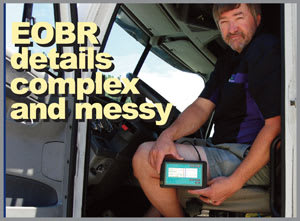
Just showing your EOBRs to enforcement officials this way is probably not in the cards.
4 min to read
Here's how the issue played out this week in deliberations among members of the Motor Carrier Safety Advisory Committee. The MCSAC has been working for months to come up with recommendations for the Federal Motor Carrier Safety Administration on how to resolve this and other difficult EOBR issues. The committee is a 19-member volunteer panel representing the interests of law enforcement, the trucking industry, independent drivers, safety advocates and the Teamsters union that the agency regularly asks for counsel and recommendations.
Police do not want to enter the cab in order to read a screen on the EOBR. They consider it unsafe for themselves and intrusive upon the driver, who may see the move as harassing.
Law enforcement budgets being tight, police do not want to have to buy a printer that the driver could plug in to the EOBR to print out a copy of the log. Not to mention the problem of finding a ruggedized printer that is compatible with all of the EOBR devices on the market, or the security risk of a computer bug being transferred from a police device to a driver's device, or vice versa.
So what the police want is a rule that would require the driver to either print out the log for the past seven days, or copy the information off of the EOBR onto a standard paper log sheet and certify that it truly represents what's on the EOBR.
Printers or paper logs
The practice among carriers that already use EOBRs, whether they have a printer or a digital read-out device that the driver can pass to the officer, does not necessarily point the way toward an industry-wide solution.
These carriers typically have an EOBR as a component of an overall management information system, a financial commitment that makes it easier to justify the cost of a printer or a digital read-out. But for many smaller carriers and independents, this kind of investment is simply out of reach.
It would be relatively simple and inexpensive to allow drivers to download their logs onto a USB device, such as a thumb drive, that they could hand over to the officer to plug into a laptop. But the security concerns surrounding this approach apparently are insurmountable. In fact, some states, such as California, have banned the use of USB devices for this sort of activity for fear that they cannot be protected against viruses or malware.
Requiring the driver to fill out a paper log by hand based on his EOBR readout runs counter to the point of using eobrs to improve accuracy and efficiency, pointed out Henry Jasny, general counsel for Advocates for Highway and Auto Safety. But, replied a law enforcement representative, it wouldn't happen that often, since most trucks are inspected no more than a couple of times a year.
And maybe that would be better than requiring the trucking industry to buy 8 million printers in order to comply with the rule, said Rob Abbott, vice president of safety policy at American Trucking Associations.
Some EOBR systems have integrated printers that add only $15 to the cost, but not all systems have that option. For instance, Qualcomm's current products have some printing capabilities, but they do not print QHOS logs at this time. Add-on printers can run up to $200 or more, said Brian McLaughlin, executive vice president and COO of PeopleNet, an EOBR system provider. "The pressure should be on law enforcement to make the investment rather than the carriers," he said.
So much for paperless
Some on the committee noted that a requirement that the driver fill out a paper log based on the EOBR readout could create an opportunity for an officer to harass a driver. Law enforcement representatives replied that they simply want to do their jobs and are not interested in harassing drivers.
ATA's Abbott noted that the overarching trend is toward a paperless business environment, and that giving an officer the option of requiring the driver to copy his EOBR is a step in the wrong direction. "The idea should be to drive resources where we want to go," he said.
All in all, not an easy call. And this is just one of 16 EOBR issues that advisory panel is thrashing through in its effort to deliver recommendations to the safety agency by the end of the year.
Among the other issues under consideration:
* security protocols for telematics and peer-to-peer data exchange;
* guidelines for transferring existing EOBR systems from trucks that are being rotated out of the fleet and plugged into new trucks;
* how to identify drivers without compromising privacy or security;
* how to define when a tractor is being used as a personal conveyance, as opposed to commercial operation.
More Drivers

Best Fleets to Drive For: Two Carriers Earn Overall Award for First Time
CarriersEdge announced the 2026 Best Fleets to Drive For overall winners, with Crawford Trucking, Fortigo Freight Services, and FTC Transportation receiving top awards.
Read More →
Federal Proposal Would Allow Pell Grants for Shorter-Term Job Training
The Department of Labor plans to expand Pell Grant eligibility to some shorter workforce training programs, a move the American Trucking Associations said will help strengthen commercial driver training schools and diesel technician training programs.
Read More →
Owner-Operator Model Gets Boost as DOL Proposes 2024 Independent Contractor Definition Reversal
For an industry that has watched this issue go back and forth for years, the independent contractor proposal marks the latest swing in the regulatory pendulum.
Read More →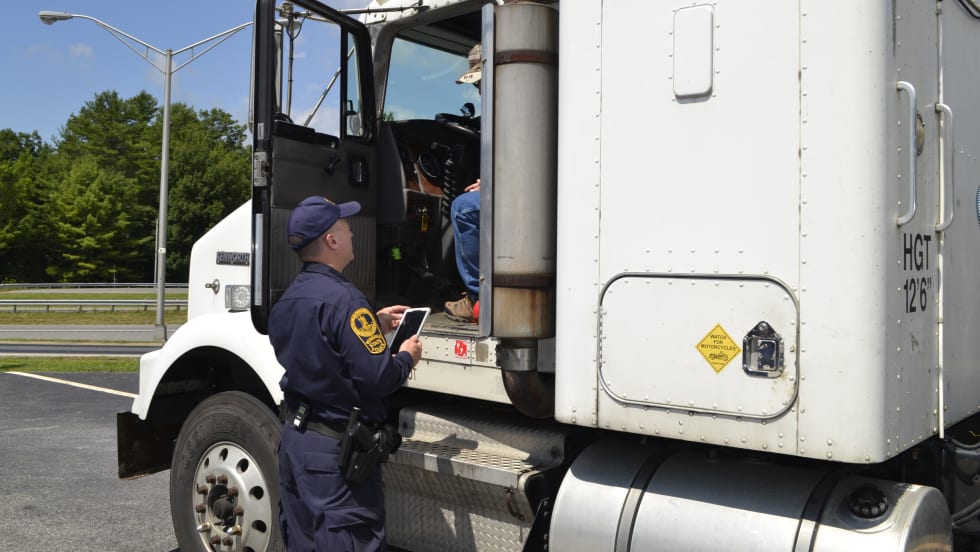
FMCSA Reinstates Field Warrior ELD to Registered Device List
One electronic logging device has been reinstated to the FMCSA's list of registered ELDs.
Read More →
How One Company is Using Smart Suspension Technology to Reduce Driver Injuries and Improve Retention
America’s Service Line adopted Link’s SmartValve and ROI Cabmate systems to address whole-body vibration, repetitive strain, and driver turnover. The trucking fleet is already seeing measurable results.
Read More →
CarriersEdge Announces 2026 Best Fleets to Drive For
The 18th annual contest recognizing the best workplaces for truck drivers sees changes to Top 20, Hall of Fame
Read More →
FMCSA Targets 550+ ‘Sham’ CDL Schools in Nationwide Sting Operation
The Federal Motor Carrier Safety Administration issued more than 550 notices of proposed removal to commercial driver training providers following a five-day nationwide enforcement sweep. Investigators cited unqualified instructors, improper training vehicles, and failure to meet federal and state requirements.
Read More →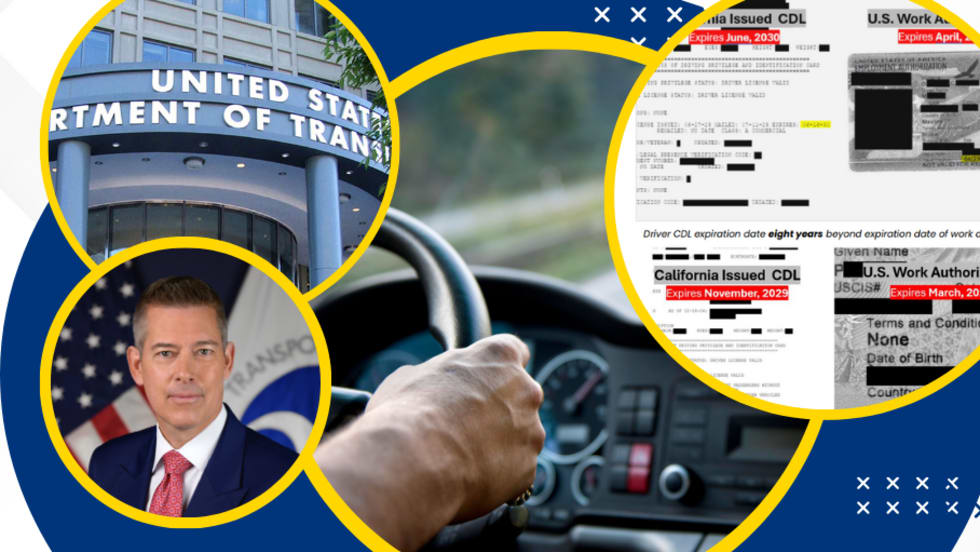
DOT Alleges Illinois Issued Illegal Non-Domiciled CDLs
Illinois is the latest state targeted and threatened with the loss of highway funding by the U.S. Department of Transportation in its review of states' non-domiciled CDL issuance procedures. The state is pushing back.
Read More →FMCSA Locks in Non-Domiciled CDL Restrictions
After a legal pause last fall, FMCSA has finalized its rule limiting non-domiciled commercial driver's licenses. The agency says the change closes a safety gap, and its revised economic analysis suggests workforce effects will be more gradual than first thought.
Read More →
Trucker Path Names Top Truck Stops for 2026
Truck driver ratings reveal the best chain and independent truck stops in the country.
Read More →