Amid rising complaints about faked driver logs and unscrupulous ELD providers, FMCSA is revamping how electronic logging devices get approved — adding new safeguards but not yet moving to full third-party certification.
The Federal Motor Carrier Safety Administration announced what it called a complete overhaul of the vetting process for electronic logging devices that track truck driver hours of service compliance, but stopped short of requiring third-party certification.
It's a step in the right direction to address what many in the industry say are growing problems with unscrupulous motor carriers and unscrupulous ELD providers editing driver logs to allow them to violate hours of service limits.
ELDs, mandatory for most interstate truck drivers, electronically record hours-of-service to help prevent fatigue-related crashes and ensure compliance with federal safety regulations.
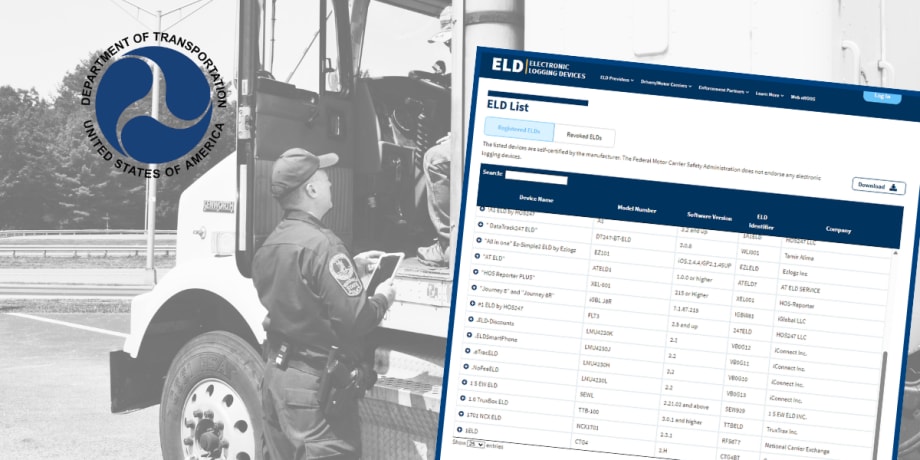
However, the way ELDs get onto the FMCSA's list of approved devices has been criticized since the mandatory electronic logging device rules went into effect in 2017. ELD providers “self-certify” that their devices meet the technical specifications in the rule (49 CFR Part 395, App. A).
FMCSA Targets Non-Compliant ELDs
A DOT news release said the overhaul will help ensure non-compliant devices are blocked before they ever reach FMCSA’s Registered ELD list.
The “move toward a more structured, hands-on vetting approach signals a notable evolution in federal oversight of the ELD marketplace,” said Brandon Wiseman of TruckSafe Consulting in a blog post.
As Wiseman notes, FMCSA has not historically tested the devices, validated the software, inspected the hardware, or otherwise verified the vendors’ claims before listing them.
Under the previous system, it was easier to register non-compliant devices or re-register devices that had been revoked by the agency. FMCSA said its updated process closes this loophole. New ELD listings will no longer flow straight from self-certification to public listing.
The New ELD Vetting Process
Key features of the updated ELD vetting process include:
Initial review: Verification of contact information, technical specifications, and device images.
Fraud detection: Cross-checking new applications against active, inactive, revoked, and in-process lists.
Application categorization:
Category 1 – Approved: Application has met all necessary requirements for approval.
Category 2 – InformationRequested: Application is pending further information from the applicant.
Category 3 – Further Review: Application requires additional internal assessment and may require additional documentation from the applicant.
Category 4 – Denied: Application does not meet the required standards for approval.
“While the agency has yet to share the specific details of how this revised system will actually function, it seems the shift will at least serve as a basic gatekeeping function for nefarious actors,” Wiseman wrote.
“While the agency still is not conducting independent laboratory tests or validating devices in real-world settings, it is at least injecting a level of scrutiny that should prevent some of the most problematic devices from ever making it to the marketplace.”
Trucking Industry Outcry About Bad Actors
There has been a growing movement in the trucking industry pushing the FMCSA to take action to deal with unscrupulous ELD providers and motor carriers blatantly violating hours of service rules through ELD data manipulation.
Industry sources say the problem isn't just a fleet or driver trying to manipulate logs, but an ELD provider editing the logs and not providing records of those edits.
Zach Meiborg, a former HDT Emerging Leader and owner of Meiborg Companies, has been on a mission to raise awareness of how bad-actor trucking operations are taking advantage of ELD loopholes, including adding fake co-drivers to an ELD to mask a truck driver’s hours of service violations.
Unscrupulous motor carriers, many of which Zeiborg maintains operate from oversees, are “webbing in overnight, and they're erasing their driver's hours of service showing that another driver completed that leg of the trip when that didn't happen at all.”
When the FMCSA revokes an ELD from its list, Meiborg said, “You know what those non-compliant e-log providers do? They copy and paste their code and start a new e-log company the following week.”
Kevin Grove, ATA’s director of safety and technology policy, told ATA newspaper Transport Topics that earlier this year, CVSA discovered some instances of fraud that involved not only drivers or trucking fleets falsifying logs, but of ELD providers doing the editing on their end.
And Jeremy Disbrow, a roadside inspection specialist at the Commercial Vehicle Safety Alliance, told Transport Topics, “Tampered ELDs usually look perfect, and it is often difficult and time-consuming to identify instances of ELD tampering during a roadside inspection.
"In many cases, the ELD providers are not only manipulating the information within the ELD, but they are also manipulating the information on the shipping papers and other supporting documents to match the fraudulent entries within the ELD.”
The end result, he said, is that the problem ELDs give carriers the ability to do edits, “allowing these fleets to erase your hours every night and give the drivers fresh brand new hours.”
Danielle Chaffin, with TMS provider Revenova, wrote in a lengthy online article on problems with the ELD self-certification process, "I’ve reviewed dozens of so-called 'certified' ELD providers. Most are foreign-owned or operated outside the U.S., and virtually none undergo meaningful cybersecurity oversight.
"With backend access, tech teams can 'reset' or alter logs on demand," she wrote. "That gives dispatchers the power to override reality, pushing drivers past legal limits while maintaining a perfectly clean digital paper trail."
Third-Party Certification of ELDs
Some have been calling for the U.S. to adopt a system where approved third parties verify ELD compliance, such as Canada uses.
The American Trucking Associations, for instance, recently updated its safety policy to support third-party certification of ELDs and oversight such as auditing and monitoring of registered devices to prevent fraud by drivers, carriers or ELD providers.
Wiseman cautioned that the FMCSA's new system is not the same as Canada’s rules.
“Fleets should recognize that the ELD marketplace in the U.S. is not yet entering a Canadian-style certification environment,” he wrote.
“Manufacturers continue to self-certify that their devices comply with the rule. FMCSA’s involvement remains procedural rather than technical. For that reason, carriers must continue to approach ELD selection with informed caution.”
NTSB Ghost Driver Investigation
Last year, the National Transportation Safety Board recommended FMCSA strengthen ELD requirements when its investigation of a 2022 truck-bus crash found the truck driver was fatigued.
The motor carrier, Triton Logistics, created fictitious driver accounts for its electronic logging device systems that allowed drivers to exceed federal hours-of-service regulations and drive while fatigued.
When NTSB examined the ELD data from the day of the crash, it showed that the truck driver was operating in a driver/codriver arrangement. But they found no evidence of such a co-driver.
The driver told investigators that his company had told him that if he exceeded his allowable driving hours, he was to stop, call the carrier’s HOS department, and Triton personnel would log him out of the ELD and log in a new driver. He could then continue driving. A post-crash compliance review by FMCSA found this was not an isolated instance.
In its recommendation, the NTSB said FMCSA should strengthen electronic logging device requirements to prevent opportunities for the creation of fake driver accounts.
Regulations should require providers of electronic logging devices to create and produce an audit log, to include date, time and editor for driver logins, driver’s license numbers, and active driver list changes, the board said.
"This administration is cracking down on every link in the illegal trucking chain,”saidU.S. Transportation Secretary Sean P. Duffy in a news release.