





"They still ultimately have to go up that on-ramp and enter into crazy, because what's happening on America's highways is nothing short of crazy."
5 Questions for Werner’s Derek Leathers on Culture, Leadership, and What Keeps Him Up at Night
Werner Enterprises CEO Derek Leathers on truck drivers, leadership, nuclear verdicts and more.
October 9, 2025
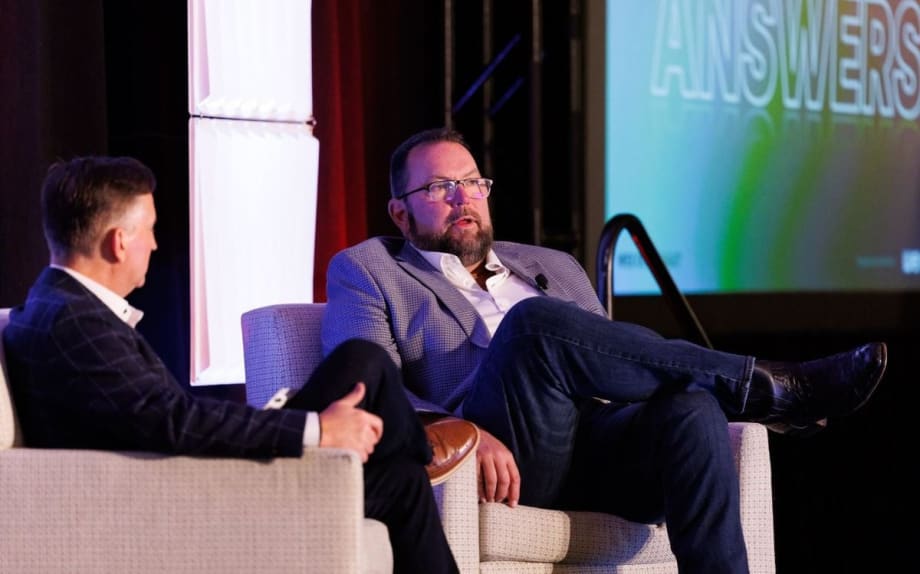
"I'm a big believer that culture matters and trumps everything else. I really believe that once you lose that, you lose everything," said Werner CEO Derek Leathers during a WEX OTR Summit session.
Photo: McLendon Photography/Wex
6 min to read
After delivering a keynote address on the state of the industry at the Wex OTR Summit, Werner Enterprises CEO Derek Leathers sat down for a question and answer session on topics that ranges from drug testing to technology adoption to driver-friendly truckstops.
We chose these five to share. (Answers have been edited for length and clarity.)
1. As CEO of a major American trucking company, what keeps you up at night?
Nuclear verdicts are really, really high on my list. I've been through my own personal pain. We have a slogan at Werner, that's “safety above service.” It's in our values, and it's pictorially displayed as the most important thing in all the values, because nothing we do is worth getting hurt or hurting others.
But the reality of the world we live in today is you can be in your own lane of travel and get hit by somebody else that crossed five lanes of traffic to hit you head on and somehow wake up with a $90 million verdict. We lived that experience personally.
That's one of many that are terrible, terrible outcomes, and so it keeps you up at night.
Social media is something that's a problem. I personally have lived under attack for the last several weeks over this ridiculous social media story about this Kenya driver importation.
We weren't involved. We didn't even know the [Nebraska] Secretary of State was there. We did nothing whatsoever to recruit anybody from Kenya. And yet, somehow, somebody decides that Werner is running a slave trade out of Kenya to bring drivers into the country.
So you've got fight stuff off that's not even real. It’s hard enough work already to safely deliver America's goods and keep America moving without having to fight off some of this ridiculousness that's out there.
2. If you could go back in time 10 years, what would you do differently?
I think it relates to the intermodal game. We’re proud truckers, and we love being truckers. But I think intermodal is, you know, real, and it's hard to be a late entry into a capital-intensive business like that. So I think that certainly would be one.
I think the other one is, I'm very proud that we were almost cult committed to promotion from within, but I think it cost, over time, the absence of fresh ideas at times. So I think we were a little late to start bringing in a mix of …we still predominantly promote from within, but I think it's absolutely critical to introduce fresh thoughts and fresh ideas from the outside.
3. What are the key attributes that influence whether a new truck driver succeeds or fails?
I think the biggest one is patience.
I just finished holding some sessions across our network and our terminals with new drivers about to come to the fleet. And one of the things I always try to explain to them is that what you're about to embark on, no matter how prepared we try to make you, no matter how good the driving school you went to was, and the four more days of training at the terminal before they ever go on a truck, and the five weeks on the road with a leader; no matter how well all of that goes, when you go and get your own truck, it is a new job.
All new jobs are scary, but the difference in an office is that you've got people sitting to your right and your left and behind you that you can ask for help.
Drivers don’t. And they need to be able to ask for help. So I try to just emphasize that you have to be willing to ask for help. You have to acknowledge that you're not going to know everything, and know that you're not going to be punished for asking for things.
And the other one, which I just don't know how we can get any better at, is, how do you prepare people?
Let's say a driver comes through, and they're really prepared, and they know what they're doing, and they're patient, and they do everything right. They still ultimately have to go up that on-ramp and enter into crazy, because what's happening on America's highways is nothing short of crazy.
Four wheelers are more distracted than ever before. The amount of people violently speeding, not just speeding, but 90 mph, 100 miles an hour, whipping in and around our trucks.
And a lot of folks, they see that for the first week, and they're like, “Nope, this is not what I thought it was going to feel like.”
I do think we're all benefiting from four-wheel technology getting better and better, more and more lane-keeping technology in cars. To be frank, I'm a big fan of driver assist in cars, because it can't be worse than what they're doing today.
4. What advice would can you share on building a strong company culture in such a challenging time?
I'm a big believer that culture matters and trumps everything else. I really believe that once you lose that, you lose everything.
And so we're all in a state of mind right now where we're cutting costs, but occasionally that starts to intersect with culture. So I've had several sort of heated exchanges in my own building recently about things like, “Let's cut the award ceremony that we do at the end of the year.”
It’s a fairly expensive we do a thing called the gala, where we recognize the associates of Werner, drivers, mechanics, office, everybody. And I just said, no. I know what it costs; let's go find something else. We are not cutting that, because that's who we are. That's the one moment in time we get to recognize folks.
5. How do you inspire and motivate your team in down times?
This is tough because traditionally, in a good market, I would say if you were a Werner associate, you would probably have the opinion that the hard charging, the guy that's never satisfied, the one that thinks we're not doing well enough, would be me.
And in the down market, I have had to change my playbook, because everybody's frustrated. They're trying as hard as they can. I've noticed that it's more the supervisory director and VP level that are really getting on folks and really trying to push and squeeze anything we possibly can get out of them.
And so I have become sort of the jovial, walk around, tell people it's going to be okay guy. Because you have to respond to what seems to be needed at the time. It would do no good, in my opinion, for me to go and start banging on desks and getting upset with people.
Instead going and telling them, “This too will pass.”
We have to remind ourselves we all have many, many people in our organizations that have only existed during the down cycle. They entered our companies during the down cycle. The only thing they know is this terrible, terrible world. And so lifting them up and taking the time to do it.
We do this maybe quirky thing, but two to three times a week, I host what we call a five minute cocktail. At the end of the day, any leader in the organization who has a group of people who did something special that week, they just call my admin, they come up, and we literally just stand in my office for five minutes. They tell me about what they did. I thank them for what they've accomplished, hear a little bit about their personal story, raise one glass and then call it a day.
And it's just a little way to say thank you, because unfortunately, we don't have the money to do anything else, but we can always afford to just say thank you.
More Fleet Management

Sponsored•September 16, 2026
Color Match Smarter: Tools That Restore & Perform
For fleet managers and collision repair professionals keeping heavy-duty trucks on the road, getting the color right the first time isn't just about appearance — it's about efficiency, turnaround time, and bottom-line results. Discover how today's digital color tools are transforming the repair process from guesswork to precision.
Read More →
FMCSA Pauses Biennial-Update Enforcement Amid Motus Transition
Carriers whose updates were due on or after June 1 have more time, while FMCSA works to stabilize its new registration system and warns of phishing sites impersonating its new carrier registration system, Motus.
Read More →
Sponsored•September 14, 2026
2026 Blueprint for Countering Smarter Supply Chain Theft
Cargo theft is no longer just the cost of doing business. It's a multi-billion-dollar criminal enterprise exploiting vulnerabilities across your fleet, drivers, and supply chain.
Read More →


Sponsored•September 1, 2026
How Telematics Improves Visibility, Control, and Performance in Refrigerated Fleets
Explore how telematics help refrigerated fleets improve visibility, uptime, efficiency, compliance, and cargo protection across connected cold chain operations.
Read More →
What the U.S.-Canada Trade War Means for Trucking
Escalating U.S.-Canada tariffs could disrupt cross-border freight, reduce truck volumes, raise costs, and create new uncertainty for carriers on both sides of the border.
Read More →
What Are Trucking’s Top Concerns for 2026?
The American Transportation Research Institute wants to know what's worrying trucking fleet managers, drivers, and other stakeholders in its annual Industry Issues survey.
Read More →
American Trucking Associations Looks for a New Leader
ATA President and CEO Chris Spear abruptly left his job at the association on August 21, at a pivotal time for the trucking industry.
Read More →
Public Wi-Fi Cybersecurity Risks: How Truck Drivers and Fleets Can Protect Their Data
Public Wi-Fi can expose truck drivers and fleets to credential theft, malware, and other cyber threats. Here’s how to reduce the risk on the road.
Read More →
For Nicky Cupp, Fleet Innovation Starts With Frustration
HDT Truck Fleet Innovator Nicky Cupp turns everyday pain points at Fraley & Schilling into opportunities for better technology and smarter processes.
Read More →
Adam Buttgenbach’s Approach to Electric Trucks: Start With Where They Fit
HDT Truck Fleet Innovator Adam Buttgenbach helped PepsiCo build one of North America’s largest EV fleets by focusing on where electric trucks make operational sense.
Read More →