




Hino Hit with Massive Emissions Fines
Fines of more than $525 million have been levied against Hino Motors for falsifying data related to emissions performance by its heavy-duty diesel engines.

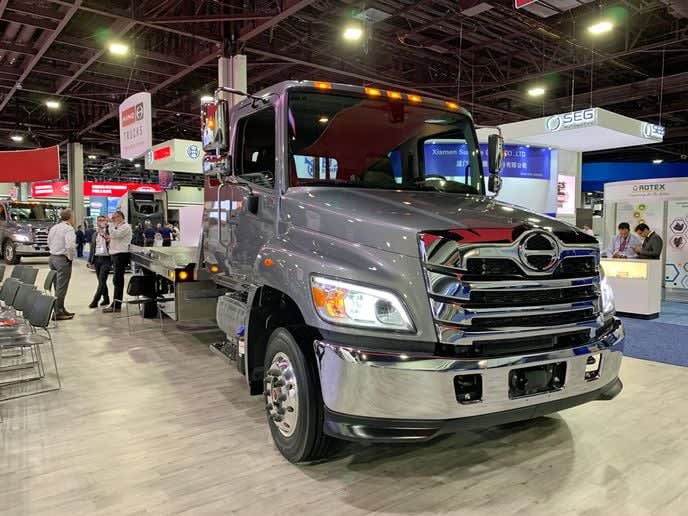
More than $1.6 billion in fines have been levied against Hino Motors for falsifying diesel engine emissions performance data.
Photo: Deborah Lockridge
The U.S. Department of Transportation’s National Highway Traffic Safety Administration has announced a $525 million civil penalty against Hino Motors and its U.S. subsidiaries. In late 2020, Hino paused U.S. truck production due to difficulty meeting U.S. Environmental Protection Agency emissions regulations.
The following year, Hino announced that it would begin using Cummins engines in its heavy truck models because it was unable to meet emissons regulations with its proprietary engines.
The fines resolve claims for falsified data for heavy-duty diesel engines, as well as related civil claims by the United States on behalf of the U.S. Environmental Protection Agency and U.S. Customs and Border Protection.
$1.6 Billion in Total Fines
This settlement is part of a larger resolution of the federal government’s criminal and civil claims, and other claims by California, against the companies.
According to news reports, all told, Hino will pay out $1.6 billion to resolve the emissions fraud scheme.
The Hino judgement is also the largest settlement that NHTSA has ever been involved in.
The settlement was reached after an extensive investigation by NHTSA in coordination with the U.S. Department of Justice, the U.S. Federal Bureau of Investigation, the U.S. DOT Office of Inspector General, the EPA and CBP.
Failure to Comply
Hino failed to comply with NHTSA fuel consumption requirements, the agency said.
The OEM also admitted it submitted false or fraudulent carbon dioxide emissions test data for the model year 2017 and 2018 J05E engines, resulting in false fuel consumption values being submitted for Hino’s heavy-duty engines.
Under the terms of the settlement, Hino admits to submitting false or fraudulent emissions test data, and agrees to file timely, complete and accurate submissions in the future as required by NHTSA’s fuel consumption program.
Hino Motors is majority owned by Toyota Motor Corp. and is headquartered in Hino, Tokyo.
“This settlement is a win for the American people and holds Hino Motors to account for falsifying fuel consumption data. NHTSA takes violations of federal law very seriously,” NHTSA Deputy Administrator Sophie Shulman said. “We would like to thank our federal partners – the U.S. Department of Justice, the Environmental Protection Agency, the U.S. DOT Office of Inspector General and U.S. Customs and Border Protection – for their invaluable work on this important case and for helping us deliver this record settlement.”
More Fuel Smarts

New California Law Could Shed Light on Electric Truck Prices
Why do battery-electric Class 8 trucks remain so expensive? A California bill signed by Gov. Gavin Newsom would give fleets and state agencies more visibility into what manufacturers charge.
Read More →
How Volvo Updated Its D13 for EPA 2027 [Watch]
Volvo’s updated D13 promises lower emissions without sacrificing performance or fuel economy. Take a closer look at what changed inside the engine in this HDT Spotlight video.
Read More →
Diesel Price Spike Shortens Payback for Natural Gas Trucks, Report Says
Energy Vision estimates fleets could recover the higher purchase price of an RNG-fueled Class 8 tractor in 1.3 to 2.8 years under current fuel-price scenarios.
Read More →

Calstart Becomes Catalyst Mobility, Reflecting Broader Focus
Calstart is now Catalyst Mobility, reflecting the nonprofit’s growing national role in clean transportation, including zero-emission trucks, infrastructure and incentive programs.
Read More →
Record Diesel Prices Squeeze Trucking Fleets
Average U.S. diesel prices have climbed to nearly $6 a gallon, surpassing the 2022 record as tight refinery capacity and Middle East disruptions keep fuel costs elevated.
Read More →
How Fuel Delivery Shapes Engine Performance
Fuel delivery depends on more than what happens at the injector. For fleet, maintenance and technical professionals, looking at the full path from pump to injector can provide useful context for understanding engine performance.
Read More →
East Coast Port Launches $45M Electric Truck Push
The Port Authority of New York and New Jersey announced millions in incentives for zero-emission drayage trucks, yard tractors, and new charging hubs near the port.
Read More →
Detroit Opens Orders for EPA 2027 Engines
Detroit isn’t starting from scratch to meet EPA 2027 diesel emissions standards. Its Gen 6 DD13 and DD15 engines keep much of today’s platform while updating the fuel and aftertreatment systems.
Read More →
Zero-Emission Truck Corridor Planned for West Coast
California, Oregon, Washington, British Columbia and Baja California are coordinating plans for truck charging and hydrogen fueling from Canada to Mexico.
Read More →
A Closer Look at Kenworth’s Electric T880E Vocational Truck [Video]
Learn more about Kenworth's T880E battery-electric vocational truck at the Paccar Technical Center, including its range, applications, upfitting considerations, and PTO options, in this HDT Spotlight video.
Read More →