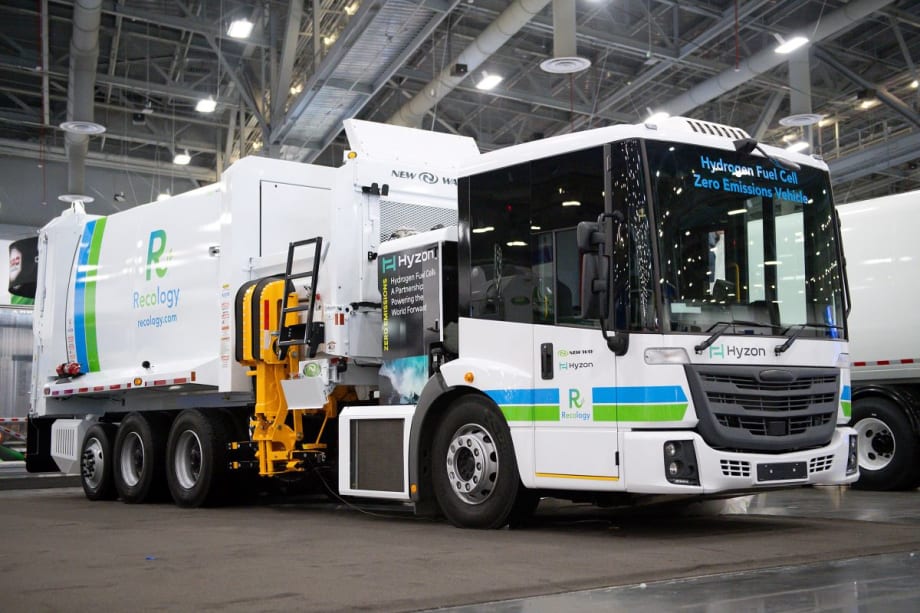
The partnership between fuel cell maker, Hyzon and refuse body builder, New Way, represents an opportunity for CNG-powered refuse fleets to transition to zero-emissions with little effort and no loss of productivity.
Hyzon said its new hydrogen fuel cell refuse truck is capable of 1,200 cart lifts a day and has a range of more than 125 miles.
Photo: Hyzon Motors
6 min to read
Having to substantially alter established operating practices is one of the biggest hurdles to decarbonization. The diminished range, reduced payloads, and decreased utilization commonly associated with batteries would thwart all but the most determined fleets from switching away from tradition energy sources.
Refuse haulers will soon have an alternative to CNG and diesel that could make the zero-emission transition practically seamless: hydrogen fuel cells.
Ad Loading...
Fuel cell maker, Hyzon, and refuse body builder, New Way, inked a joint development agreement in February to build North America's first fuel-cell powered refuse truck.
It was introduced at Waste Expo in May. It's now out doing customer demos. They expect to have production trucks ready by January 2026.
"The intent is to commercialize fuel cell EVs in the refuse the industry," said Tyler White, product manager, New Way trucks, speaking at ACT Expo in May. "It gives us a path to zero emissions that not only has plenty of power, but it's also small and lightweight, and it gives us more payload."
Ad Loading...
Range & Payload Matter
White emphasized the importance of both range and payload to refuse haulers.
"Batteries are very heavy and take away from your payload in most situations," he told the assembled crowd. "The fuel cell gets you back to a chassis weight that's very similar to a CNG unit, or even a diesel ICE unit."
Hyzon/New Way Refuse Truck Specs
Fuel Cell Electric powertrain specs:
Typical driving range: 125 miles (Including 1,200 collecting cycles)
Electric motor power: 240kW (320 hp) continuous, 360kW (482 hp) peak
Electric motor torque: 960lb-ft continuous, 1475 lb-ft peak
High voltage battery energy: 55 kWh
Powertrain voltage: 615 volt
Maximum speed: 55 mph
Fuel cell power: 200 kW
On-board hydrogen: 25 kg
Working pressure cylinders: 350 bar
Refueling time: 15 minutes
Chassis Specs
Chassis: Freightliner EconicSD
GCWR: 64,000 lbs.
Payload: 32,000 lbs.
Wheelbase: 192”, 204”, or 216”
Compactor Body
New Way Trucks’ automated side loader, Sidewinder XTR
smooth arm operation, 12-foot reach, 6-cubic-yard hopper
31 cubic yard capacity
Range-wise, a typical haul (if there is such a thing), swings from 40-50 miles a day in places like the San Fransisco Bay area to 100-150 miles in more spread out locations. The longest portion of a typical trip is to the landfill site or transfer station. That's on-road with minimal opportunity for regenerative braking. A collection route is all stop-and-go, so regen opportunities abound.
"Regenerative braking adds to the efficiency of the fuel cell and really helps in the refuse industry," White said. "The range that these things offer pretty much aligns perfectly with the refuse industry's needs because you're not going on a long haul."
Bruce Kurtt, Hyzon's senior vice president, commercial, for North America, told HDT the fuel storage capacity on the pre-production truck offers all the range refuse haulers need.
Ad Loading...
"We have enough "fuel" on board to do 100-125 miles as well as 1,200 can lifts," he said. "And the thing is, we're 4,000 to 5,000 pounds lighter than a battery truck. We go substantially further, and it takes just a few minutes refill the tanks."
Almost Plug 'N Play
The elegance of this solution lies in the similarity of a CNG drivetrain compared to that of a fuel cell drivetrain. The chassis is an off the shelf Freightliner EconicSD, minus the engine, transmission and driveshaft. The drive axles are stock.
Freightliner is not directly involved in this H2 conversion.
"Up front, where the CNG or diesel ICE formerly resided, sits the fuel cell. The distribution block that manages the electricity is right behind that. The electric motor and four-speed transmission sit between the frame rails in roughly the same place the transmission would be today," said Kurtt
Ad Loading...
The whole system consists of 10 modules, designed in-house by Hyzon. They are installed by the mod shop.
"From the brand perspective, whoever's chassis we're integrated into, we use their drive shaft, their axles, their brakes, their suspension," Kurtt explained. "That engineering is already done. And in the cab, all the driver controls are exactly the same as they are used to."
On top of that, the refuse industry, being long-time consumers of CNG, are familiar with pressure vessels. The H2 storage tanks in this truck mount in the same place the CNG tanks are today. Kurtt said the tanks even have the same part number, although they're filled to 5,000 psi rather than 3,600-3,800 psi common with CNG. Current tanks can story 25 kg (55 lbs.) of hydrogen at 350 bar (5,000 psi).
Fuel Cell & Batteries
The heart of the system is a 200-kW single-stack fuel cell, designed by Hyzon. Kurtt says 200 kilowatts is, "kind of overkill for this refuse space," but the application allows the fuel cell to run at about 50-70% of its output capacity.
"That's it's sweet spot," he said. "It's like a diesel engine; just because it'll turn 1,800 rpm you don't want to run there. It's more efficient at 1,300 or something. Fuel cells are like that. They don't like to idle either."
Ad Loading...
On a collection route, for example, when the truck is lurching from can to can, the truck would likely be running on batteries alone, capturing the benefit of all the regen braking. The fuel cell would likely be shut off. It would restart to bring the batteries up to charge if necessary.
The batteries used on this truck are designed specifically to react to very quickly to charge and discharge cycles. Kurtt called them "3 C batteries."
"It is a function of the battery chemistry. It is a measurement of the charge and discharge rate. It can be different between charge and discharge. There is also continuous and Peak," he explained. "Our batteries charge at 2 C continuous, 3 C peak. We discharge at 3 C continuous and 5 C peak."
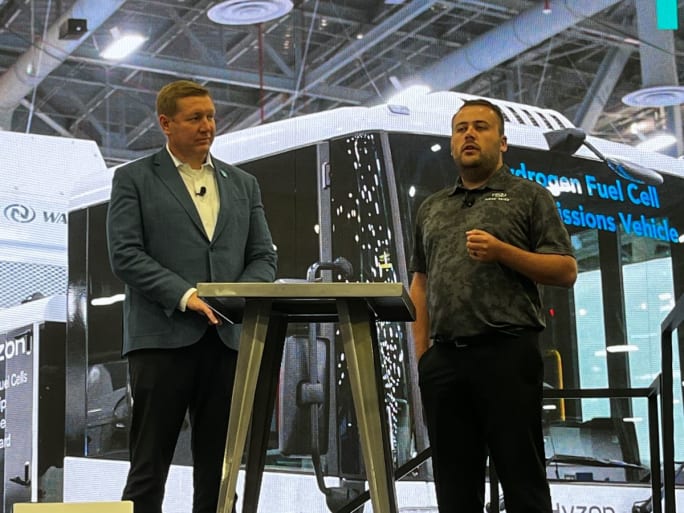
Steven Boyer, (left) vice president, commercial at Hyzon, and Tyler White (right), product manager, New Way trucks, speaking at ACT Expo in May.
Photo: Jim Park
The fuel cell also powers compactor components. That remains hydraulic, but rather than a conventional PTO mounted on the transmission, cables run from the main power distribution block to an appropriately sized electric motor that drives the hydraulic pump for the body.
Hyzon to Focus on Core North American Markets
On July 8, Hyzon announced that after considering its options and completing an assessment of challenging market conditions across Europe and Australia, the Company will halt its operations in the Netherlands and Australia.
Hyzon said the government support for fuel cell-powered transportation in Europe and Australia has waned, including the disbandment in many European countries of hydrogen subsidies. Hyzon currently intends to maintain the potential to return to the European and Australian markets as a fuel cell system supplier to OEMs.
DIY H2
Refuse haulers have been making their own fuel for years, tapping into the landfill gas for a quick fill up. Apparently, that is still possible with hydrogen.
Landfills and many other sources such as manure ponds produce thousands of cubic feet of highly potent methane gas, which can be converted to hydrogen with small-scale steam methane reformation.
Any refuse fleet currently running on CNG could quite easily convert to hydrogen. Most of the refilling infrastructure is already in place. There's just the interim step of converting the biomethane to hydrogen, cleaning it up a bit and then pumping into the trucks.
"Something like 76% of the globe's hydrogen comes from SMR," said Kurtt. "You can do SMR in a small machine that's making 400 gallons, 400 kg, a day. That's enough to run 10-15 trucks. It's a lot easier than one might think."
Companies like OneH2 and HyGear specialize in scalable hydrogen production from methane sources such as landfill gas. Depending on the capacity, the plants can be as small as a 20-foot marine container.
And there's one final benefit to consider with homegrown hydrogen. It has a negative carbon intensity.
Ad Loading...
Because you're harvesting methane, which is a greenhouse gas about 20 times more potent than CO2, the carbon intensity can be as low as -300. Compare that to Calstart's estimate of Southern California electric grid. It has a CI score of about 80, which pushes the electrolysis CI score up as well.
Suddenly, hydrogen produced from landfill gas looks pretty damn attractive.
"When we get good at grabbing this biogas and making it into hydrogen, at a location that we need to use the hydrogen so we don't have to haul it, that will be the winning ticket," said Kurtt.
During the presentation at ACT Expo, Boyer said Hyzon has had a refuse truck running in Australia for about the last six months.
"That truck has shown great range and great opportunity," he said. "We've been able to do 1,200 cans or more in a day, and over 100 miles of range as well. It has shown the operational characteristics that we expect from a refuse truck."
Ad Loading...
This fuel cell technology represents an opportunity for current CNG fleets to transition to zero-emissions with little effort and no loss of productivity. The trucks will run the same routes and carry the same weight they're the current fleet does. And from a fuel standpoint, they can still take landfill gas and create their own fuel to keep operating costs down.
Operating-cost savings have overtaken sustainability goals as the leading reason surveyed fleets are adopting battery-electric terminal tractors, according to new NACFE research.
The new card combines fuel discounts with telematics-based purchase controls. Geotab’s analysis also points to potential savings from choosing lower-priced fuel stops.
ACT Research expects costs, charging infrastructure, and technology improvements to drive zero-emission commercial vehicle adoption as federal regulations and incentives retreat.
Why do battery-electric Class 8 trucks remain so expensive? A California bill signed by Gov. Gavin Newsom would give fleets and state agencies more visibility into what manufacturers charge.
Volvo’s updated D13 promises lower emissions without sacrificing performance or fuel economy. Take a closer look at what changed inside the engine in this HDT Spotlight video.
Energy Vision estimates fleets could recover the higher purchase price of an RNG-fueled Class 8 tractor in 1.3 to 2.8 years under current fuel-price scenarios.
Calstart is now Catalyst Mobility, reflecting the nonprofit’s growing national role in clean transportation, including zero-emission trucks, infrastructure and incentive programs.
Average U.S. diesel prices have climbed to nearly $6 a gallon, surpassing the 2022 record as tight refinery capacity and Middle East disruptions keep fuel costs elevated.
The Port Authority of New York and New Jersey announced millions in incentives for zero-emission drayage trucks, yard tractors, and new charging hubs near the port.