





What do Inflation and Interest Rate Numbers Tell Us About Trucking Now?
DAT Truckload Volume Index: Volume Falls in July
Truckload freight volumes fell last month and national benchmark spot rates for dry van and refrigerated loads retreated from their gains in June, reported DAT Freight & Analytics.
August 21, 2023
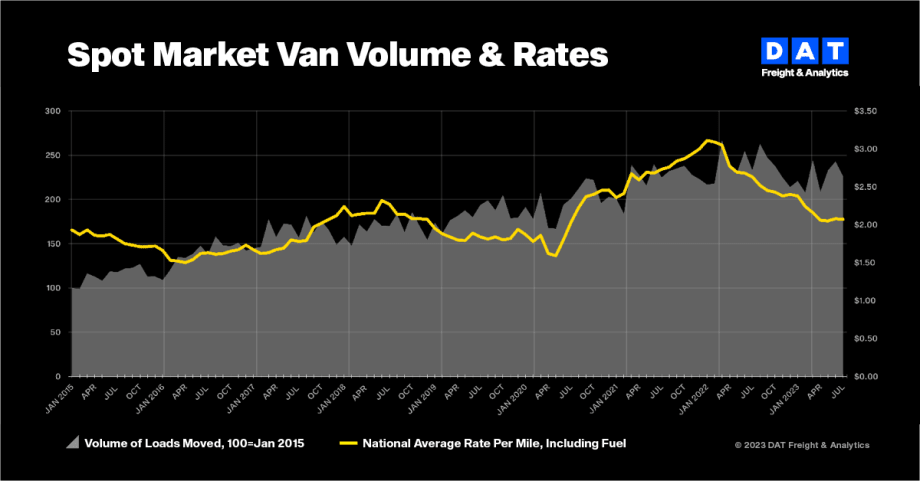
The spot van rate was $2.07 per mile, down 1 cent compared to June and 56 cents lower than in July 2022.
Source: DAT Analytics
3 min to read
Truckload freight volumes fell last month and national benchmark spot rates for dry van and refrigerated loads retreated from their gains in June, reported DAT Freight & Analytics.
The DAT Truckload Volume Index (TVI), a measure of loads moved during a given month, was lower in July for all three equipment types:
Van TVI was 226, down 7.0% from June and 3.0% lower year over year.
Reefer TVI slipped to 169, 3.4% lower than in June but 1.2% higher year over year.
Flatbed TVI was 238, 12.8% lower compared to June but 3.5% higher year over year.
“Shippers faced service disruptions at the ports and in the less-than-truckload sector but were able to secure van capacity without causing the needle to move on spot rates and volumes,” said Ken Adamo, chief of analytics.
Despite month-over-month declines, the reefer and flatbed TVI numbers were the highest on record for July as fresh and frozen food, metals, machinery, construction materials and other seasonal freight moved through supply chains.
Demand for Trucks Slowed
National average load-to-truck ratios for van and reefer freight have been virtually unchanged for three straight months:
The van ratio was 2.6, equal to June and down from 3.8 in July 2022.
The reefer ratio was 3.8 - unchanged from June and down from 7.2 a year earlier.
The flatbed ratio was 7.1, down from 9.7 in June and significantly down from 21.8 in July 2022.
Spot, Contract Rates Dipped
Reflecting flat demand, DAT’s benchmark spot rates slipped in July:
The spot van rate was $2.07 per mile, down 1 cent compared to June and 56 cents lower than in July 2022.
The spot reefer rate dipped 3 cents to $2.44 per mile and 60 cents lower year-over-year.
The spot flatbed rate was $2.54 a mile, down 7 cents month over month and 72 cents lower year-over-year.
Line-Haul Rates Declined
Line-haul rates, which subtract an amount equal to a fuel surcharge, declined as well. DAT’s benchmark van line-haul rate was $1.63 per mile, down 2 cents compared to June.
The reefer line-haul rate fell 5 cents to $1.96 per mile and the flatbed line-haul rate dropped 9 cents to $2.01 per mile.
The average fuel surcharge increased by 2 cents to an average of 44 cents a mile for van freight, 48 cents for reefers and 53 cents for flatbeds in July.
“Spot rates, as a reminder, are ‘all-in’ rates, meaning no separate fuel surcharge to help mitigate the risk of fuel price fluctuations. You have to negotiate each individual load with fuel and operating costs in mind, which is not always easy,” Adamo said. “The sudden increase in fuel prices is testing the wherewithal of small carriers at a time when freight volumes are in a seasonal lull.”
DAT’s benchmark rates for contracted freight strengthened compared to pricing on the spot market. The van rate fell 1 cent to $2.57 a mile, the reefer rate gained 3 cents to $2.91 a mile and the flatbed rate rose 5 cents to $3.29 a mile.
Contract/Spot Spread
After closing for three straight months, the spread between contract and spot rates was unchanged for van freight and increased by 6 cents for reefers and 12 cents for flatbed loads. The size of the gap is an indicator of bargaining power among shippers, brokers, and carriers, Adamo explained.
More Fleet Management
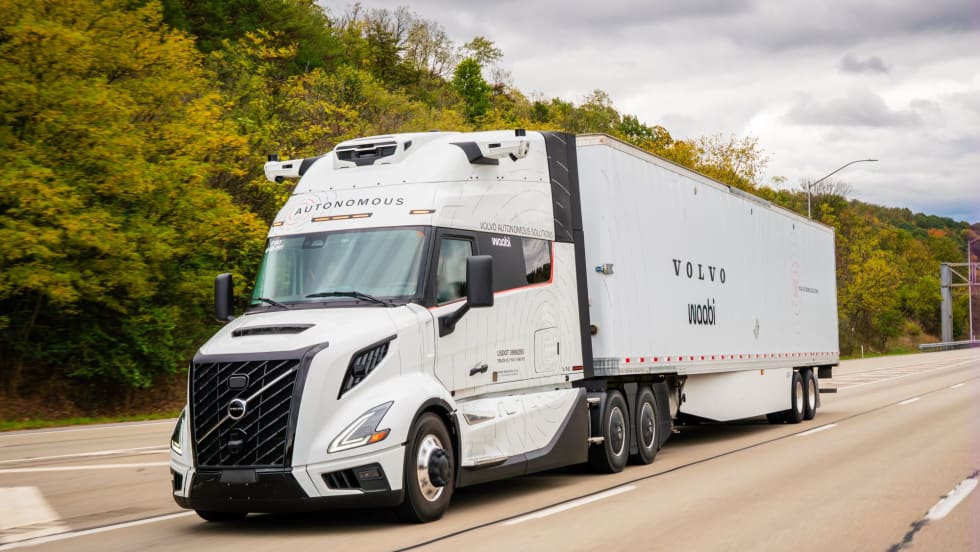
Volvo, Waabi Start Commercial Autonomous Operations in Texas
Volvo VNL Autonomous trucks, powered by the Waabi Driver, are hauling freight directly to third-party facilities for a customer in Texas.
Read More →
Samsara Launches Custom AI Agent Builder
Agent Studio lets fleets create AI tools for hours-of-service monitoring, reporting and driver support, including agents that communicate by phone.
Read More →
Geotab Links Fleet Card to Vehicle Data
The new card combines fuel discounts with telematics-based purchase controls. Geotab’s analysis also points to potential savings from choosing lower-priced fuel stops.
Read More →

How MFA Helps Protect Trucking Fleets
Multi-factor authentication adds protection when passwords are stolen. Here’s how it works and where fleets should start.
Read More →
How Better Freight Data Helps Trucking Teams Get Ahead of Disruption
Trucking and logistics teams have plenty of data. The problem is getting the right information in front of the right people soon enough to act. Better-connected data can help teams spot trouble earlier and make smarter decisions before small problems become big ones.
Read More →
Trimble: Taking Artificial Intelligence in Trucking Beyond Faster Tasks
At Insight 2026, Trimble executives argued that fleets may need to redesign workflows to get more from AI as it introduced new products and enhancements. AI’s value will depend on how fleets combine automation with their people's knowledge.
Read More →
Sponsored•September 28, 2026
Build a bulletproof fleet: Uniting ELDs and dash cams for total compliance
An ELD can prove compliance, but it cannot always prove what happened on the road. Discover how uniting accurate ELD data with AI-powered dash cam video can help your fleet strengthen compliance, defend against liability, protect drivers and reduce operational costs.
Read More →
Nominations Open for HDT Emerging Leaders
Heavy Duty Trucking is looking for accomplished trucking fleet professionals under 40 who are making an impact and helping lead the industry forward.
Read More →
Why Private Fleets Are Taking More Freight
Private fleets are putting their own trucks on demanding customers and high-cost lanes as companies seek greater control over service, costs, and capacity.
Read More →
Sponsored•September 16, 2026
Color Match Smarter: Tools That Restore & Perform
For fleet managers and collision repair professionals keeping heavy-duty trucks on the road, getting the color right the first time isn't just about appearance — it's about efficiency, turnaround time, and bottom-line results. Discover how today's digital color tools are transforming the repair process from guesswork to precision.
Read More →