





2024 Update:Driver Monitoring Tech Won’t Prevent Crashes Without Fleet Oversight
NTSB Probes Deadly Bus Collision with Trucks Parked on Ramp
The National Transportation Safety Board is investigating what happened last week when a bus crashed into three tractor-trailers parked along an exit ramp leading into an Illinois rest area.
July 17, 2023
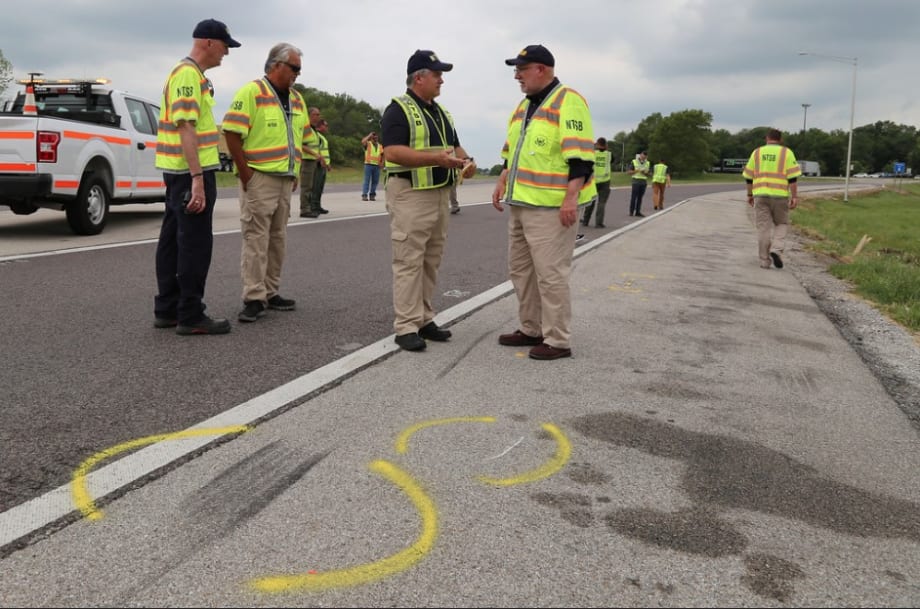
NTSB investigators study the ramp into an Illinois rest area following the deadly crash.
Photo: NTSB
3 min to read
The National Transportation Safety Board is investigating what happened last week when a passenger bus struck three tractor-trailers parked along an exit ramp leading into a rest area near Highland, Illinois. Three bus passengers died, and others sustained serious injuries.
Part of NTSB’s investigation will look at why the trucks were parked along the entrance ramp rather than in the rest area.
Finding available truck parking is often a challenge for drivers. The 2019 Jason’s Law Report from the Department of Transportation found that 98% of drivers regularly experience problems finding safe parking.
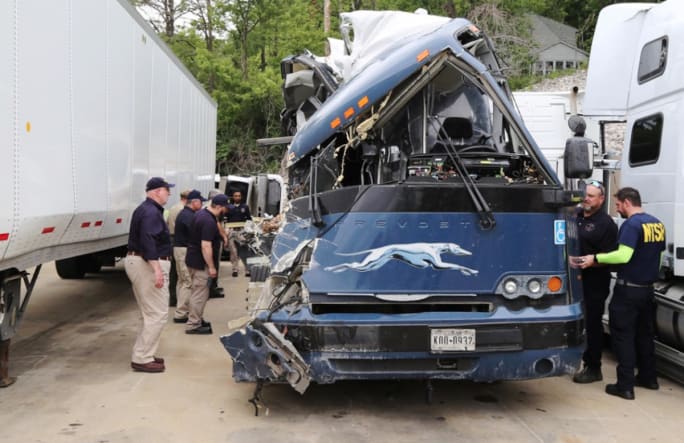
Investigators look at the Greyhound bus that struck three parked trucks.
Photo: NTSB
Tom Chapman, an NTSB board member, explained that his organization is running a safety investigation in parallel with the law enforcement investigation by the Indianola State Police. The Federal Motor Carrier Safety Administration also dispatched investigators to the crash site.
Chapman said the final NTSB report will be made available within 12 to 24 months.
The bus, a 2014 Prevost motorcoach, was traveling Interstate 70 from Indianapolis, Indiana, to St. Louis, Missouri, carrying 22 passengers. Around 2 a.m. July 12, it struck the trucks.
“With regard to this tragedy, we are particularly interested in issues relating to rest area safety, bus occupant protection, potential driver fatigue, and medical fitness,” Chapman said during a media briefing.
Truck Parking Shortage
Responding to a press conference question about whether the trucks should have been parked along the ramp into the rest area, Chapman pointed out that is a matter of state law, and it may vary from state to state.
“That's something we're still seeking to determine. We'll look at that very closely. We'll look at the circumstances under which those vehicles were located where they were. And again, if recommendations are appropriate, we will certainly make them,” he explained.
Another reporter asked Chapman if the NTSB has any advocacy stance on there not being enough truck parking available and how that makes it hard for drivers to stop and rest.
“It's absolutely an issue. We do have a history in terms of rest area safety," responded Chapman. “We're actually investigating an accident involving somewhat similar circumstances involving parked trucks, that occurred in Oregon, within the last two years.
"The reason that we are focusing on this particular crash relates in part to those very issues that you raise. It's certainly one of the things that we will be looking at closely. And again, if recommendations are appropriate, we won't hesitate to make them.”
Elaborating more, he said NTSB investigators will be looking at the location and proximity of the parked trucks plus the width and the length of the ramp.
Reviewing In-Cab Cameras
Chapman said the bus contained both forward-facing and inward-facing cameras and said the data will be downloaded.
“Assuming it can be recovered and will be shared with us, we have a team of experts who specialize in analyzing and collecting that sort of data,” he added.
Safety Recommendations
Even though the full investigation is expected to take 12 to 24 months, safety recommendations if needed could come sooner.
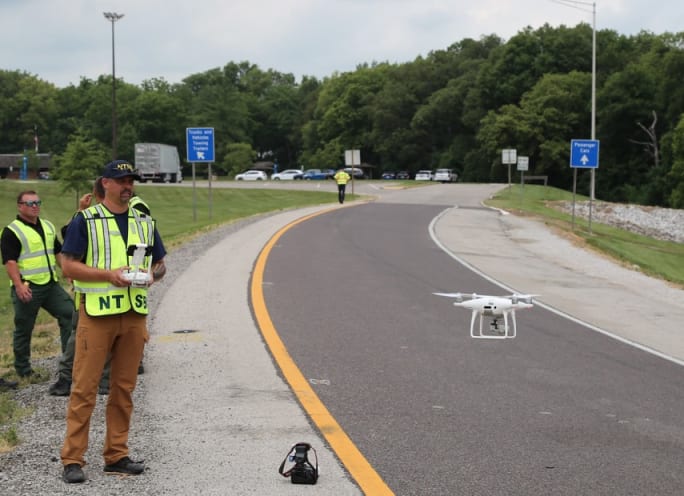
A drone operator launches a drone to survey the fatal crash section of the ramp.
Photo: NTSB
“If we find in the course of our investigation in the early stages, for example, that it's appropriate to make recommendations before the investigation is completed, we have that ability, that authority, and we do that," Chapman said.
"We will make emergency recommendations when it's appropriate to do so when during the fact-finding effort that some condition occurred that needs to be addressed more quickly than it would be if the final results of our investigation held it up."
More Safety & Compliance

FMCSA Pauses Biennial-Update Enforcement Amid Motus Transition
Carriers whose updates were due on or after June 1 have more time, while FMCSA works to stabilize its new registration system and warns of phishing sites impersonating its new carrier registration system, Motus.
Read More →
ZF Expands Commercial Vehicle Push in North America
ZF is expanding its North American commercial-vehicle presence with new transmission applications, electrification, trailer technology and autonomous-driving systems.
Read More →
Truck Drivers Need More Than Another Alert
Fleets have more visibility into truck health, safety events, and driver activity than ever. The next challenge is turning all that information into useful guidance for the person who has to decide what to do next.
Read More →
Tesla Wants a Self-Driving Semi. Are Cameras Enough?
Could Tesla’s camera-only autonomous driving technology work on an 80,000-pound Semi? In this commentary, HDT's Deborah Lockridge takes a look at Tesla, Cybercab, and how autonomous trucks see the road.
Read More →
What DOT’s Automated Vehicle Strategy Means for Trucking
The U.S. Department of Transportation issued a new automated-vehicle strategy that outlines plans for driverless-truck regulations, cross-state freight corridors, and federal safety standards.
Read More →
NYC Expands Speed, Pedestrian Safety Tech Across Fleet
New York City is expanding intelligent speed assistance and pedestrian-alert systems across its municipal fleet, moving the technologies from pilot programs into vehicle procurement and retrofit requirements.
Read More →
FMCSA Removes 110 Truck Driver Training Schools from Certified ELDT List
Federal regulators also are targeting more than 160 additional training providers and launching a nationwide audit of third-party CDL skills testers as part of a broader crackdown on trucking fraud.
Read More →
Beyond DOT Compliance: What Makes a Trucking Fleet Truly Safe?
A trucking fleet can follow every rule and still make unsafe decisions. The real test comes when safety conflicts with freight, productivity, or cost.
Read More →
Hours of Service Pilot Programs: FMCSA Readies for 2027 Rollout
Two pilot programs could eventually reshape hours-of-service rules, giving truck drivers options to pause their 14-hour clock or use longer split sleeper rest periods.
Read More →
New Guide Offers Pet Safety Tips for Truck Drivers
Hundreds of thousands of pets travel in truck cabs. A new safety guide from Volvo Trucks and the Center for Pet Safety offers practical advice for truck drivers who bring dogs and cats along for the ride.
Read More →