




Volvo Unveils Electric Heavy-Haul Tractor in Europe
Volvo has taken the wraps off a heavy-haul FH Electric truck with a gross combination weight of 163,142 lbs.

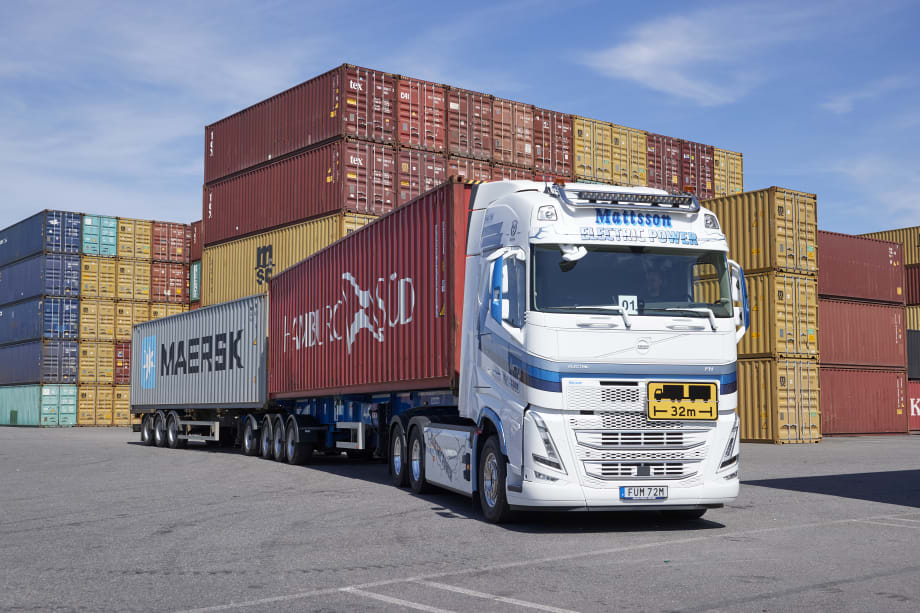
Volvo FH Electric tractors are currently participating in High-Capacity Transport tests in Europe to determine if longer trucks with heavier payloads can efficiently carry more gross weight per trip.
Photo: Volvo Trucks
Volvo Trucks has delivered an electric truck for heavy transport to a fleet in Gothenburg, Sweden. The truck, a Volvo FH Electric Class 8 cabover tractor, can handle a total weight of 74 tons, or 163,142 lbs.
The OEM said that more and more heavy-haul fleets in Europe are starting to spec electric trucks for heavy transportation applications. The fleet taking ownership of the new FH Electric is Mattsson Åkeri, which has already purchased two other heavy electric Volvo FH trucks.
For the past few weeks, according to Volvo, testing has been going on with one of the electric trucks in container traffic applications in the port area of Arendal in Gothenburg. The test is a so-called High-Capacity Transport project. The test truck is pulling two trailers with a total overall length of 104 ft.
“We want to show that all-electric solutions also work in applications with high total weights and a high utilization rate,” said Lena Larsson, project manager of the HCT project within Volvo's technology organization. “Together with Mattsson Åkeri, the Swedish Transport Administration and several other partners, we are now looking at how we can optimize the operation of the electric truck, including how charging should take place in the most efficient way.”
The electric truck being tested is a Volvo FH Electric 6X4. It is charged with green electricity at two fast 180 kW chargers that Mattsson Åkeri has installed in the company's depot in Arendal. Eventually, the truck will also run between Gothenburg and the city of Borås, 43 miles from Gothenburg.
In Operation 12 Hours a Day
“Driving long and heavy loads using electricity works very well so far, and we can carry as much cargo as a diesel truck,” says Jan-Olof Mattsson, CEO of Mattsson Åkeri. “The truck runs 12 hours a day, with a stop for charging when the driver takes a break. We charge with green electricity and thus get no CO2 emissions. Silent, electric operation also means a better working environment for the driver.”
Since Volvo Trucks started production of all-electric trucks in 2019, the company has sold nearly 5,000 electric trucks in 40 countries around the world. Volvo globally offers six electric models in series production that meet a broad range of needs for transport in and between cities. Globally, Volvo Trucks has a goal that half of all Volvo trucks sold are electric by 2030.
High-Capacity Transport Testing
The High-Capacity Transport concept allows for longer trucks and trailers that can carry more gross weight during transit. The idea is that this configuration allows for a larger load to be transported per vehicle/per trip. According to Volvo, HCT can be applied on all types of drivelines. The idea is that HCT will contribute to lower transport costs, reduced environmental impact, higher traffic safety, reduced road wear and lower maintenance costs.
Volvo notes that currently in Europe there are several ongoing, and planned, HCT projects. One example is in Finland, where trucks are being permitted to drive with 167,551 lbs. of total weight hauled by a 113-foot-long tractor-trailer combination on most roads. Another HCT project cited by Volvo is also in Sweden. In this test, the truck has been specially permitted to haul 220,463 lbs. on a 113-foot-long tractor-trailer combination.
More Fuel Smarts

How Volvo Updated Its D13 for EPA 2027 [Watch]
Volvo’s updated D13 promises lower emissions without sacrificing performance or fuel economy. Take a closer look at what changed inside the engine in this HDT Spotlight video.
Read More →
Diesel Price Spike Shortens Payback for Natural Gas Trucks, Report Says
Energy Vision estimates fleets could recover the higher purchase price of an RNG-fueled Class 8 tractor in 1.3 to 2.8 years under current fuel-price scenarios.
Read More →
Calstart Becomes Catalyst Mobility, Reflecting Broader Focus
Calstart is now Catalyst Mobility, reflecting the nonprofit’s growing national role in clean transportation, including zero-emission trucks, infrastructure and incentive programs.
Read More →

Record Diesel Prices Squeeze Trucking Fleets
Average U.S. diesel prices have climbed to nearly $6 a gallon, surpassing the 2022 record as tight refinery capacity and Middle East disruptions keep fuel costs elevated.
Read More →
How Fuel Delivery Shapes Engine Performance
Fuel delivery depends on more than what happens at the injector. For fleet, maintenance and technical professionals, looking at the full path from pump to injector can provide useful context for understanding engine performance.
Read More →
East Coast Port Launches $45M Electric Truck Push
The Port Authority of New York and New Jersey announced millions in incentives for zero-emission drayage trucks, yard tractors, and new charging hubs near the port.
Read More →
California Bill Could Shed Light on Electric Truck Prices
Why do battery-electric Class 8 trucks remain so expensive? A California bill headed to Gov. Gavin Newsom would give fleets and state agencies more visibility into what manufacturers charge.
Read More →
Detroit Opens Orders for EPA 2027 Engines
Detroit isn’t starting from scratch to meet EPA 2027 diesel emissions standards. Its Gen 6 DD13 and DD15 engines keep much of today’s platform while updating the fuel and aftertreatment systems.
Read More →
Zero-Emission Truck Corridor Planned for West Coast
California, Oregon, Washington, British Columbia and Baja California are coordinating plans for truck charging and hydrogen fueling from Canada to Mexico.
Read More →
A Closer Look at Kenworth’s Electric T880E Vocational Truck [Video]
Learn more about Kenworth's T880E battery-electric vocational truck at the Paccar Technical Center, including its range, applications, upfitting considerations, and PTO options, in this HDT Spotlight video.
Read More →