




Canada-U.S.-Mexico Intermodal Market Heats Up
Even as the new CPKC combined railway announced another major customer, three railroads announced they have teamed up to create a competing Mexico-U.S.-Canada rail service.

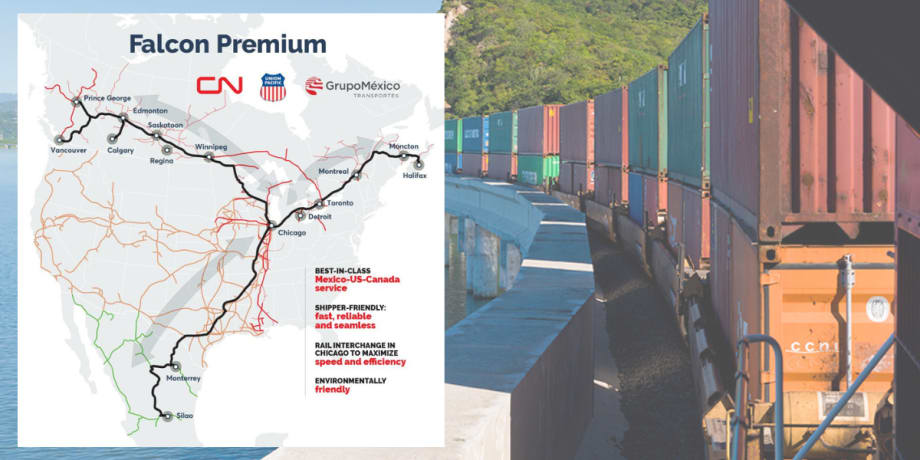
The three railoads say the new Falcon intermodal service “will be the fastest, most reliable intermodal rail service between Canada and Mexico."
Photos: UP, GMXT
Even as the new CPKC combined railway announced another major customer, three railroads announced they have teamed up to create a competing Mexico-U.S.-Canada rail service.
Earlier this month, Canadian Pacific and Kansas City Southern combined to create Canadian Pacific Kansas City Railroad, creating the first single-line railway connecting Canada, the U.S., and Mexico. CPKC is predicting its new intermodal services will shift some 64,000 truck shipments from highway to rail, although not everyone’s on board with that prediction.
It soon announced its first major intermodal customer, Schneider National. The trucking giant, furthering its plans to double its intermodal size by 2030, announced it will offer “truck-competitive” intermodal service on the newly merged Canadian Pacific Kansas City railroad between the upper Midwest and Mexico.
That was followed by an announcement between CPKC and Knight-Swift Transportation Holdings for Knight-Swift to provide truckload intermodal transportation service on CPKC's new single-line north-south corridor connecting Mexico, the United States and Canada. Knight-Swift's established Mexico customer base will be able to leverage CPKC's broad network of rail lines, terminals, and cross-border efficiency and expertise to improve service reliability and competitiveness, according to the announcement.
Competing Rail and Intermodal Service
Not to be outdone, on April 24, three other rail companies — CN (Canadian National Railway Company), Union Pacific Railroad, and GMXT (GrupoMexico Transportes) — announced Falcon Premium intermodal service, “a best-in-class Mexico-U.S.-Canada service with a seamless rail connection in Chicago, Illinois.”
It will directly connect all CN origin points within Canada and Detroit to GMXT terminals in Mexico. This service will benefit intermodal customers shipping automotive parts, food, FAK (freight all kinds), home appliances, and temperature-controlled products, according to the companies.
The announcement claims that Falcon Premium service “will be the fastest, most reliable intermodal rail service between Canada and Mexico by combining the unique benefits of each partner. The seamless service will leverage GMXT’s best-in-class transit times between Silao, Guanajuato, and Eagle Pass, Texas; Union Pacific’s superior route from Texas to Chicago and CN’s best-in-class service connecting Chicago to all points in Canada through the unique EJ&E Chicago bypass.”
The new service allows the maximization of lading weights between Mexico/Canada for greater efficiency for customers. Falcon Premium intermodal service will also contribute to lower greenhouse gas emissions through reduced rail miles and significant truck-to-rail conversion.
“The Falcon Premium service is tailor-made with the objective of providing new solutions to customers catering to the requirements of nearshoring demands,” said Fernando Lopez, GMXT CEO.
More Fleet Management

Color Match Smarter: Tools That Restore & Perform
For fleet managers and collision repair professionals keeping heavy-duty trucks on the road, getting the color right the first time isn't just about appearance — it's about efficiency, turnaround time, and bottom-line results. Discover how today's digital color tools are transforming the repair process from guesswork to precision.
Read More →
FMCSA Pauses Biennial-Update Enforcement Amid Motus Transition
Carriers whose updates were due on or after June 1 have more time, while FMCSA works to stabilize its new registration system and warns of phishing sites impersonating its new carrier registration system, Motus.
Read More →
2026 Blueprint for Countering Smarter Supply Chain Theft
Cargo theft is no longer just the cost of doing business. It's a multi-billion-dollar criminal enterprise exploiting vulnerabilities across your fleet, drivers, and supply chain.
Read More →


How Telematics Improves Visibility, Control, and Performance in Refrigerated Fleets
Explore how telematics help refrigerated fleets improve visibility, uptime, efficiency, compliance, and cargo protection across connected cold chain operations.
Read More →
What the U.S.-Canada Trade War Means for Trucking
Escalating U.S.-Canada tariffs could disrupt cross-border freight, reduce truck volumes, raise costs, and create new uncertainty for carriers on both sides of the border.
Read More →
What Are Trucking’s Top Concerns for 2026?
The American Transportation Research Institute wants to know what's worrying trucking fleet managers, drivers, and other stakeholders in its annual Industry Issues survey.
Read More →
American Trucking Associations Looks for a New Leader
ATA President and CEO Chris Spear abruptly left his job at the association on August 21, at a pivotal time for the trucking industry.
Read More →
Public Wi-Fi Cybersecurity Risks: How Truck Drivers and Fleets Can Protect Their Data
Public Wi-Fi can expose truck drivers and fleets to credential theft, malware, and other cyber threats. Here’s how to reduce the risk on the road.
Read More →
For Nicky Cupp, Fleet Innovation Starts With Frustration
HDT Truck Fleet Innovator Nicky Cupp turns everyday pain points at Fraley & Schilling into opportunities for better technology and smarter processes.
Read More →
Adam Buttgenbach’s Approach to Electric Trucks: Start With Where They Fit
HDT Truck Fleet Innovator Adam Buttgenbach helped PepsiCo build one of North America’s largest EV fleets by focusing on where electric trucks make operational sense.
Read More →