




TuSimple, Navistar End Autonomous Truck Partnership
TuSimple and Navistar have announced an end to their nearly two-and-a-half-year partnership intended to co-develop autonomous semi-trucks for production by 2024.

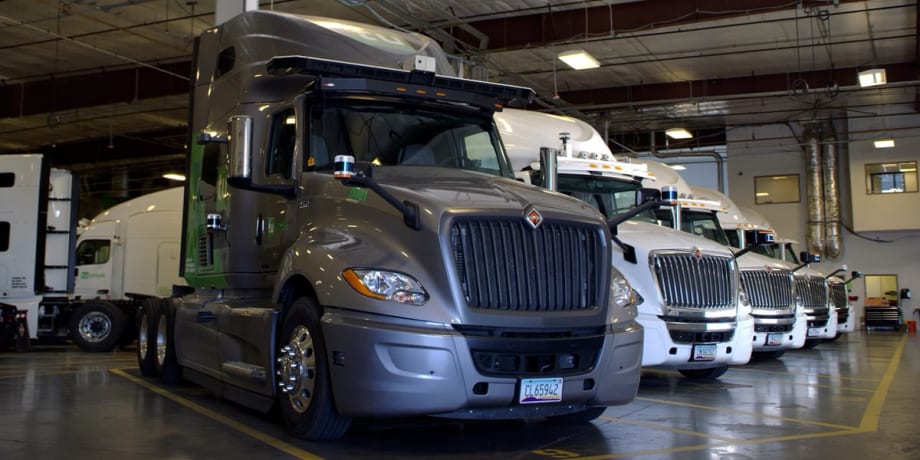
Both Navistar and TuSimple officials said they remain committed to the development of autonomous trucks.
Photo: TuSimple
In a joint announcement, TuSimple and Navistar have announced an end to their nearly two-and-a-half-year partnership intended to co-develop SAE Level 4 autonomous semi-trucks for production by 2024.
The decision to end the development agreement does not preclude the companies from working together in the future, the companies said in the statement.
Both Navistar and TuSimple officials said they remain committed to the development of autonomous trucks.
"Navistar believes autonomous driving technologies will be a key component of a future transportation and logistics system and is committed to the development of a safe and efficient autonomous driving solution," said Navistar Vice President Srinivas Gowda.
Look Back on TuSimple and Navistar’s Autonomous Truck Development Partnership
2020: The Start
At the start of the partnership agreement is July 2020, TuSimple was the first technology company to partner with an OEM to manufacture trucks under a clear timeline.
Later that year, Traton Group followed suit. Traton and TuSimple launched a development program to operate an autonomous hub-to-hub route in Sweden, and said the autonomous systems would be used in Traton brand trucks (MAN, Scania and Volkswagen Caminhões e Ônibus.)
2021: Reservations Come In
Among the first customers to place reservations for the TuSimple autonomous truck were: Penske Truck Leasing, Schneider and U.S. Xpress.
By May 10, TuSimple had received 6,775 reservations for the new line of SAE Level 4 International LT Series autonomous trucks. The trucks were to be equipped with TuSimple's advanced autonomous driving system and manufactured by Navistar beginning in 2024.
2022: In the Conversation
As recently as May of this year, at ACT Expo, Navistar CEO Mathias Carlbaum was talking about the TuSimple partnership.
"When it comes to autonomous technology, the U.S. is clearly the world leader in developing this technology. Scania is working with TuSimple in Europe. And Navistar will work with them here in the U.S. So we will have a common approach, and shared resources based on what is happening in Europe." — Carlbaum, May 2022
When talking to HDT’s Deborah Lockridge in October, TuSimple officials said production had been pushed from 2024 to late 2025 or even 2026.
On Oct. 30, Xiaodi Hou, TuSimple’s then CEO, president and chief technology officer, was fired. The Wall Street Journal reported the company faces federal investigations into whether it improperly financed and transferred technology to a Chinese startup. By November, TuSimple brought back Cheng Lu as CEO.
"I decided to return as TuSimple's CEO to address the challenges ahead and to set us on a path to long term stability,” Lu said in the Dec. 5 joint statement. “We have proven our technology works, and I'm committed to addressing the concerns of stakeholders. I firmly believe in this company and its ability to improve the safety and efficiency of the trucking industry through world-class autonomous driving technology.”
Also in October, Göran Nyberg, executive vice president, commercial operations, hinted that there might be a change when asked about the TuSimple project in an interview with HDT at theAmerican Trucking Associations' Management Conference and Exhibition.
“We have had a good partnership with TuSimple, but it’s not an exclusive, and we are working on autonomous solutions in the group. I would say overall we are quite well prepared in the journey toward autonomous vehicles. We are running extensive testing in Europe as well as in America. That’s the benefit of scale.” — Nyberg, November 2022.
See photos of the autonomous trucks on display at ATA's MC&E.
More Equipment

How Volvo Updated Its D13 for EPA 2027 [Watch]
Volvo’s updated D13 promises lower emissions without sacrificing performance or fuel economy. Take a closer look at what changed inside the engine in this HDT Spotlight video.
Read More →
Michelin Tire Improves Efficiency and Durability for Regional Fleets
The Michelin X Multi Energy D2 is a regional haul drive tire engineered to help fleets improve fuel efficiency, durability and traction in demanding stop-and-go operations.
Read More →
ZF Expands Commercial Vehicle Push in North America
ZF is expanding its North American commercial-vehicle presence with new transmission applications, electrification, trailer technology and autonomous-driving systems.
Read More →
Tesla Wants a Self-Driving Semi. Are Cameras Enough?
Could Tesla’s camera-only autonomous driving technology work on an 80,000-pound Semi? In this commentary, HDT's Deborah Lockridge takes a look at Tesla, Cybercab, and how autonomous trucks see the road.
Read More →
Kodiak: Driverless Long-Haul Truck Launch on Track for 2026
Kodiak AI says its driverless long-haul safety case is 93% complete and it remains on track to begin commercial operations by year-end 2026.
Read More →
What DOT’s Automated Vehicle Strategy Means for Trucking
The U.S. Department of Transportation issued a new automated-vehicle strategy that outlines plans for driverless-truck regulations, cross-state freight corridors, and federal safety standards.
Read More →
East Coast Port Launches $45M Electric Truck Push
The Port Authority of New York and New Jersey announced millions in incentives for zero-emission drayage trucks, yard tractors, and new charging hubs near the port.
Read More →
PlusAI Going Public to Fund Autonomous Truck Launch
A SPAC deal could provide PlusAI with up to $300 million as it works toward a 2027 commercial launch of factory-built autonomous trucks.
Read More →
NHTSA Moves to Rewrite Truck Fuel-Economy Rules
The National Highway Traffic Safety Administration says it lacks authority to regulate medium- and heavy-duty truck engines separately from complete vehicles, but the existing standards have not yet been eliminated.
Read More →
Detroit Opens Orders for EPA 2027 Engines
Detroit isn’t starting from scratch to meet EPA 2027 diesel emissions standards. Its Gen 6 DD13 and DD15 engines keep much of today’s platform while updating the fuel and aftertreatment systems.
Read More →