




Tradelink Transport to Add 15 Battery-Electric Trucks
Tradelink Transport ordered Volvo VNR Electric trucks for its land-bridge operations between the ports of Los Angeles and Long Beach and nearby rail yards. The trucks will make up nearly a third of the fleet.

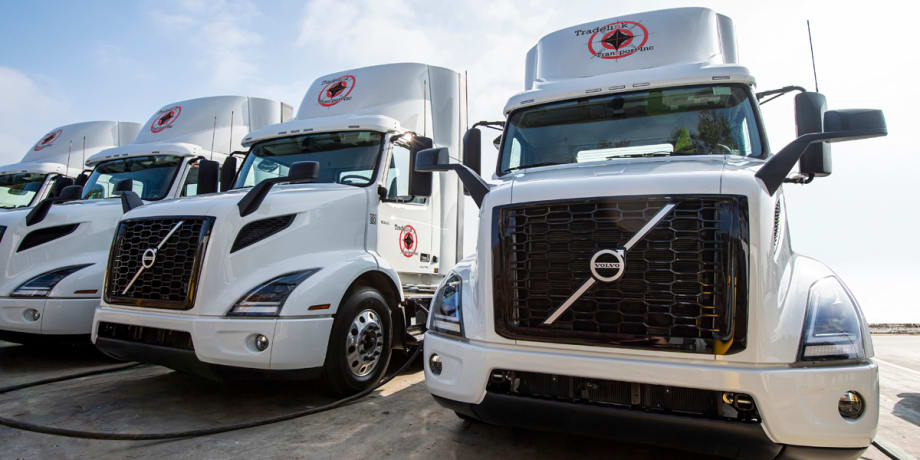
Tradelink Transport’s 15 Volvo VNR Electric trucks will comprise nearly 30% of the total fleet.
Photo: VTNA
California-based Tradelink Transport purchased 15 Volvo VNR Electric trucks for its land-bridge operations transporting a variety of products for major shipping companies between the ports of Los Angeles and Long Beach and nearby rail yards.
The Class 8, zero-tailpipe emission trucks will provide air quality and noise-reduction benefits to the disadvantaged communities located adjacent to the ports and the heavily trafficked Interstate 110 and I-710 Southern California freeway corridors.
“Since we started our business in 1998, Tradelink Transport has demonstrated its commitment to sustainable transportation, having always utilized a mix of new compressed natural gas trucks and the cleanest diesel models available. With this order of 15 Volvo VNR Electric trucks, we are excited to become one of the first fleets in the nation to deploy battery-electric trucks and supporting infrastructure into our operations at scale,” said Rigoberto Cea, president of Tradelink Transport in a Volvo Trucks North America press release. “Our drivers are excited to drive the new VNR Electric trucks. Most live within a 15-mile radius of our facility and see how vital it is for the trucking industry to reduce its emissions and community impact.”
Tradelink Transport, which primarily operates an employee-driver model, is deploying battery-electric trucks in part as a driver recruitment and retention strategy. The Volvo VNR Electric model produces zero-tailpipe emissions and significantly reduces heat, noise, and vibrations.
Tradelink Transport’s 15 Volvo VNR Electric trucks will comprise nearly 30% of the total fleet once the trucks are deployed into its existing fleet of 40 Class 8 trucks at its Compton transfer facility.
“This is a beautiful story,” VTNA President Peter Voorhooeve said during a press conference. “He strongly believes this is the way for him to drive his company.”
As a smaller company, he said, unlike some of the larger fleets that have been adopting electric trucks, this fleet can’t afford to try out an electric truck just for research.
“He needs to earn his money every month, yet he goes into this that everyone says is very expensive.”
To determine which of its routes were the most ideal for battery-electric trucks, Tradelink Transport worked with TEC Equipment – La Mirada, a certified Volvo Trucks electric vehicle dealer, and Volvo Trucks North America, to simulate real-world Volvo VNR Electric truck routes via Volvo Trucks’ Electric Performance Generator route planning tool. The EPG application takes into consideration the vehicle configuration and battery capacity, environmental factors such as terrain and ambient temperature, and specific route details, including traffic patterns.
“The EPG route planning tool helped us identify a driver training opportunity by highlighting that the heavy traffic around the ports will allow significant regenerative braking. This in turn can increase range by returning up to 15% of the power back to the battery,” said Tracey Craik, regional sales director for TEC Equipment.
Ten of the 15 Volvo VNR Electric trucks were purchased with vouchers from California’s Hybrid and Zero-Emission Truck and Bus Voucher Incentive Project (HVIP). Launched by the California Air Resources Board in 2009, HVIP provides point-of-sale vouchers to make advanced technology vehicles more affordable with first-come first-served incentives that reduce the incremental cost of commercial vehicles.
To support its growing battery-electric truck fleet, Tradelink Transport is utilizing Southern California Edison’s Charge Ready Transport program to install 10 chargers — a mix of 180 kW and 360 kW dual chargers. The chargers will be installed at Tradelink Transport’s new, five-acre facility, paired with onsite solar panels to generate renewable electricity and help offset peak charging costs.
More Fuel Smarts

How Volvo Updated Its D13 for EPA 2027 [Watch]
Volvo’s updated D13 promises lower emissions without sacrificing performance or fuel economy. Take a closer look at what changed inside the engine in this HDT Spotlight video.
Read More →
Diesel Price Spike Shortens Payback for Natural Gas Trucks, Report Says
Energy Vision estimates fleets could recover the higher purchase price of an RNG-fueled Class 8 tractor in 1.3 to 2.8 years under current fuel-price scenarios.
Read More →
Calstart Becomes Catalyst Mobility, Reflecting Broader Focus
Calstart is now Catalyst Mobility, reflecting the nonprofit’s growing national role in clean transportation, including zero-emission trucks, infrastructure and incentive programs.
Read More →

Record Diesel Prices Squeeze Trucking Fleets
Average U.S. diesel prices have climbed to nearly $6 a gallon, surpassing the 2022 record as tight refinery capacity and Middle East disruptions keep fuel costs elevated.
Read More →
How Fuel Delivery Shapes Engine Performance
Fuel delivery depends on more than what happens at the injector. For fleet, maintenance and technical professionals, looking at the full path from pump to injector can provide useful context for understanding engine performance.
Read More →
East Coast Port Launches $45M Electric Truck Push
The Port Authority of New York and New Jersey announced millions in incentives for zero-emission drayage trucks, yard tractors, and new charging hubs near the port.
Read More →
California Bill Could Shed Light on Electric Truck Prices
Why do battery-electric Class 8 trucks remain so expensive? A California bill headed to Gov. Gavin Newsom would give fleets and state agencies more visibility into what manufacturers charge.
Read More →
Detroit Opens Orders for EPA 2027 Engines
Detroit isn’t starting from scratch to meet EPA 2027 diesel emissions standards. Its Gen 6 DD13 and DD15 engines keep much of today’s platform while updating the fuel and aftertreatment systems.
Read More →
Zero-Emission Truck Corridor Planned for West Coast
California, Oregon, Washington, British Columbia and Baja California are coordinating plans for truck charging and hydrogen fueling from Canada to Mexico.
Read More →
A Closer Look at Kenworth’s Electric T880E Vocational Truck [Video]
Learn more about Kenworth's T880E battery-electric vocational truck at the Paccar Technical Center, including its range, applications, upfitting considerations, and PTO options, in this HDT Spotlight video.
Read More →