




Are You Up to Speed on Autonomous Trucking?
Do you feel behind in figuring out how your fleet can take advantage of autonomous technology? You may be surprised by what autonomous trucking executives have to say.


Executives from (left to right) Plus, Waymo and Aurora sat in on a panel at the Truckload Carrier Association’s annual Truckload convention in Las Vegas in March, to discuss autonomous trucking technology.
Photo: Vesna Brajkovic
Let’s set the scene.
You’ve been hearing about autonomous technology for what feels like years. You read about advancements in the technology in the industry press, and keep up with the handful of companies devoting energy and investing serious dollars into developing that technology in trucking applications. Yet… no one is trying to sell you an autonomous truck. You can’t get one, and you don’t know anyone else that has one.
So, what gives? Are you missing something? Executives from three of the companies developing autonomous trucking systems say no, not really. You’re probably part of the majority. Executives from Waymo, Plus, and Aurora sat in on a panel discussion at the Truckload Carriers Association’s annual Truckload convention in Las Vegas in March to explain in simple terms where the industry is, where it’s headed, and what you need to know.
Demonstrations Versus Commercial Applications
Autonomous trucking companies are deep into the development and testing of autonomous trucks in various applications. Most of that is happening in the Sunbelt of the U.S. (mostly between Arizona, New Mexico and Texas), where conditions are optimal for the sensors and cameras autonomous trucks rely on. But there’s also inclement-weather testing being done in states such as New York, Washington, Ohio, and Michigan.
Every once in awhile you may read news about companies removing a driver from one vehicle for an autonomous run, or they might perform an autonomous test in a “protective bubble,” explained Dima Kislovskiy, vice president of truck programs at Aurora. This could mean the vehicle operates without a driver, but there are three lead vehicles and three “chase” vehicles.
Essentially, these are not commercially representative ways of running a truck. What you’re hearing so much about are these demonstrations.
“The reality of actually trying to remove a driver is tougher than [those conditions],” Kislovskiy said.
Getting autonomous trucking to a commercial-scale deployment is not going to happen overnight, and you haven’t missed it. It will take a lot of evaluation.
Not a ‘Flip of the Switch’ Technology
“This industry is so diverse, so large, that this isn’t going to be flip of the switch and the next day the autonomous trucks are out on the road,” said Wiley Deck, vice president of government affairs and public policy at Plus. “We’re talking about millions of trucks out there right now. How quickly can the OEMs manufacture these trucks to replace millions of trucks? It’s not going to happen overnight. It’s years out before you start seeing vast quantities of autonomous trucks on the road.”
Charlie Jatt, Waymo’s head of commercialization for trucking, agreed.
“This technology is not going to be a flip of the switch,” Jatt said. “That’s … one area where the hype versus reality may diverge a little bit. Sometimes it's painted as this technology revolution that's going to come overnight, and that's just not the reality of what it takes to develop a safety-critical technology where you have to take really incremental, methodical steps.”
Waymo hasn’t given firm dates for when autonomous trucking will be in full force, but the company does plan to deploy fully autonomous trucks in a limited use case within the next few years. There will be a gradual rollout, similar to how the company is deploying its technologies in the consumer passenger vehicle market.
Aurora says by the end of 2023, it’ll be launching limited pilots where fleets will use the Aurora Driver to run fully autonomous loads. Kislovskiy makes it clear that this won’t be one of those one-off demonstrations. It will be part of the company’s commercial operation.
Aurora’s pilot will allow fleets to experience the technology before purchasing assets by 2025.
“We expect that you can purchase an Aurora Driver-equipped vehicle … and then you subscribe to the Aurora Horizon product, which is our Driver-as-a-Service product, and you're getting kind of a continuous supply of autonomy through that,” he said.
There are some barriers to commercial deployment, according to Plus’ Deck, that go beyond just technology development and testing. The Federal Motor Carrier Safety Administration has pushed back a rulemaking on autonomous trucking policy four times, and the Commercial Vehicle Safety Alliance still has to set up inspection criteria for these vehicles.
“While I think that our systems will be ready by 2023, I just don't think that anything else will be ready to accommodate in any scale these vehicles," Deck said. Deck, hired by Plus in May 2021, previously served as deputy administrator to the FMCSA.
Is Your Fleet Lagging Behind?
Fleets should be thinking about what latest autonomous trucking developments could mean for their business, and how they want to evolve their business to take advantage of, or evolve alongside, the latest technology. But if you haven’t figured it out yet, don’t worry. There’s still time to figure it out, Waymo’s Jatt said.
“That’s one of the most important messages,” he said. “This is not a flip of the switch, and so there’s time to figure it out. Take the time, get involved, forge relationships [with autonomous trucking companies], and go from there.”
[Editor's note: This article was updated on April 5 at 2:18 p.m. CT to correct the spelling in the first reference of Wiley Deck's name.]
More Fleet Management

What the U.S.-Canada Trade War Means for Trucking
Escalating U.S.-Canada tariffs could disrupt cross-border freight, reduce truck volumes, raise costs, and create new uncertainty for carriers on both sides of the border.
Read More →
What Are Trucking’s Top Concerns for 2026?
The American Transportation Research Institute wants to know what's worrying trucking fleet managers, drivers, and other stakeholders in its annual Industry Issues survey.
Read More →
American Trucking Associations Looks for a New Leader
ATA President and CEO Chris Spear abruptly left his job at the association on August 21, at a pivotal time for the trucking industry.
Read More →
Public Wi-Fi Cybersecurity Risks: How Truck Drivers and Fleets Can Protect Their Data
Public Wi-Fi can expose truck drivers and fleets to credential theft, malware, and other cyber threats. Here’s how to reduce the risk on the road.
Read More →
For Nicky Cupp, Fleet Innovation Starts With Frustration
HDT Truck Fleet Innovator Nicky Cupp turns everyday pain points at Fraley & Schilling into opportunities for better technology and smarter processes.
Read More →
Adam Buttgenbach’s Approach to Electric Trucks: Start With Where They Fit
HDT Truck Fleet Innovator Adam Buttgenbach helped PepsiCo build one of North America’s largest EV fleets by focusing on where electric trucks make operational sense.
Read More →
Deen Albert: Let Automation Do the Math, People Make the Decisions
HDT Truck Fleet Innovator Deen Albert makes sure people are still at the heart of operations at Grand Island Express, even while adopting artificial intelligence tools. AI-assisted dispatch helped boost revenue 25% with the same number of trucks.
Read More →
Trimble’s New AI Agent Takes Aim at Fleet Back-Office Busywork
Arc Agent works across Trimble TMS products to automate repetitive tasks such as freight orders, maintenance, invoices, fuel costs and more.
Read More →
How HDT’s 2026 Truck Fleet Innovators Are Rethinking Fleet Operations
Meet five trucking leaders who are challenging assumptions, solving operational problems, and putting innovative ideas to work.
Read More →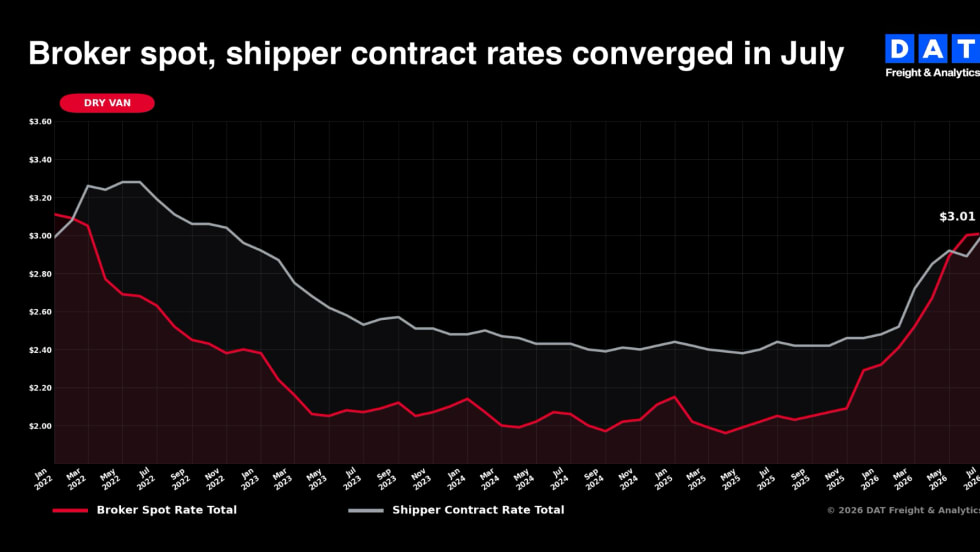
Tight Trucking Capacity Pushes Rates Higher Even as Freight Volumes Fall
“Spot rates moving ahead of contract rates have historically signaled a tightening market, but we haven’t seen a capacity-driven market quite like this one,” said DAT's Dean Croke.
Read More →