





ACT: Third of Class 4-8 Vehicles to be Battery-Electric in 10 Years
Tesla Semi Delayed Again
Companies such as UPS and FritoLay will have to wait a little longer for their all-electric Tesla Semi Class 8 trucks, as a second-quarter earnings report pushed production out to 2022.
July 28, 2021
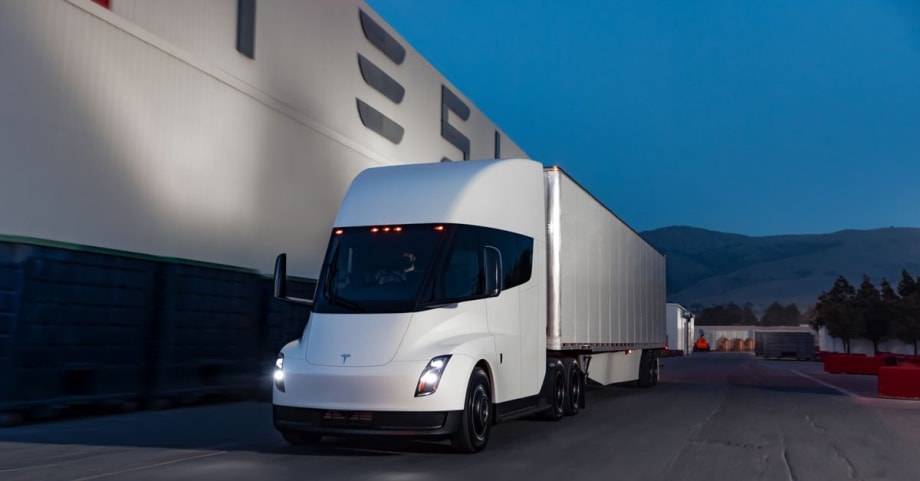
Waiting for a Tesla Semi? It'll be at least 2022.
Photo: Tesla
3 min to read
Companies such as UPS and FritoLay will have to wait a little longer for their all-electric Tesla Semi Class 8 trucks, as a second-quarter earnings report pushed production out to 2022. It’s just the latest delay in a string of them since the Semi was unveiled in 2017 with a projected date of 2019 for availability.
Back in January, Tesla’s Elon Musk said the Tesla Semi was ready for production, held back only by a limited ability to get battery cells, but he was optimistic that the setback was only temporary.
In fact, in March, a PepsiCo press release about the transformation of its Modesto, Calif. Frito-Lay manufacturing site into a “showcase for environmentally sustainable manufacturing, warehousing and distribution,” it said the site had nearly 60 tractors, box trucks, yard trucks or forklifts powered by electric, lithium-ion technologies or renewable natural gas, with the remaining 15 electric tractors expected to deploy later this year, which published reports indicated referred to its Tesla Semi order.
However, in its second-quarter earnings report, Tesla said that to better focus on its Berlin and Austin factories for the Model Y, “and due to the limited availability of battery cells and global supply chain challenges, we have shifted the launch of the Semi truck program to 2022."
It also said it is “making progress on the industrialization of Cybertruck, which is currently planned for Austin production subsequent to Model Y.” Cybertruck is Tesla's electric pickup truck.
A chart showing “installed annual capacity” shows the Tesla Semi with location TBD and status “in development.” The Cybertruck electric pickup status is also “in development.”
The news came after just last week, Electrek reported that the Semi was finally nearing production. In March, Electrek exclusively reported that Tesla was building a production line for the Tesla Semi at a new building near Gigafactory Nevada to produce five Tesla Semi electric trucks per week by the end of the year. Last week, sources familiar with the matter told Electrek that the drive axle production line was ready and the general assembly line was going through its final debugging before starting production — one of the last steps before starting production.
However, as Electrek reported this week, any significant production depends on the availability of Tesla’s new 4680 battery cells.
Tesla Semi: A Story of Delays
A little more than a year ago, in June 2020, reports indicated that Musk told his staff in an email it was time to “go all out” to bring the Tesla Semi commercial truck to “volume production,” but he didn’t specify a time frame.
Initially, when the Tesla Semi was introduced in 2017, Musk announced production would begin in 2019. Companies such as Anheuser-Busch, J.B. Hunt, Fedex and UPS put in orders.
Over the next year, Tesla Semis were spotted along highways and details started to emerge on an electric truck charging network.
Then, in April 2019, during Tesla’s first-quarter earnings call, company officials indicated that production would begin in 2020. This was pushed back further in January, when a leaked email sent by Tesla to a company that had reserved one of the Semis reportedly said production would begin in the second half of 2020, with a limited run.
Then in spring of 2020, Musk said in an earnings call that the long-awaited battery-electric truck wouldn’t be in production until 2021.
More Fuel Smarts

How Volvo Updated Its D13 for EPA 2027 [Watch]
Volvo’s updated D13 promises lower emissions without sacrificing performance or fuel economy. Take a closer look at what changed inside the engine in this HDT Spotlight video.
Read More →
Diesel Price Spike Shortens Payback for Natural Gas Trucks, Report Says
Energy Vision estimates fleets could recover the higher purchase price of an RNG-fueled Class 8 tractor in 1.3 to 2.8 years under current fuel-price scenarios.
Read More →
Calstart Becomes Catalyst Mobility, Reflecting Broader Focus
Calstart is now Catalyst Mobility, reflecting the nonprofit’s growing national role in clean transportation, including zero-emission trucks, infrastructure and incentive programs.
Read More →

Record Diesel Prices Squeeze Trucking Fleets
Average U.S. diesel prices have climbed to nearly $6 a gallon, surpassing the 2022 record as tight refinery capacity and Middle East disruptions keep fuel costs elevated.
Read More →
Sponsored•September 9, 2026
How Fuel Delivery Shapes Engine Performance
Fuel delivery depends on more than what happens at the injector. For fleet, maintenance and technical professionals, looking at the full path from pump to injector can provide useful context for understanding engine performance.
Read More →
East Coast Port Launches $45M Electric Truck Push
The Port Authority of New York and New Jersey announced millions in incentives for zero-emission drayage trucks, yard tractors, and new charging hubs near the port.
Read More →
California Bill Could Shed Light on Electric Truck Prices
Why do battery-electric Class 8 trucks remain so expensive? A California bill headed to Gov. Gavin Newsom would give fleets and state agencies more visibility into what manufacturers charge.
Read More →
Detroit Opens Orders for EPA 2027 Engines
Detroit isn’t starting from scratch to meet EPA 2027 diesel emissions standards. Its Gen 6 DD13 and DD15 engines keep much of today’s platform while updating the fuel and aftertreatment systems.
Read More →
Zero-Emission Truck Corridor Planned for West Coast
California, Oregon, Washington, British Columbia and Baja California are coordinating plans for truck charging and hydrogen fueling from Canada to Mexico.
Read More →
A Closer Look at Kenworth’s Electric T880E Vocational Truck [Video]
Learn more about Kenworth's T880E battery-electric vocational truck at the Paccar Technical Center, including its range, applications, upfitting considerations, and PTO options, in this HDT Spotlight video.
Read More →