Daimler Testing Hydrogen-Powered Truck for Long Haul
Daimler Trucks has begun rigorous testing of its second-generation hydrogen-powered prototype truck, which the company calls an important milestone on the path to production of the Mercedes-Benz GenH2 Truck.
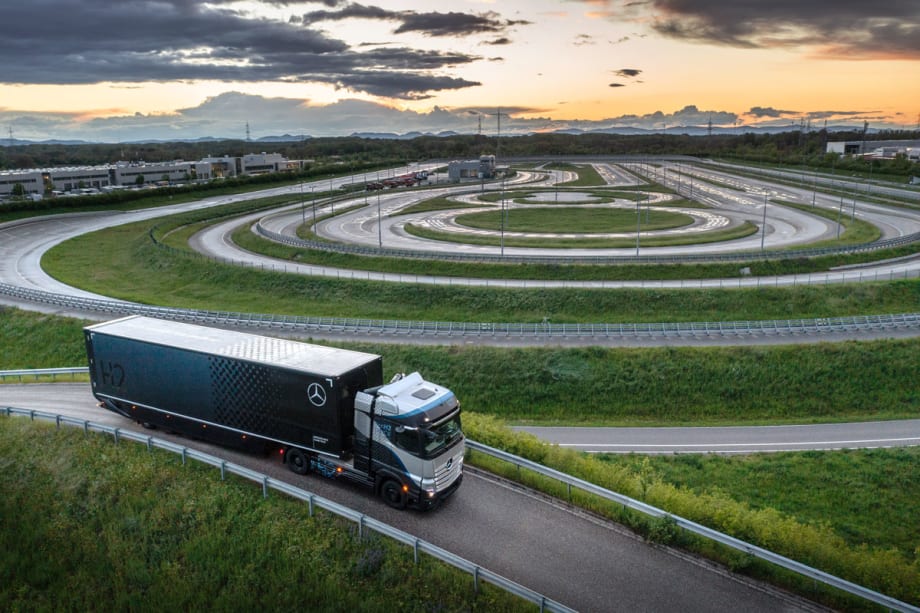
In late April, Daimler Trucks began to conduct an extensive series of demanding tests on its hydrogen-fuel-cell-powered Mercedes-Benz GenH2 Truck.
Photo: Daimler Trucks
4 min to read
Daimler Trucks has begun rigorous testing of its second-generation hydrogen-powered prototype truck, which the company calls an important milestone on the path to production of the Mercedes-Benz GenH2 Truck, which was unveiled in 2020.
Daimler Trucks is focusing on hydrogen-powered fuel-cells for the electrification of long-haul truck models. It aims to achieve ranges of up to 1,000 kilometers (more than 600 miles) and more without any stops for refueling.
Ad Loading...
In late April, the truck maker began to conduct an extensive series of demanding tests, focusing on factors such as continuous operation, different weather and road conditions, and various driving maneuvers.
During the first few weeks of testing, the vehicle has already covered hundreds of kilometers under continuous load on a road-to-rig test stand and gone through many extreme situations that are based on real-life operating conditions. Examples include emergency braking and curbstone drives along the test track.
According to Daimler Trucks’ development plan, the vehicle will also be tested on public roads before the end of the year. Customer trials are scheduled to begin in 2023. The first series-produced GenH2 Trucks are expected to be handed over to customers starting in 2027.
Ad Loading...
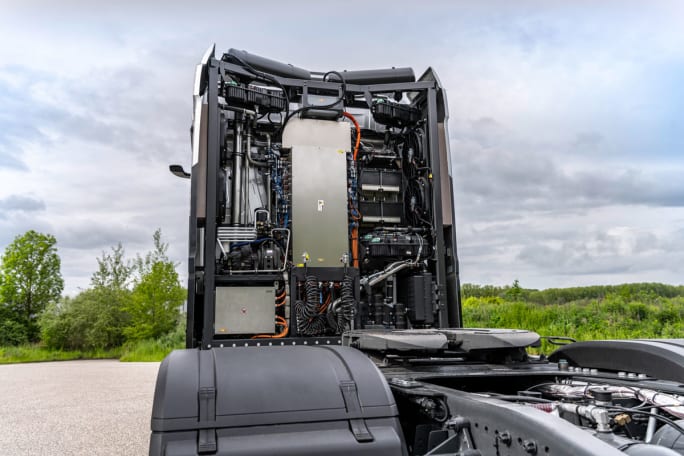
The GenH2 Truck has been newly designed from the ground up. It features completely new components, which the developers are particularly focusing on during the tests.
Photo: Daimler Trucks
The development engineers at Daimler Trucks are designing the GenH2 Truck so that the vehicle and its components meet the same durability requirements as a comparable conventional Mercedes-Benz Actros. This means 1.2 million kilometers (about 750,000 miles) on the road over a period of 10 years.
The GenH2 Truck has been newly designed from the ground up. It features completely new components, which the developers are particularly focusing on during the tests. These components include the fuel-cell system, the all-electric powertrain, and all of the associated systems such as the special cooling unit.
In addition, the new components’ specific weight and position in the vehicle affect the truck’s handling properties. As a result, the vibrations caused by bumpy roads, for example, and especially by extreme situations, subject the fuel-cell truck to different forces than those in conventional vehicles. In order to obtain extensive information about this at an early stage, the current prototype is loaded during the tests with a payload of up to 25 tons for a gross vehicle weight of about 40 tons, which is identical with the specifications planned for the series-produced variant of the GenH2 Truck.
Liquid Hydrogen Tanks in Development
Daimler Trucks prefers to use liquid hydrogen, saying it has a far higher energy density in relation to volume than gaseous hydrogen. As a result, the tanks of a fuel-cell truck using liquid hydrogen are much smaller and, due to the lower pressure, significantly lighter, according to the truck maker. This gives the trucks more cargo space and a higher payload. At the same time, more hydrogen can be carried, which significantly increases the trucks’ range.
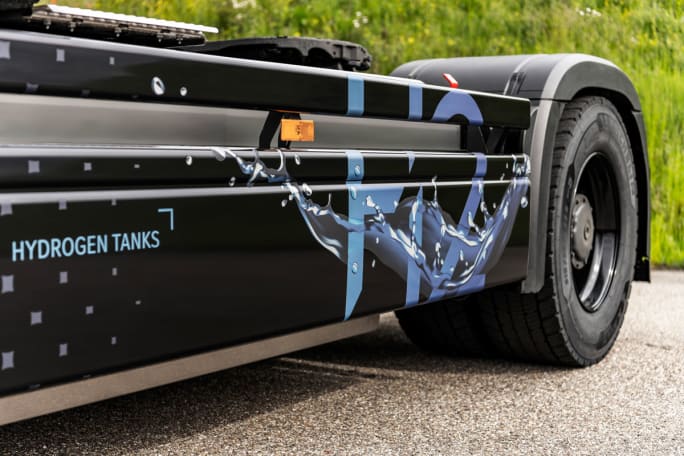
Daimler Trucks is developing tanks for liquid hyrogen, but for now they are using gaseous H2.
Photo: Daimler Trucks
The experts at Daimler Trucks are forging ahead with the development of tank technologies for liquid hydrogen on the basis of a predefined development plan. By the end of the year, the engineers plan to have the new prototype tank system ready to use in the ongoing tests of the GenH2 Truck. The vehicle tests will then be conducted exclusively with liquid hydrogen tank systems until the series-production stage is reached.
Ad Loading...
Until this can be done, the extensive internal testing of the GenH2 Truck will use a gaseous hydrogen tank system as an interim solution. Daimler Trucks is thus demonstrating that both variants – gaseous and liquid – can be technically implemented.
The truck bears the message, “powered by cellcentric,” which is the joint fuel-cell venture recently formed by Daimler Truck AG and Volvo Group to accelerate the rollout of hydrogen-based fuel-cells for trucks.
The European Momentum for Carbon-Neutral Trucks
“We want to offer our customers the best locally CO2-neutral trucks — powered by either batteries or hydrogen-based fuel-cells, depending on the use case,” said Martin Daum, Daimler Trucks chief. “The hydrogen-powered fuel-cell drive will become indispensable for CO2-neutral long-haul road transport in the future. This is also confirmed by our many partners with whom we are working together at full steam to put this technology on the road in series-production vehicles.”
He also pointed to the “considerable momentum” being generated by European regulators for the use of hydrogen for road freight transport.
“Political support plays an important role in promoting the creation of an infrastructure for green hydrogen and making an economically viable use of fuel-cell trucks possible for our customers,” he said.
What do you need to know about hydrogen fuel cells? Fuel-cell supplier Loop Energy has been around for nearly 20 years, so HDT Talks Trucking asked Loop President and CEO Ben Nyland.
Average U.S. diesel prices have climbed to nearly $6 a gallon, surpassing the 2022 record as tight refinery capacity and Middle East disruptions keep fuel costs elevated.
Fuel delivery depends on more than what happens at the injector. For fleet, maintenance and technical professionals, looking at the full path from pump to injector can provide useful context for understanding engine performance.
The Port Authority of New York and New Jersey announced millions in incentives for zero-emission drayage trucks, yard tractors, and new charging hubs near the port.
Why do battery-electric Class 8 trucks remain so expensive? A California bill headed to Gov. Gavin Newsom would give fleets and state agencies more visibility into what manufacturers charge.
Detroit isn’t starting from scratch to meet EPA 2027 diesel emissions standards. Its Gen 6 DD13 and DD15 engines keep much of today’s platform while updating the fuel and aftertreatment systems.
California, Oregon, Washington, British Columbia and Baja California are coordinating plans for truck charging and hydrogen fueling from Canada to Mexico.
Learn more about Kenworth's T880E battery-electric vocational truck at the Paccar Technical Center, including its range, applications, upfitting considerations, and PTO options, in this HDT Spotlight video.
HDT Truck Fleet Innovator Jennie Abarca is building confidence in fleet electrification one load at a time while openly sharing the challenges she encounters along the way as a small-fleet owner.
The engine maker will gradually introduce its new Model Year 2027 diesel engines while continuing to offer current models during the transition, citing the EPA's proposed emissions rule changes.