Zero-Emission Drayage Trucks Make Strides — but Big Barriers Remain
Despite major progress, zero-emission drayage trucks at the L.A. and Long Beach ports still face high costs and limited charging and hydrogen fueling capacity, according to the latest feasibility report.
The report cited progress in charging availability for electric drayage trucks at the ports of Long Beach and Los Angeles, but said more progress needs to be made.
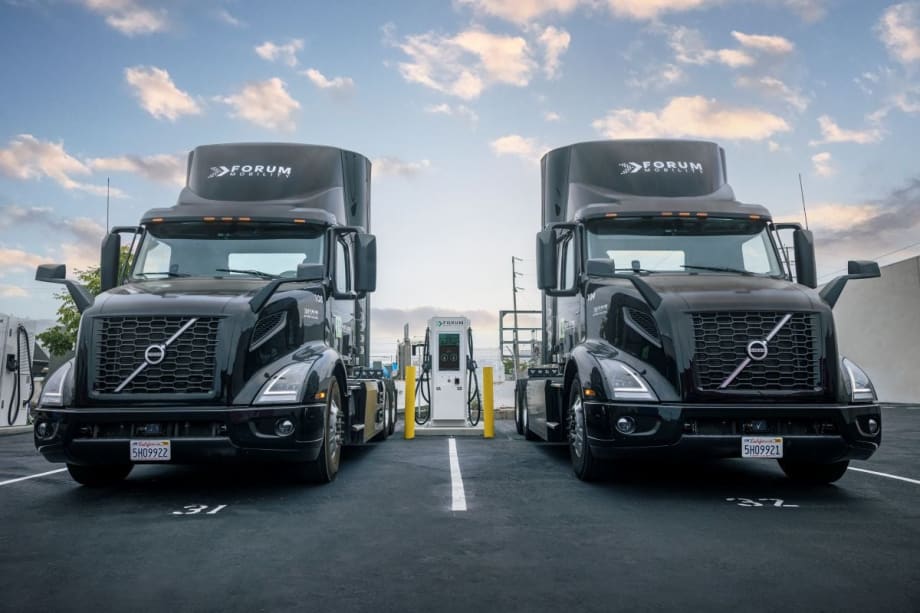
Photo: Kevin Krause for Forum Mobility
8 min to read
A report on the current state and feasibility of zero-emission drayage trucks at the ports of Los Angeles and Long Beach found that they have come a long way, but there are still major challenges in areas such as total cost of ownership and charging/fueling infrastructure.
The current capabilities of zero-emission truck technologies both battery-electric and fuel-cell-electric, show potential to meet certain operational requirements of port drayage activities, according to 2024 feasibility assessment for ZE drayage trucks from the San Pedro Bay ports.
Ad Loading...
But it also cited significant gaps when looking at the diverse needs of operators.
The 2024 report evaluates the feasibility of Class 8 ZE drayage trucks across five key areas: technical, commercial, operational, economic, and infrastructure viability.
It concluded that drayage operations involving shorter routes and single-shift schedules, particularly those with trips of less than 150 miles, are currently more compatible with existing zero-emission truck technology.
Ad Loading...
However, longer-haul operations, multi-shift schedules, and trips requiring high-payload capacities are still constrained by technological, operational, and economic barriers.
Why a Zero-Emission Drayage Trucks Feasibility Report?
Regular feasibility reports are part of the San Pedro Bay port complex efforts to reach ambitious zero-emissions goals adopted in the 2017 Clean Air Action Plan (CAAP) Update.
What Are Zero-Emission Trucks?
Zero-emission trucks produce no direct tailpipe emissions, reducing air pollution and transportation-related greenhouse gas emissions. There are two types:
Battery-electric trucks (BETs) use a battery to store electricity for the motor, and the battery is charged via outlets or stations.
Hydrogen fuel cell electric trucks (FCETs) use hydrogen and oxygen to produce electricity in a fuel cell, emitting only water vapor. FCETs have rapid refueling times and longer driving ranges than battery-electric trucks.
It established goals of ZE trucks by 2035 and ZE terminal equipment by 2030. The ports committed to developing periodic feasibility assessments for drayage trucks and terminal equipment. Previous assessments were conducted in 2018 and 2021.
Since 2005, port-related air pollution emissions in San Pedro Bay have dropped 90% for diesel particulate matter, 70% for nitrogen oxides, and 98% for sulfur oxides.
Targets for reducing greenhouse gases from port-related sources were introduced as part of the 2017 CAAP, which calls for the ports to reduce GHGs 40% below 1990 levels by 2030 and 80% below 1990 levels by 2050.
Ad Loading...
As of the end of 2024, more than 600 zero-emission vehicles were in operation throughout the San Pedro Bay port complex, according to the report.
A Zero-Emission Snapshot in Time
However, the report authors caution that the information reflects the state of the industry at the end of 2024. It does not reflect the major regulatory changes that have happened since then under the Trump administration.
In January, the California Air Resources Board withdrew its waiver request to the Environmental Protection Agency, rendering the priority fleet and drayage fleet provisions of its Advanced Clean Fleet (ACF) regulation unenforceable. In May, CARB agreed to officially repeal them.
With the withdrawal of the ACF waiver, there is currently no mandate requiring the transition of drayage trucks to ZE technology by 2035.
Despite this, CARB has said it will explore alternative strategies. The CAAP goals remain unchanged, and the ports will continue their efforts to promote the adoption of ZE drayage trucks.
Ad Loading...
The future of the ACF regulation, potential revisions to the Advanced Clean Trucks (ACT) rule, and federal trade policies or tariffs, can impact the pace, cost, and feasibility of ZE truck deployment.
Availability of Zero-Emission Drayage Trucks
The 2024 report highlights significant advancements in the technical viability of both BETs and FCETs, saying they are widely available on the market.
Port Drayage Fleet Facts
As of November 2024, the Port Drayage Truck Registry (PDTR) database showed 2,156 companies operating at the Ports of Los Angeles and Long Beach.
82% of the fleets have 20 or fewer trucks.
64% have 10 or fewer trucks.
Fleets with more than 100 trucks, though making up just 2% of companies, own 27% of the trucks operating at the ports.
The state of the fuel-cell-electric market, however, changed shortly after the cut-off date for the report, with the dissolution of Hyzon and the bankruptcy of Nikola.
As of the end of 2024, there were seven different makes and models of Class 8 BETs available, offering a variety of configurations with electric ranges between 150 and 330 miles, and an average range of 209 miles.
In comparison, FCETs provide longer driving ranges, between 249 and 500 miles, with six models on the market as of December 2024.
Ad Loading...
ZETs: Reduced Payload Capacity
In addition to availability and range, payload capacity is a key factor in the feasibility of zero-emissions trucks, given the heavier weight of BETs and FCETs.
Both battery-electric and fuel-cell-electric trucks, the report found, have a curb weight averaging around 23,000 lbs. — about 8,000 lbs. heavier than traditional diesel trucks. This added weight reduces payload capacity.
While 54% of port drayage operators typically haul lighter loads under 60,000 lbs., the report said, the increased weight can limit flexibility for occasional heavier hauls and reduce profitability by requiring more trips to haul the same amount of cargo.
Are Zero-Emission Trucks Viable For Port Drayage Operation?
The zero-emission trucks available can meet requirements in most drayage truck operational contexts, such as short-haul, low-mileage routes or single-shift operations, according to the report.
However, both technologies face limitations in areas such as range, payload capacity, refueling or charging infrastructure, and cost.
Ad Loading...
With an average range of 209 miles, BETs can support a substantial portion of drayage operations at the Ports of Los Angeles and Long Beach, where 50% of operators report trips under 100 miles per shift, and 55% run single-shift schedules.
However, range limitations pose challenges for the 25% of operators who travel over 200 miles per shift, as well as for fleets with multi-shift operations.
On top of that, fleet operators have found that electric-truck ranges often fall short of rated values, particularly under heavy loads and varying traffic conditions, with some trucks rated for 150 miles achieving only 120 miles in the real world.
With an extended range of 250–500 miles, FCETs can cover 80% of current port drayage activities, where average trip distances remain under 250 miles per shift.
For the one-third of operators running two-shift schedules, FCETs can be a viable option as long as each shift stays within the truck’s range, according to the report. Their short refueling times of 12–20 minutes offer an advantage over BETs. And FCETs' longer range reduces the need for frequent refueling stops.
Ad Loading...
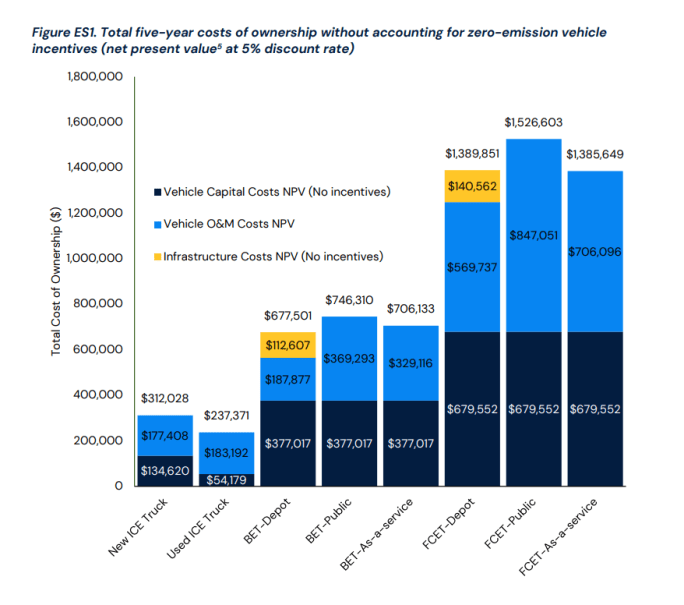
According to the feasibility report, total cost of ownership is still a major challenge in the adoption of zero-emission trucks.
Source: 2024 Class 8 Drayage Truck Feasibility Assessment
Economic Viability: ZET TCO With And Without Incentives
A big hurdle in the ports' transition to zero-emission trucks technology are the significant economic challenges, with high upfront costs for Class 8 zero-emissions trucks.
The feasibility report includes a total cost of ownership (TCO) analysis over a five-year period. It establishes baseline scenarios for new and used internal combustion engine (ICE) trucks as reference points and evaluates different ZE truck options based on refueling strategies.
For BETs, scenarios include depot charging (centralized charging infrastructure), public charging, and charging-as-a-service (third-party management of charging infrastructure).
For FCETs, depot refueling (on-site hydrogen refueling stations), public refueling, and refueling-as-a-service are considered.
The TCO analysis showed that used ICE trucks have the lowest total cost of ownership at roughly $240,000.
New ICE trucks were slightly higher at approximately $312,000, significantly more affordable than ZE alternatives.
BETs have a TCO that is 2 to 2.4 times higher than new ICE trucks, while FCETs have the highest TCO, reaching up to around $1.5 million, 4.5 to 5 times the cost of a new ICE truck and double that of BETs, according to the analysis.
While BETs benefit from lower fuel costs when charged at depots (18% lower than diesel), public charging significantly increases expenses, making refueling costs up to 85% higher than diesel.
FCETs face even steeper fuel costs, particularly in public refueling scenarios, where costs can reach more than $700,000, over six times that of diesel.
The feasibility assessment also presents a scenario that incorporates incentives for vehicle purchase and infrastructure. In this scenario, the report said, TCO significantly decreases by up to 55% for the BET scenarios, while FCET scenarios see reductions of 25% to 32%.
In the case of depot-charged BETs, incentives bring the TCO down to about $307,000, below the $312,000 estimated for a new ICE truck.
Ad Loading...
Zero-Emission Infrastructure Availability
The report found that as of the end of 2024, charging/refueling infrastructure, both existing and under construction at the time, within a 150-mile radius of the Ports included:
21 charging stations with 462 charging ports
6 hydrogen refueling stations capable of dispensing 25,200 kg of hydrogen daily.
The current charging network in operation or under construction can support only 800 Class 8 BETs, while hydrogen refueling infrastructure can accommodate 350 Class 8 FCETs.
To fully transition the Ports’ drayage fleet, approximately 17,000 active Class 8 trucks, significant infrastructure development is required, said the report.
This includes a 14-fold increase in charging ports, bringing the total to around 6,200 ports, and a significant scale-up of hydrogen refueling capacity by an additional 98,000 kg/day, reaching a total of 32 stations.
Ad Loading...
The report noted that future projects, utility programs, and technology advancements, such as megawatt charging, are expected to expand infrastructure availability and may reduce the scale of additional infrastructure ultimately required.
Progress in ZEVs
The report notes “steady and significant progress since the last feasibility assessments.”
In 2018, when the first assessment was conducted, zero-emission Class 8 truck technology was still in its infancy. At the time, only one manufacturer (BYD) offered a pre-commercial battery electric truck with a limited range of 100 to 150 miles and no capacity for commercial-scale production.
By 2021, seven OEMs had introduced early-commercial BETs with ranges up to 230 miles, though production volumes remained low.
By 2024, BETs had seven makes/models available offering ranges between 150 and 330 miles, with fleets operating dozens of units in real-world settings.
Ad Loading...
FCETs followed a similar trajectory, progressing from pilot stages in 2018 and 2021, to having six models on the market at the end of 2024.
Although the infrastructure available to support ZE trucks remains limited, it has significantly improved since previous assessments.
For BETs, charging infrastructure was nonexistent in 2018 and remained limited in 2021. Similarly, prior assessments indicated that no hydrogen refueling stations were available.
“In less than three years… significant progress has occurred, both in the number of trucks deployed and the expansion of supporting infrastructure. That said, a long road lies ahead before these trucks become widely available across the drayage sector’s varied operations.”
Volvo’s updated D13 promises lower emissions without sacrificing performance or fuel economy. Take a closer look at what changed inside the engine in this HDT Spotlight video.
Energy Vision estimates fleets could recover the higher purchase price of an RNG-fueled Class 8 tractor in 1.3 to 2.8 years under current fuel-price scenarios.
Calstart is now Catalyst Mobility, reflecting the nonprofit’s growing national role in clean transportation, including zero-emission trucks, infrastructure and incentive programs.
Average U.S. diesel prices have climbed to nearly $6 a gallon, surpassing the 2022 record as tight refinery capacity and Middle East disruptions keep fuel costs elevated.
Fuel delivery depends on more than what happens at the injector. For fleet, maintenance and technical professionals, looking at the full path from pump to injector can provide useful context for understanding engine performance.
The Port Authority of New York and New Jersey announced millions in incentives for zero-emission drayage trucks, yard tractors, and new charging hubs near the port.
Why do battery-electric Class 8 trucks remain so expensive? A California bill headed to Gov. Gavin Newsom would give fleets and state agencies more visibility into what manufacturers charge.
Detroit isn’t starting from scratch to meet EPA 2027 diesel emissions standards. Its Gen 6 DD13 and DD15 engines keep much of today’s platform while updating the fuel and aftertreatment systems.
California, Oregon, Washington, British Columbia and Baja California are coordinating plans for truck charging and hydrogen fueling from Canada to Mexico.
Learn more about Kenworth's T880E battery-electric vocational truck at the Paccar Technical Center, including its range, applications, upfitting considerations, and PTO options, in this HDT Spotlight video.