




White House Continues Efforts to Unsnarl Supply Chain
While the new bipartisan infrastructure bill passed by Congress will result in long-term improvements at the nation’s ports, where backlogs of intermodal containers have been a focus of the supply-chain problems that have plagued the country and the globe, near-term efforts from the federal government are still continuing.

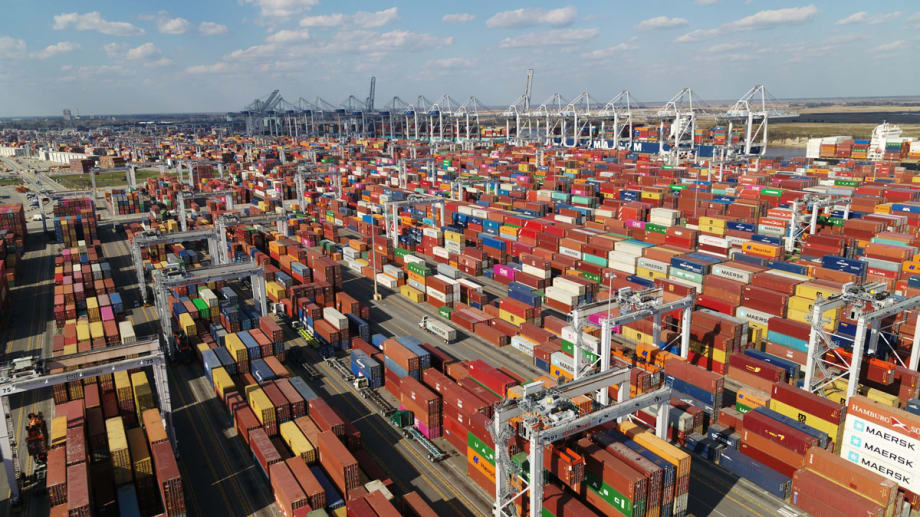
The Port of Savannah was the first container terminal in the Southeast or Gulf Coast to move 5 million twenty-foot equivalent container units in a fiscal year.
File Photo: Georgia Ports Authority / Jeremy Polston
While the new bipartisan infrastructure bill passed by Congress will result in long-term improvements at the nation’s ports, where backlogs of intermodal containers have been a focus of the supply-chain problems that have plagued the country and the globe, near-term efforts from the federal government are still continuing.
Imports at the nation’s congested container ports are expected to remain at near-record levels for the remainder of the year as retailers rush to move merchandise from docks to shelves in time to meet the expectations of holiday shoppers, according to the monthly Global Port Tracker report released Nov. 8 by the National Retail Federation and Hackett Associates.
“Dockworkers are unloading ships as fast as they can, but the challenge is to move the containers out of the ports to make room for the next ship,” NRF Vice President for Supply Chain and Customs Policy Jonathan Gold said in a statement. “We need better empty return procedures and more chassis, truck drivers, rail capacity and warehouse workers to keep the system moving.”
More than 70 ships were reported waiting to dock at the Ports of Los Angeles and Long Beach last week, the NRF said, and the wait at Los Angeles has averaged two weeks over the past month.
More Efforts at Southern California Ports
Last month, President Biden announced a deal for the Port of Los Angeles to operate 24 hours a day, seven days a week. This followed a similar move by the Port of Long Beach. However, critics say, more hours won’t help if truckers don’t take advantage of these off-hour appointments.
In a Nov. 10 progress report, the White House said there’s an effort to waive port fees for truckers on nights and weekends to incentivize off-peak use.
Currently, it said, truck drivers pay a fee to enter the ports to pick up cargo. This system, known as Pier Pass, was originally designed to incentivize off peak hours and reduce emissions. However, in recent years the terminal operators who run Pier Pass had converted it to a flat fee.
The terminal operators have been considering changing the system to create a financial incentive for trucks to use night and weekend hours. If they move forward, their proposal would waive the current fee during nights and weekends for the remainder of the shipping high season.
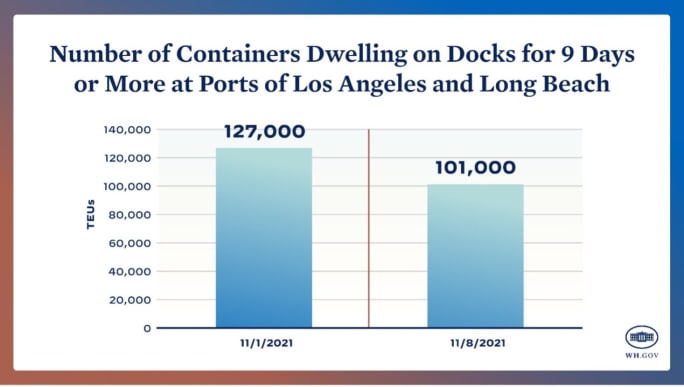
The White House said it is starting to see improvement in the container-ship backlog at the southern California ports.
Graph: White House
By getting more containers picked up during the lower-traffic nights and weekends, trucks would move containers off the docks more efficiently. To be most impactful, the White House noted, terminal operators would need to also fully staff the nighttime and weekend shifts.
The White House also said more retailers are joining its efforts to increase the use of off-peak hours. Stanley Black & Decker has committed to moving 33% of its Los Angeles and Long Beach cargo during the off-peak while Gap Inc. has committed to a 15% increase. They join Walmart, Target, FedEx, UPS, Home Depot, and Samsung.
According to published reports from sources such as the Wall Street Journal and CNBC, the administration also will begin work within the next 60 days with the U.S. Army Corps of Engineers on $4 billion worth of construction work at coastal ports and inland waterways.
In addition, there are plans to work to standardize data-sharing requirements for shipping lines, terminal operators, railroads, truckers, warehouses and cargo owners.
Repurposing Unused Grant Money at Ports
While the problem may be the worst at the southern California ports, responsible for 40% of the nation’s incoming container imports, East Coast ports also have experienced record-setting volumes. The Port of Savannah, the fourth-largest container port in the U.S., has seen a surge in the number of ships at sea and containers to process.
The White House announced that the Georgia Port Authority, with support from the U.S. Department of Transportation, will have over $8 million available to establish five pop-up container yards in Georgia and North Carolina. These five yards, accessible by rail and truck, can accommodate more than 500,000 containers over the course of a year or the equivalent of 27 mega container ships.
The Department of Transportation will support the Port of Savannah, and other ports seeking to solve current supply chain disruptions, by providing new flexibility in existing grants, allowing ports to re-allocate unused grant money to address these immediate needs.
Infrastructure Funding for Ports, Intermodal
As the WSJ reports, some $17 billion in total will go to port and waterway projects under the $1.2 trillion infrastructure plan.
A Nov. 10 White House fact sheet said the deal “will make the fundamental changes that are long overdue for our ports, airports, rail and roads to ensure that our supply chains are more resilient and efficient from future shocks. Modern, resilient, and sustainable port, airport, and freight infrastructure will help improve efficiency, reduce costs, and support U.S. competitiveness by removing bottlenecks and expediting commerce, while reducing greenhouse gas emissions and the environmental impact on neighboring communities. The plan will strengthen supply chains by investing almost $50 billion in our ports and airports on top of expanding existing programs that support freight investment across modes.”
The legislation invests $17 billion in port infrastructure and waterways to address repair and maintenance backlogs, reduce congestion and emissions near ports and airports, and drive electrification and other low-carbon technologies.
The coastal ports have not been the only site of intermodal container backlogs; inland domestic facilities in areas such as Chicago have been overwhelmed, as well.
The new infrastructure deal also looks to improve the rail system and intermodal freight, with $10 billion devoted to grant programs for highway and rail projects critical to efficient goods movement and for projects that improve the safety, efficiency, and reliability of intercity passenger and freight rail.
The Intermodal Association of North America issued a statement praising the infrastructure package, noting that it includes $567 billion allocated specifically for preparing the nation’s freight supply chain for the future. It also establishes an Office of Multimodal Freight Infrastructure and Policy in the Department of Transportation, which will provide coordination for advancing major freight projects.
More Fleet Management

Color Match Smarter: Tools That Restore & Perform
For fleet managers and collision repair professionals keeping heavy-duty trucks on the road, getting the color right the first time isn't just about appearance — it's about efficiency, turnaround time, and bottom-line results. Discover how today's digital color tools are transforming the repair process from guesswork to precision.
Read More →
FMCSA Pauses Biennial-Update Enforcement Amid Motus Transition
Carriers whose updates were due on or after June 1 have more time, while FMCSA works to stabilize its new registration system and warns of phishing sites impersonating its new carrier registration system, Motus.
Read More →
2026 Blueprint for Countering Smarter Supply Chain Theft
Cargo theft is no longer just the cost of doing business. It's a multi-billion-dollar criminal enterprise exploiting vulnerabilities across your fleet, drivers, and supply chain.
Read More →


How Telematics Improves Visibility, Control, and Performance in Refrigerated Fleets
Explore how telematics help refrigerated fleets improve visibility, uptime, efficiency, compliance, and cargo protection across connected cold chain operations.
Read More →
What the U.S.-Canada Trade War Means for Trucking
Escalating U.S.-Canada tariffs could disrupt cross-border freight, reduce truck volumes, raise costs, and create new uncertainty for carriers on both sides of the border.
Read More →
What Are Trucking’s Top Concerns for 2026?
The American Transportation Research Institute wants to know what's worrying trucking fleet managers, drivers, and other stakeholders in its annual Industry Issues survey.
Read More →
American Trucking Associations Looks for a New Leader
ATA President and CEO Chris Spear abruptly left his job at the association on August 21, at a pivotal time for the trucking industry.
Read More →
Public Wi-Fi Cybersecurity Risks: How Truck Drivers and Fleets Can Protect Their Data
Public Wi-Fi can expose truck drivers and fleets to credential theft, malware, and other cyber threats. Here’s how to reduce the risk on the road.
Read More →
For Nicky Cupp, Fleet Innovation Starts With Frustration
HDT Truck Fleet Innovator Nicky Cupp turns everyday pain points at Fraley & Schilling into opportunities for better technology and smarter processes.
Read More →
Adam Buttgenbach’s Approach to Electric Trucks: Start With Where They Fit
HDT Truck Fleet Innovator Adam Buttgenbach helped PepsiCo build one of North America’s largest EV fleets by focusing on where electric trucks make operational sense.
Read More →