




What Is CVSA's Focus For 2025 Roadcheck Inspection Blitz?
The Commercial Vehicle Safety Alliance will hold its annual International Roadcheck commercial vehicle inspection blitz May 13-15, with a special focus on one driver violation area and one vehicle violation area.

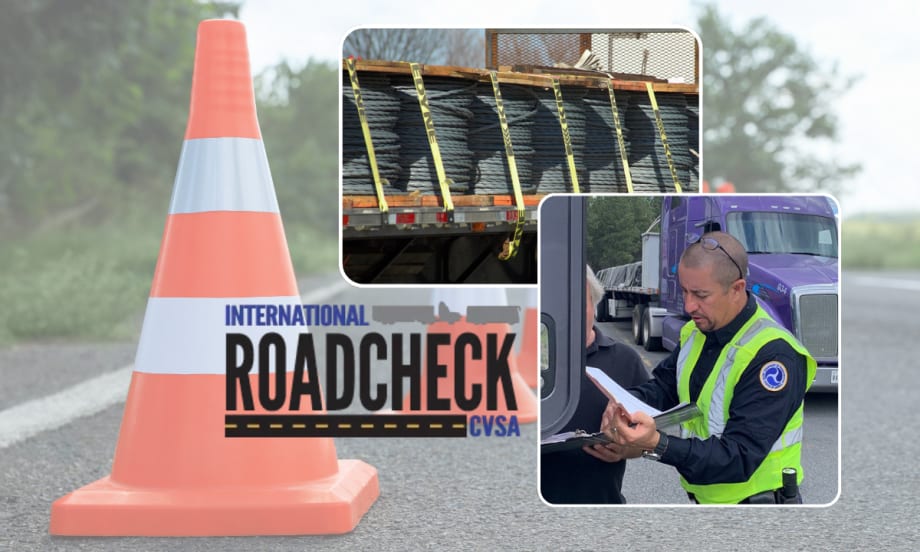
Inspection officials will be focusing on tires and driver hours of service records.
HDT Graphic. Photos Jim Park, CVSA
The Commercial Vehicle Safety Alliance will hold its annual International Roadcheck commercial vehicle inspection blitz May 13-15, focusing on tires and truck driver hours of service.
Roadcheck is a high-visibility, high-volume commercial motor vehicle inspection and regulatory compliance enforcement initiative that takes place over three days in Canada, Mexico and the United States.
Law enforcement personnel will inspect commercial motor vehicles and drivers at weigh/inspection stations, temporary sites and mobile patrols. Data from the 72 hours of International Roadcheck will be collected and the results will be released this summer.
Each year, International Roadcheck places special emphasis on a driver violation category and a vehicle violation category.
During International Roadcheck, inspectors will primarily conduct the North American Standard Level I Inspection, a 37-step procedure that includes an examination of driver operating requirements and vehicle mechanical fitness.
This year inspectors will pay special attention to hours-of-service compliance and to tires during this DOT blitz week.
CVSA Focusing on Hours of Service for Roadcheck Driver Inspections
In last year’s Roadcheck, hours of service were the top out-of-service violation for drivers, making up 32% of the driver violations in North America. It was also the top driver violation in the U.S.
To ensure compliance of driver hours-of-service regulations, drivers track their times and duty statuses in an electronic or paper log, what CVSA calls the record of duty status (RODS).
Failure to record, complete or retain the log, or knowingly falsifying logs or other related reports, is not only a driver out-of-service violation, it also makes the driver and/or carrier liable to prosecution.
During the driver portion of an inspection, inspectors check the driver’s documents, license or commercial driver’s license, medical examiner’s certificate and skill performance certificate (if applicable), record of duty status, Drug and Alcohol Clearinghouse status (in the U.S.), seat belt usage, and alcohol and/or drug impairment.
If an inspector identifies driver out-of-service violations, they place the driver out of service, restricting that driver from operating their vehicle.
Tires to Be CVSA's Vehicle Focus Area
CVSA is focusing on tires during this year's Roadcheck
“Tire failure while in transit is a hazard to all motorists," CVSA said in its Roadcheck announcement.
"It is also far more expensive and time-consuming for motor carriers to repair an in-transit tire failure versus proactively maintaining tire health and addressing tire issues before the vehicle is on the road.”
During International Roadcheck, inspectors will check tires’ tread depth and proper inflation. They will also be on the lookout for tire damage, such as air leaks, tread separation, cuts, bulges, sidewall damage and improper repairs.
Last year’s top vehicle out-of-service violation in North America was for defective brakes, with 25% of the violations. It also was the top OOS vehicle violation in the U.S.
But tires were close behind at 21% in second place in North American inspections.
What is a CVSA Level 1 Commercial Vehicle Inspection?
During the vehicle portion of the Level I Inspection, inspectors ensure the vehicle’s brake systems, cargo securement, coupling devices, driveline/driveshaft components, driver’s seat, fuel and exhaust systems, frames, lighting devices, steering mechanisms, suspensions, tires, wheels, rims, hubs, and windshield wipers are compliant with applicable regulations.
A vehicle that successfully passes a Level I or V Inspection without any critical vehicle inspection item violations may receive a CVSA decal, which is valid for up to three months.
If out-of-service violations are found during an inspection, as outlined in the North American Standard Out-of-Service Criteria, the vehicle is restricted from operating until all out-of-service violations have been properly addressed.
As part of International Roadcheck, inspectors may also be available to answer questions about tire health and violations, and to help drivers navigate the HOS regulations in their jurisdictions.
CVSA is a nonprofit organization made up of local, state, provincial, territorial and federal commercial motor vehicle safety officials and industry representatives in Canada, Mexico and the U.S. Its mission is to improve commercial motor vehicle safety and enforcement across North America.
More Safety & Compliance

FMCSA Pauses Biennial-Update Enforcement Amid Motus Transition
Carriers whose updates were due on or after June 1 have more time, while FMCSA works to stabilize its new registration system and warns of phishing sites impersonating its new carrier registration system, Motus.
Read More →
ZF Expands Commercial Vehicle Push in North America
ZF is expanding its North American commercial-vehicle presence with new transmission applications, electrification, trailer technology and autonomous-driving systems.
Read More →
Truck Drivers Need More Than Another Alert
Fleets have more visibility into truck health, safety events, and driver activity than ever. The next challenge is turning all that information into useful guidance for the person who has to decide what to do next.
Read More →
Tesla Wants a Self-Driving Semi. Are Cameras Enough?
Could Tesla’s camera-only autonomous driving technology work on an 80,000-pound Semi? In this commentary, HDT's Deborah Lockridge takes a look at Tesla, Cybercab, and how autonomous trucks see the road.
Read More →
What DOT’s Automated Vehicle Strategy Means for Trucking
The U.S. Department of Transportation issued a new automated-vehicle strategy that outlines plans for driverless-truck regulations, cross-state freight corridors, and federal safety standards.
Read More →
NYC Expands Speed, Pedestrian Safety Tech Across Fleet
New York City is expanding intelligent speed assistance and pedestrian-alert systems across its municipal fleet, moving the technologies from pilot programs into vehicle procurement and retrofit requirements.
Read More →
FMCSA Removes 110 Truck Driver Training Schools from Certified ELDT List
Federal regulators also are targeting more than 160 additional training providers and launching a nationwide audit of third-party CDL skills testers as part of a broader crackdown on trucking fraud.
Read More →
Beyond DOT Compliance: What Makes a Trucking Fleet Truly Safe?
A trucking fleet can follow every rule and still make unsafe decisions. The real test comes when safety conflicts with freight, productivity, or cost.
Read More →
Hours of Service Pilot Programs: FMCSA Readies for 2027 Rollout
Two pilot programs could eventually reshape hours-of-service rules, giving truck drivers options to pause their 14-hour clock or use longer split sleeper rest periods.
Read More →
New Guide Offers Pet Safety Tips for Truck Drivers
Hundreds of thousands of pets travel in truck cabs. A new safety guide from Volvo Trucks and the Center for Pet Safety offers practical advice for truck drivers who bring dogs and cats along for the ride.
Read More →