




What do Pandemic-Scrambled Retail Inventory Trends Mean for Trucking?
The inventories-to-sales ratio traditionally has been a key indicator for assessing near-term transportation demand. Right now they're very lean, which usually is good news for trucking – but there's a catch.
The largest drivers of freight demand are consumption and production. For the past year, the growth in consumption of has been unprecedented. The four largest month-over-month gains in retail sales have come since April 2020, largely driven by stimulus from Washington.
Production has not matched the trajectory, but the challenge has not been a lack of demand. For example, if you exclude the troubled aircraft industry, orders for durable manufactured goods have been running at record levels. Rather, the issue is supply of materials, components, and labor.
Another significant factor in the demand for freight transportation is inventories – or, more to the point, the relation of inventories to sales. The inventories-to-sales ratio traditionally has been a key indicator for assessing near-term transportation demand. Individual sectors – manufacturing, wholesale, and retail – have different norms for the ratio of inventories to sales, but as the ratio falls, we expect to see pressure for inventory replenishment, which bolsters freight volume beyond the period of initial consumer or manufacturing demand.
The pandemic produced wild swings in inventories-to-sales ratios due to abrupt changes in consumption and production. As of February, the most recent month for which data is available, the ratios for the manufacturing sector are roughly in line with where they were before the pandemic, and inventories in wholesale are noticeably leaner than they had been.
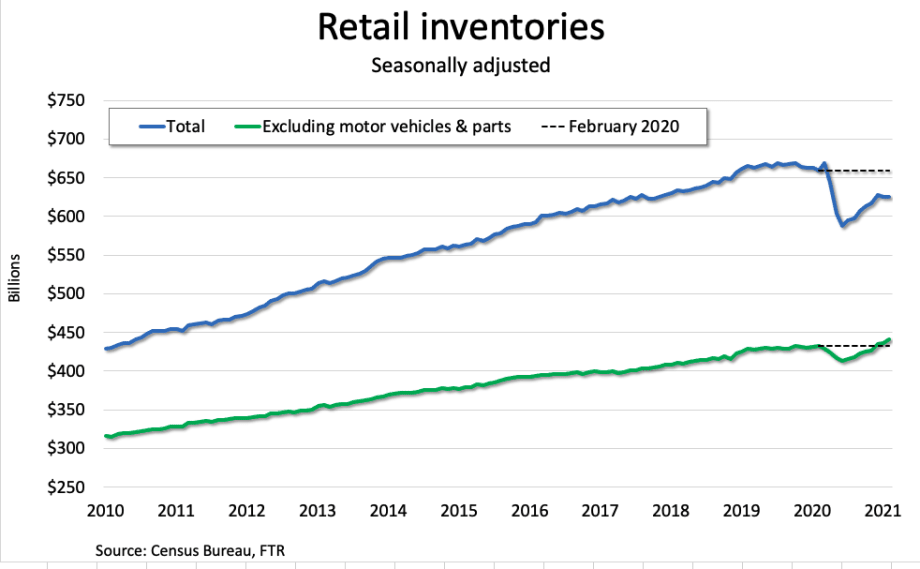
The most dramatic change has been in retail inventories. February saw an uptick in the ratio of inventories to sales following a record low retail inventories-to-sales ratio in January. With a huge jump in retail sales in March in the wake of the third round of stimulus, the inventories-to-sales ratio likely was as low as or even lower than January.
For trucking companies involved in hauling retail goods, this sounds like great news. It suggests that freight demand will outlive the bursts of consumption we have seen after each round of stimulus.
However, if we dig deeper, we find that a single sector – motor vehicles and parts – skews the data.
Motor vehicles are far more expensive than any other retail item, so changes in inventories or sales of automobiles and light trucks have an outsized effect on total retail inventories and sales, even when changes are small. During the pandemic, those changes have not been small. Sales have been robust, but their growth has been mostly in line with retail sales in general. The distortion comes from inventories.
Total retail trade inventories in February were down 5.1% year over year. However, inventories of motor vehicles and parts were down 17.1%. Excluding motor vehicles and parts, retail trade inventories were up 1.2%. That is not much growth, but it is growth. Of course, retail sales have been so strong that the ratio of inventories to sales is still extraordinarily low. But if sales weaken down the road, we will not necessarily see the same demand for replenishment that we would see if inventories were down on an absolute basis.
Aside from automotive, the only retail sectors with large declines in inventories during the pandemic are clothing stores and department stores – segments where lower inventories might not yield much sales pressure owing to the surge in e-commerce.
Automotive, however, faces a potentially crippling inventory crunch in the near term. While inventories are down quite sharply, retail sales of motor vehicles and parts were the highest on record in March. Meanwhile, automotive production during March was still about 8% below February 2020 (seasonally adjusted), and the near-term outlook for higher production is bleak due to the shortage of semiconductors.
The “glass half full” view of the situation is that extraordinarily tight inventories of cars, trucks, and SUVs could keep automotive production humming for many months beyond the period of very strong retail sales.
More Fleet Management

Geotab Links Fleet Card to Vehicle Data
The new card combines fuel discounts with telematics-based purchase controls. Geotab’s analysis also points to potential savings from choosing lower-priced fuel stops.
Read More →
How MFA Helps Protect Trucking Fleets
Multi-factor authentication adds protection when passwords are stolen. Here’s how it works and where fleets should start.
Read More →
How Better Freight Data Helps Trucking Teams Get Ahead of Disruption
Trucking and logistics teams have plenty of data. The problem is getting the right information in front of the right people soon enough to act. Better-connected data can help teams spot trouble earlier and make smarter decisions before small problems become big ones.
Read More →

Trimble: Taking Artificial Intelligence in Trucking Beyond Faster Tasks
At Insight 2026, Trimble executives argued that fleets may need to redesign workflows to get more from AI as it introduced new products and enhancements. AI’s value will depend on how fleets combine automation with their people's knowledge.
Read More →
Build a bulletproof fleet: Uniting ELDs and dash cams for total compliance
An ELD can prove compliance, but it cannot always prove what happened on the road. Discover how uniting accurate ELD data with AI-powered dash cam video can help your fleet strengthen compliance, defend against liability, protect drivers and reduce operational costs.
Read More →
Nominations Open for HDT Emerging Leaders
Heavy Duty Trucking is looking for accomplished trucking fleet professionals under 40 who are making an impact and helping lead the industry forward.
Read More →
Why Private Fleets Are Taking More Freight
Private fleets are putting their own trucks on demanding customers and high-cost lanes as companies seek greater control over service, costs, and capacity.
Read More →
Color Match Smarter: Tools That Restore & Perform
For fleet managers and collision repair professionals keeping heavy-duty trucks on the road, getting the color right the first time isn't just about appearance — it's about efficiency, turnaround time, and bottom-line results. Discover how today's digital color tools are transforming the repair process from guesswork to precision.
Read More →
FMCSA Pauses Biennial-Update Enforcement Amid Motus Transition
Carriers whose updates were due on or after June 1 have more time, while FMCSA works to stabilize its new registration system and warns of phishing sites impersonating its new carrier registration system, Motus.
Read More →
2026 Blueprint for Countering Smarter Supply Chain Theft
Cargo theft is no longer just the cost of doing business. It's a multi-billion-dollar criminal enterprise exploiting vulnerabilities across your fleet, drivers, and supply chain.
Read More →