




WattEV Opens World’s Largest Solar-Powered Truck Charging Depot
WattEV’s newest charging depot in Bakersfield features MCS rapid charging and battery energy storage system.

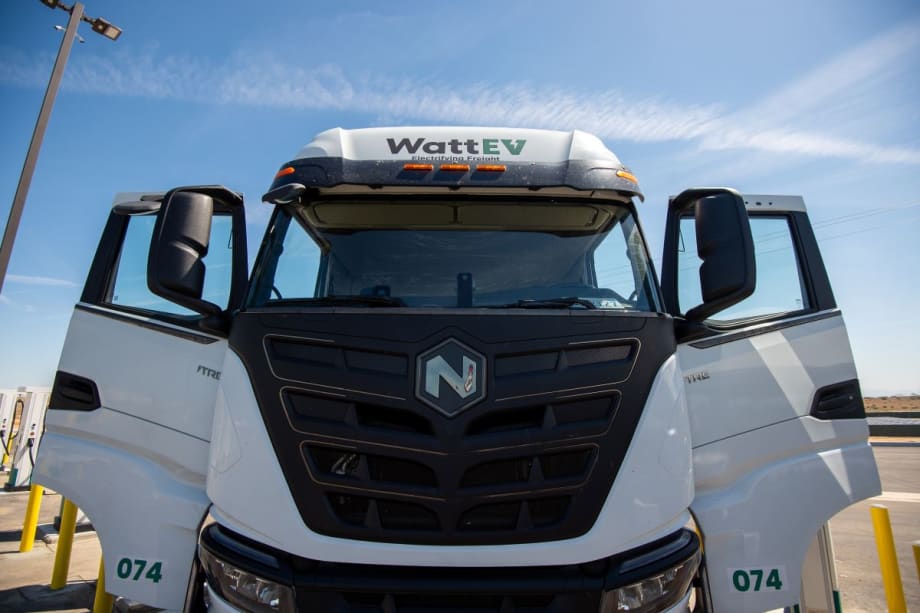
WattEV has opened what it says is the world's largest solar charging station for battery-electric trucks near Bakersfield, California.
Photo: WattEV
WattEV has opened its fourth electric truck charging depot. This newest facility, which the company bills as the largest solar-powered truck charging depot in the world is located in Bakersfield, California. Opening ceremonies were held on May 6.
The WattEV Bakersfield depot will connect the San Joaquin Valley’s vast agricultural sector and growing warehousing complexes to California’s seaports and inland destinations.
1 Megawatt Charging Capability
The 119-acre site is designed, owned, and operated by WattEV. This is the world’s first electric truck stop featuring a solar-powered microgrid with a battery energy storage system (BESS) and is capable of megawatt rapid charging (MCS), according to the company.
This state-of-the art station features 16 dual-cord 360kW chargers connected to the grid and 15 single-cord 240kW CCS chargers, plus three MCS 1,200kW rapid chargers, drawing power from the site’s solar array.
Significantly, the MCS chargers will bring down truck charging “dwell time” from hours to less than 30 minutes, said WattEV CEO Salim Youssefzadeh.
“Reducing the charge time to less than 30 minutes for a 300-mile range will be a game-changer in the adoption of electric trucks,” Youssefzadeh said. “We developed all of our charging facilities to allow for the transition from the current CCS charging standard to the new, faster MCS charging, in preparation for this evolution.”
Strategically Located
With its black, green and white “WattEV” brand, the depot is located near the junction of busy highways CA-99 at CA-65. It will serve heavy-duty electric trucks with routes connecting the San Joaquin Valley’s vast agricultural sector and growing distribution warehouse region to the state’s seaports and inland destinations throughout Southern California and the West.
The WattEV Bakersfield charge depot features amenities such as restrooms and a commercial center with lease space available for food and merchandise vendors.
In support of its mission to accelerate the transition to zero-emission transport solutions, this is the third new electric truck charging depot WattEV has opened in California in the past month, adding to the Port of Long Beach station that started operation in July 2023. Other open locations include San Bernardino and Gardena. All future WattEV depots will include MCS charging.
WattEV has it has spent the past three years building out the first freight corridors in the nation for public-access, MHD electric vehicle charging. This includes large-scale solar-powered charging depots in the permitting stages in Blythe (on Interstate 10) and Sacramento, Gustine and Taft Highway (on Interstate 5) all in California, as well as Salem, Oregon, and Seattle-Tacoma, Washington (on Interstate 5).
Along with the Bakersfield depot, WattEV is completing the electrification of the CA-99 freight corridor connecting the nation's most productive agricultural region in the San Joaquin Valley to major ports, with more depots planned in Fresno, Stockton and Oakland.
Truck-as-a-Service Business Model
To assist shippers and fleet operators with the transition to zero-emission truck transport, WattEV offers an innovative electric Truck-as-a-Service (TaaS) model that provides fleets or individual operators with access to Class 8 battery-electric trucks, reliable maintenance support, insurance, and charging across WattEV’s network, all at a total cost of operation that is on par with diesel trucks, according to the company.
WattEV received some $5 million in grant funding from the California Energy Commission to build the WattEV Bakersfield charging depot, with future support from the San Joaquin Valley Air Pollution Control District to expand the capacity.
“We appreciate the leadership of WattEV in helping to move forward nation-leading efforts to deploy the next generation of zero-emissions freight infrastructure in the San Joaquin Valley,” stated Samir Sheikh, Executive Director and Air Pollution Control Officer for the Valley Air District.
“This charging depot is a significant milestone for the region and state as a whole, and is a testament to the Valley Air District's commitment to reducing air pollution, improving public health, and supporting the Valley’s economy,” he said.
The APCD says mobile sources of emissions account for the single largest source of ozone and PM2.5 forming NOx, toxic diesel particulate matter, and greenhouse gas emissions in the Valley.

WattEV CEO Salim Youssefzadeh talks to the media during the grand opening of its new truck charging facility in Bakersfield, California on May 6, 2024.
Photo: WattEV
Reducing emissions from these mobile sources, including both heavy-duty and light duty vehicles, is a critical component of the District’s overall strategy to attain stringent health-based federal air quality standards. With 45% of the truck traffic in California occurring in the San Joaquin Valley, projects such as these are critical in improving air quality in the region.
Liane Randolph, chair of the California Air Resources Board, reiterated the clean air benefits WattEV’s Bakersfield charging will bring to the San Joaquin Valley.
“With the opening of this latest of four charging depots across California – all located in strategic locations that serve the state’s freight industry – WattEV is demonstrating the infrastructure build-out that will support a zero-emissions future,” said Randolph. “The truckers who transport goods across the state will be able to charge quickly, save on fueling costs, and contribute to air quality solutions that create healthier communities for all.”
More Fuel Smarts

How Volvo Updated Its D13 for EPA 2027 [Watch]
Volvo’s updated D13 promises lower emissions without sacrificing performance or fuel economy. Take a closer look at what changed inside the engine in this HDT Spotlight video.
Read More →
Diesel Price Spike Shortens Payback for Natural Gas Trucks, Report Says
Energy Vision estimates fleets could recover the higher purchase price of an RNG-fueled Class 8 tractor in 1.3 to 2.8 years under current fuel-price scenarios.
Read More →
Calstart Becomes Catalyst Mobility, Reflecting Broader Focus
Calstart is now Catalyst Mobility, reflecting the nonprofit’s growing national role in clean transportation, including zero-emission trucks, infrastructure and incentive programs.
Read More →

Record Diesel Prices Squeeze Trucking Fleets
Average U.S. diesel prices have climbed to nearly $6 a gallon, surpassing the 2022 record as tight refinery capacity and Middle East disruptions keep fuel costs elevated.
Read More →
How Fuel Delivery Shapes Engine Performance
Fuel delivery depends on more than what happens at the injector. For fleet, maintenance and technical professionals, looking at the full path from pump to injector can provide useful context for understanding engine performance.
Read More →
East Coast Port Launches $45M Electric Truck Push
The Port Authority of New York and New Jersey announced millions in incentives for zero-emission drayage trucks, yard tractors, and new charging hubs near the port.
Read More →
California Bill Could Shed Light on Electric Truck Prices
Why do battery-electric Class 8 trucks remain so expensive? A California bill headed to Gov. Gavin Newsom would give fleets and state agencies more visibility into what manufacturers charge.
Read More →
Detroit Opens Orders for EPA 2027 Engines
Detroit isn’t starting from scratch to meet EPA 2027 diesel emissions standards. Its Gen 6 DD13 and DD15 engines keep much of today’s platform while updating the fuel and aftertreatment systems.
Read More →
Zero-Emission Truck Corridor Planned for West Coast
California, Oregon, Washington, British Columbia and Baja California are coordinating plans for truck charging and hydrogen fueling from Canada to Mexico.
Read More →
A Closer Look at Kenworth’s Electric T880E Vocational Truck [Video]
Learn more about Kenworth's T880E battery-electric vocational truck at the Paccar Technical Center, including its range, applications, upfitting considerations, and PTO options, in this HDT Spotlight video.
Read More →