





Watch Walmart’s Weeks speak about creating a roadmap to zero emissions on HDT's 2023 Road to Zero Emissions webinar.
Walmart Says It Won't Meet 2040 GHG Goals
Walmart said it will not be able to meet its ambitious emissions goals, in part because it does not expect cost-effective low-carbon transportation to become a reality as soon as earlier projected.
January 10, 2025
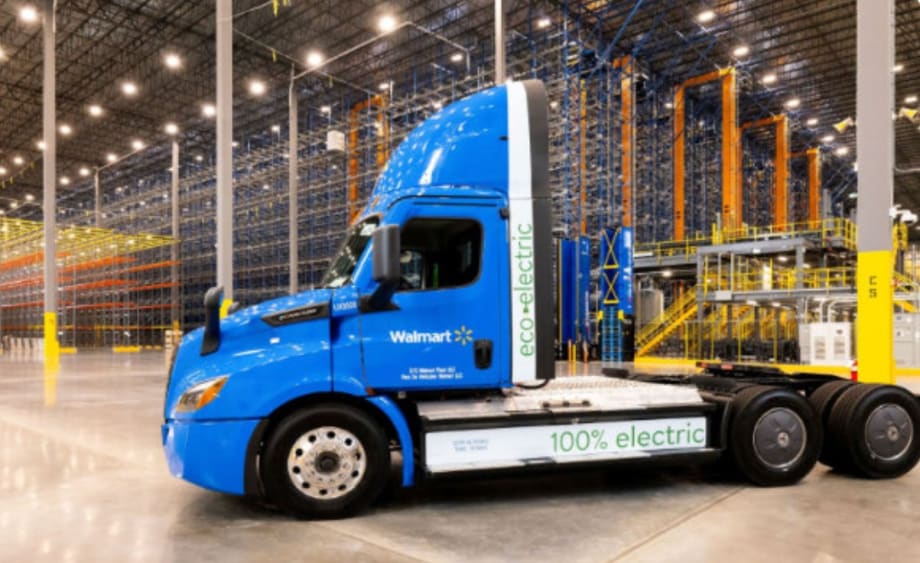
Walmart has been piloting all-electric trucks and other zero-emissions technologies, but says it doesn't expect cost-effective zero-emissions transport to be a reality in the near future.
Photo: Walmart
3 min to read
Walmart said it will not be able to meet its ambitious emissions goals, in part because it does not expect cost-effective low-carbon transportation to become a reality as soon as earlier projected.
In its ESG report released last month, Walmart said, “While we continue to work toward our aspirational target of zero operational emissions by 2040, progress will not be linear… and depends not only on our own initiatives but also on factors beyond our control.”
Among those factors, it said, was “timely emergence of cost-effective technologies for low-carbon heavy tractor transportation (which does not appear likely until the 2030s).”
In 2020, Walmart announced a plan to achieve zero-carbon operations by 2040. Part of that plan was electrifying all of its vehicles, including long-haul trucks, by 2040. But Class 8 electric trucks are still too expensive.
The Challenges of ZEVs in Trucking
During a panel discussion at ACT Expo 2024, Walmart Senior Engineering Manager Brooke Weeks explained, “We hope the cost curve will start bending as there is more consistency and scale in vehicles, but today for some use cases ZEVs are two-and-a-half times the cost of diesel.”
The good news, she said, was the company was seeing lower operating costs for zero-emission vehicles. “We can achieve more by managing charging schedules and sharing charging infrastructure.”
The company said it will consider revising its targets in 2025 based on the best available information and assumptions available.
In 2023, the Walmart fleet (transport fuel, mobile refrigerants) contributed 26% of its Scope 1 emissions.
“While we have prioritized achieving zero emissions from our vehicles and transportation network, we have also been transparent that meaningfully addressing transportation-related emissions would take many years,” Walmart said.
“Indeed, relevant technologies for the highest-emitting sources — including Class 8 tractors, refrigerated trailers, and yard trucks — are nascent.”
At the same time, Walmart has grown its fleet and brought some routes formerly served by third parties in-house to serve with its private fleet. Those increases contributed to a 10% increase in transportation fuel emissions in 2023 vs. 2022.
What Walmart is Doing to Reduce Transportation Emissions
“While the nascent state of scalable technology will mean that transportation-related emissions are unlikely to decline over the next few years,” Walmart said it is using several strategies to make headway.
It is testing new technologies such as heavy-duty battery electric vehicles and hydrogen fuel cell vehicles, including transitioning to liquid hydrogen-operated forklifts.
While truck fleet efficiency remains a focus, new technologies will play a role in decarbonizing long-haul/heavy-duty Class 8 tractors and yard trucks, Walmart said, including renewable diesel, battery-electric, and hydrogen fuels.
Walmart is actively deploying and piloting these technologies. For example, it uses electric yard trucks at some facilities.
More Fuel Smarts

How Volvo Updated Its D13 for EPA 2027 [Watch]
Volvo’s updated D13 promises lower emissions without sacrificing performance or fuel economy. Take a closer look at what changed inside the engine in this HDT Spotlight video.
Read More →
Diesel Price Spike Shortens Payback for Natural Gas Trucks, Report Says
Energy Vision estimates fleets could recover the higher purchase price of an RNG-fueled Class 8 tractor in 1.3 to 2.8 years under current fuel-price scenarios.
Read More →
Calstart Becomes Catalyst Mobility, Reflecting Broader Focus
Calstart is now Catalyst Mobility, reflecting the nonprofit’s growing national role in clean transportation, including zero-emission trucks, infrastructure and incentive programs.
Read More →

Record Diesel Prices Squeeze Trucking Fleets
Average U.S. diesel prices have climbed to nearly $6 a gallon, surpassing the 2022 record as tight refinery capacity and Middle East disruptions keep fuel costs elevated.
Read More →
Sponsored•September 9, 2026
How Fuel Delivery Shapes Engine Performance
Fuel delivery depends on more than what happens at the injector. For fleet, maintenance and technical professionals, looking at the full path from pump to injector can provide useful context for understanding engine performance.
Read More →
East Coast Port Launches $45M Electric Truck Push
The Port Authority of New York and New Jersey announced millions in incentives for zero-emission drayage trucks, yard tractors, and new charging hubs near the port.
Read More →
California Bill Could Shed Light on Electric Truck Prices
Why do battery-electric Class 8 trucks remain so expensive? A California bill headed to Gov. Gavin Newsom would give fleets and state agencies more visibility into what manufacturers charge.
Read More →
Detroit Opens Orders for EPA 2027 Engines
Detroit isn’t starting from scratch to meet EPA 2027 diesel emissions standards. Its Gen 6 DD13 and DD15 engines keep much of today’s platform while updating the fuel and aftertreatment systems.
Read More →
Zero-Emission Truck Corridor Planned for West Coast
California, Oregon, Washington, British Columbia and Baja California are coordinating plans for truck charging and hydrogen fueling from Canada to Mexico.
Read More →
A Closer Look at Kenworth’s Electric T880E Vocational Truck [Video]
Learn more about Kenworth's T880E battery-electric vocational truck at the Paccar Technical Center, including its range, applications, upfitting considerations, and PTO options, in this HDT Spotlight video.
Read More →