





Related: Active Steering is There to Assist Drivers, Not Take Over
Volvo Trucks Brings Volvo Dynamic Steering to North America
Volvo Trucks is introducing Volvo Dynamic Steering to North America following five years of production in Europe. It’s billed now as a driver assist feature, but it will likely be a pathway to some active steering technology.
September 13, 2019
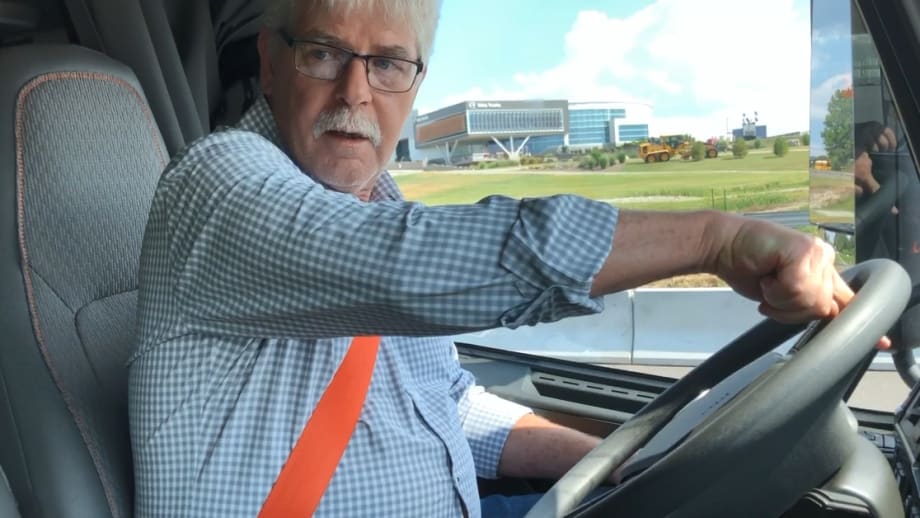
When the system was active, sharp turns could be accomplished with just one finger on the wheel.
Photo: Jim Park
4 min to read
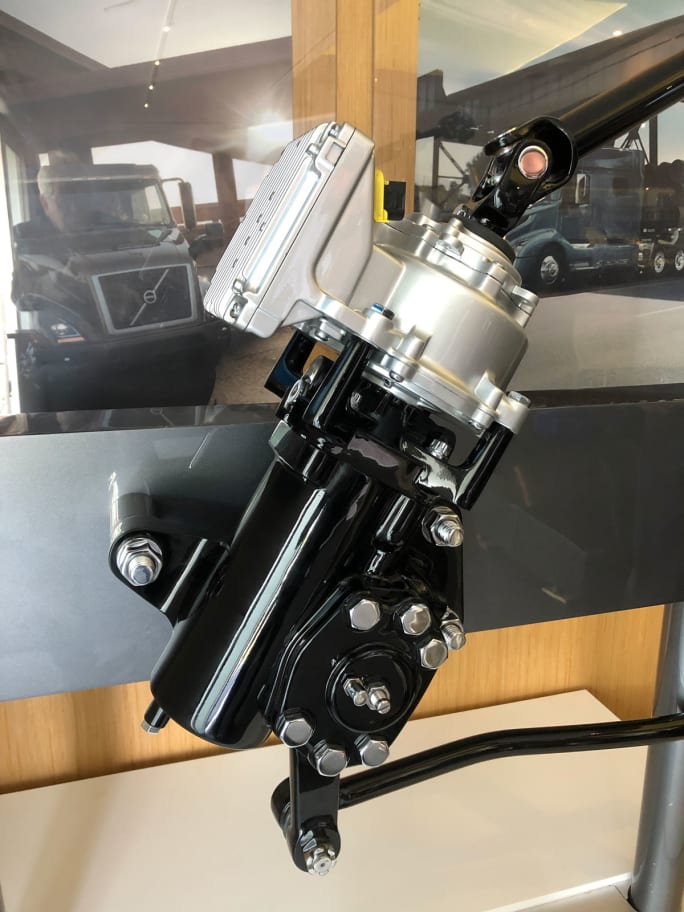
Volvo Dynamic Steering consists of an electric motor mounted on the power steering gear. The steering column runs through the motor to the steering gear.
Photo: Jim Park
Volvo Trucks is adding a new driver-assist steering feature to its 2020 model-year line-up. Volvo Dynamic Steering is an electric-over-hydraulic steering-assist system designed to improve maneuverability and lessen driver steering effort by up to 85% at low speed while maintaining a stiffer feel at highway speeds. VDS is also said to reduce driver fatigue through reduced steering effort while reducing road-shock transmitted through the steering column and steering wheel to the driver.
VDS is an active steering system that uses an electric motor mounted on top of the hydraulic steering gear. The motor provides additional torque when needed in the steering effort, but it also helps absorb and mitigate steering column torque originating at the wheels. Drivers will immediately notice the absence of shocks and abrupt wheel movement when driving on rough surfaces.
Volvo believes VDS will help reduce driver irritation and injuries resulting from repetitive strain associated with traditionally stiff steering and shock loads at the steering wheel.
"Drivers are the trucking industry’s biggest assets, and opportunities to increase driver recruitment and retention are top-of-mind for our customers," said Chris Stadler, product marketing manager, Volvo Trucks North America. "Providing state-of-the-art features that improve drivers' physical working conditions and comfort is an important aspect of driver satisfaction, as well as increasing overall productivity and road safety."
First launched by Volvo Trucks in Europe in 2013 (and the subject of viral videos like The Epic Split), VDS is ideal for diverse and changing terrains and automatically adjusts to handle any roadway condition. From rough roads to tight maneuvers in urban environments, VDS can help drivers navigate unexpected situations such as potholes and rapid tire deflations. It provides up to nine ft.-lb. of torque in the steering column.
VDS had to be adapted for North American trucks from the European cabover trucks with their unique steering geometry and heavier axle loads.
VDS is not an active steering system. It will not steer the truck – merely assist the driver in doing so. Stadler told reporters the VDS mechanism could be a stepping=stone to active steering functionality such as lane keeping assist and lane departure prevention, which will likely be added at some later date.
Should the system fail or malfunction, the steering reverts to standard hydraulic steering in the absence of the electric assist. Drivers will also get a notification in the driver display alerting them to the status of the system.
"Nothing with VDS short of a hydraulic system failure will disable the truck or put it down," said Stadler. "The truck will be completely safe to operate without VDS and won't force any unnecessary downtime."
With more controlled steering, VDS also helps reduce operational fatigue by filtering road vibration and noise that comes up through the steering wheel. Repetitive motions due to varying roadway conditions and maneuvering actions could cause physical discomfort, which can be lessened when using this system. In fact, testing has shown that VDS has the potential to cut muscular strain by up to 30% and for some specific motions, strain can be reduced up to 70%.
“With the VDS system, we see increased productivity for our customers and decreased fatigue for drivers," said Stadler. "In addition, it contributes to improved stability and control of the vehicle, thereby increasing road safety.”
Key VDS features include:
Vehicle Stability Control leads to increased directional stability on the highway, which offers a more relaxed and safe driving experience with full control at all speeds.
Return-to-Center, or Zero Return enables the steering wheel to return to the center position when the vehicle is in motion, making it easier to reverse the vehicle and maneuver in tight areas.
Dampening allows the steering system to filter inputs from the road surface and, based on feedback from multiple sensors, helps improve handling and vehicle stability.
Lead/Pull Compensation provides a torque offset within the steering system to compensate for crowned roads, steady crosswinds and other short-term conditions that can affect handling.
Quick Spin
Following a technical discussion where VDS was introduced, editors had the opportunity to drive trucks equipped with VDS on the test track at Volvo's Customer Center in Dublin, Virginia.
The system could be switched on and off for demonstration purposes, but it will be always on in real-world service and utterly transparent to drivers.
At low speed, the steering is car-like and the wheel is extremely easy to turn. It stiffens up as speed increases to a point where the VDS is probably not contributing at all to the steering effort. While backing, the system will self-center the wheels (something truck steering will not normally do) to aid in steering precision.
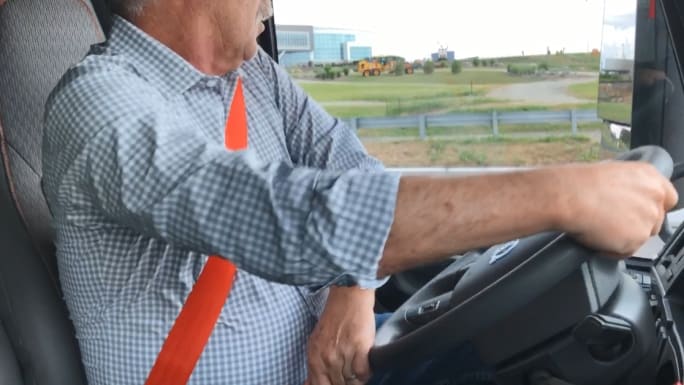
Some effort is required to turn the wheel sharply at low speed, such as when reversing or making sharp turns, when the system was turned off for the demonstration.
Photo: Jim Park
The demonstration included a trip across a series of off-set bumps. Without VDS the steering tugged hard right and left as the wheels rode over the bumps. With VDS on, the bumps couldn't even be felt.
VDS dramatically reduced the effort required to turn the steering wheel at low speeds, and nearly eliminated the shock and vibration felt through the wheel by the driver.
Volvo will start taking orders for Dynamic Steering beginning in this fall. It will go into production in April 2020.
More Equipment

How Volvo Updated Its D13 for EPA 2027 [Watch]
Volvo’s updated D13 promises lower emissions without sacrificing performance or fuel economy. Take a closer look at what changed inside the engine in this HDT Spotlight video.
Read More →
Michelin Tire Improves Efficiency and Durability for Regional Fleets
The Michelin X Multi Energy D2 is a regional haul drive tire engineered to help fleets improve fuel efficiency, durability and traction in demanding stop-and-go operations.
Read More →
ZF Expands Commercial Vehicle Push in North America
ZF is expanding its North American commercial-vehicle presence with new transmission applications, electrification, trailer technology and autonomous-driving systems.
Read More →
Tesla Wants a Self-Driving Semi. Are Cameras Enough?
Could Tesla’s camera-only autonomous driving technology work on an 80,000-pound Semi? In this commentary, HDT's Deborah Lockridge takes a look at Tesla, Cybercab, and how autonomous trucks see the road.
Read More →
Kodiak: Driverless Long-Haul Truck Launch on Track for 2026
Kodiak AI says its driverless long-haul safety case is 93% complete and it remains on track to begin commercial operations by year-end 2026.
Read More →
What DOT’s Automated Vehicle Strategy Means for Trucking
The U.S. Department of Transportation issued a new automated-vehicle strategy that outlines plans for driverless-truck regulations, cross-state freight corridors, and federal safety standards.
Read More →
East Coast Port Launches $45M Electric Truck Push
The Port Authority of New York and New Jersey announced millions in incentives for zero-emission drayage trucks, yard tractors, and new charging hubs near the port.
Read More →
PlusAI Going Public to Fund Autonomous Truck Launch
A SPAC deal could provide PlusAI with up to $300 million as it works toward a 2027 commercial launch of factory-built autonomous trucks.
Read More →
NHTSA Moves to Rewrite Truck Fuel-Economy Rules
The National Highway Traffic Safety Administration says it lacks authority to regulate medium- and heavy-duty truck engines separately from complete vehicles, but the existing standards have not yet been eliminated.
Read More →
Detroit Opens Orders for EPA 2027 Engines
Detroit isn’t starting from scratch to meet EPA 2027 diesel emissions standards. Its Gen 6 DD13 and DD15 engines keep much of today’s platform while updating the fuel and aftertreatment systems.
Read More →