





"We used to be happy with high sevens, but now we're into the 9+ mpg range with 80,000 pounds one way and back empty. I no longer think 10 mpg is out of the question."
Volvo Boosts Fuel Economy by the Power of Two
Volvo's Adaptive Loading axle system turns a 6x2 into a 4x2 when the extra axle in the tractor tandem isn't needed. When it comes to fuel efficiency, 2 is definitely better than 4.
August 24, 2015
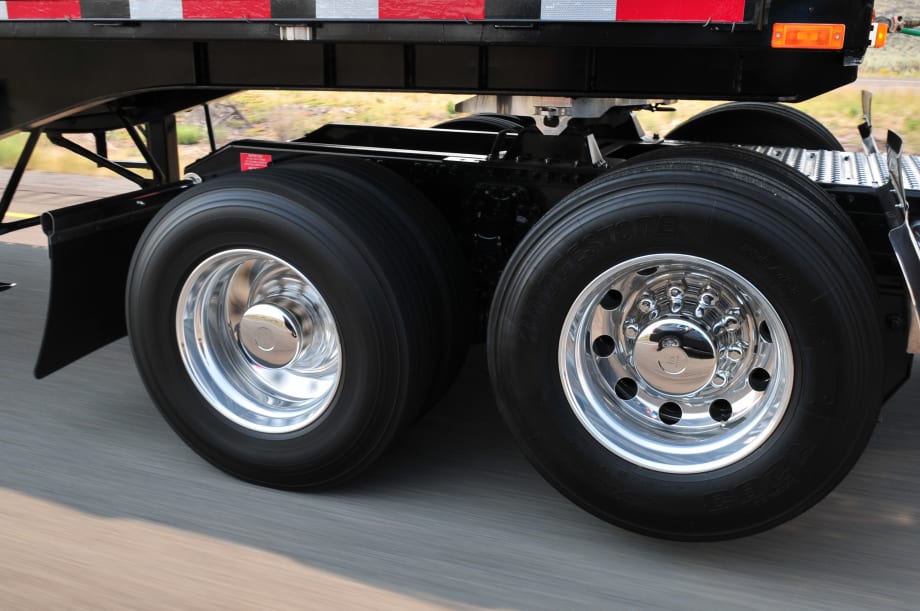
When there's no work to do, an unladen axle is just fuel-sucking dead weight. Volvo gets it up and out of the way when it's not needed. Photo by Jim Park.
4 min to read
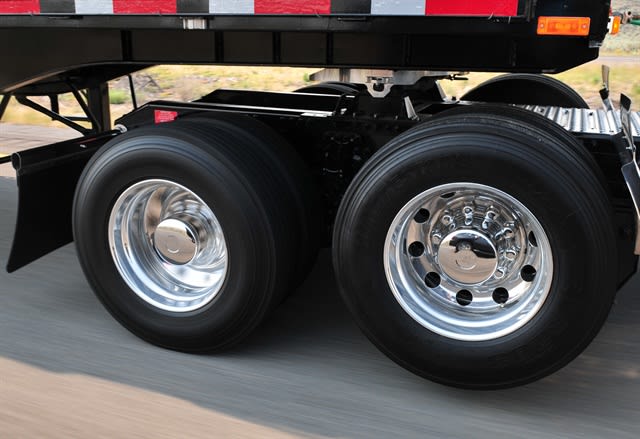
When there's no work to do, an unladen axle is just fuel-sucking dead weight. Volvo gets it up and out of the way when it's not needed. Photo by Jim Park.
HEYBURN, IDAHO -- The 6x2 concept has taken a new twist, and Volvo Trucks is the first North American truck maker to offer such a configuration. Volvo calls the concept Adaptive Loading. It's a 6x2 arrangement but with a pusher axle rather than a tag, and the pusher axle is liftable, turning the tractor into a 4x2 set up for lightly loaded or empty conditions.
Volvo unveiled Adaptive Loading at the Mid-America Trucking Show in March, and introduced the concept to the trade press at ride and drive event here on August 20.
Adaptive Loading begins with an electronically controlled tractor air suspension that senses vehicle weight via the air pressure in the suspension. When the truck is empty or just lightly loaded, the system lifts the (forward) pusher axle, letting the (rear) drive axle bear the weight.
When the truck is loaded and the liftable axle is down, the system will automatically bias the suspension pressure toward the driving axle for better traction. Under normal conditions, the rear axle might run 5 psi higher pressure than the pusher axle.
In situations where additional traction is required, such as on slippery pavement, the suspension will further bias the suspension pressure toward the rear axle. While this function is automatic, the driver can select enhanced traction from a dash mounted traction control switch. This will further bias the rear axle suspension pressure and can be applied only up to 15 mph. In adverse on highway conditions, the system will slightly bias the rear suspension for enhanced traction over the basic mode where the pressure is roughly equal between the two axles.
Chris Stadler, Volvo Trucks' product marketing manager for regional haul, says this improves fuel economy as well as tire wear.
"Fleets participating in our initial trials are reporting fuel economy improvements in the range of 3% to 5%," Stadler said. "They also reported better tire wear on the drive axle, which in a 6x2 arrangement is often worse than a 6x4 axle arrangement."
Adaptive Loading addresses a big concern for bulk haulers and other fleets that run a high percentage of empty or lightly loaded miles. Historically such carriers are plagued with high rates of irregular tire wear due to the lightly loaded axles. Lightly loaded but fully inflated tires tend to bounce along the road, causing cupping and scalloping wear and sometimes flat-spotting.
"This preserves tire life on the liftable axle while adding weight to the driving axle and promoting even contact with the pavement and better tire wear," says Peter Blonde, manager of product strategy for drivetrain systems at Volvo Trucks. "When the truck is empty, you might have 2,500 to 3,000 pounds at each of the four wheel positions in a standard tandem axle. When we lift the front axle of the tandem the weight shifts to the steer axle and the rear drive axle, increasing the weight on the drive tires to 5,000 or 6,000 pounds per wheel position."
Customer Impressions
Volvo invited several fleets to the press event that are currently running Adaptive Loading, and opinions are strongly favorable. Idaho Milk Transport of Burley, Idaho, was the first fleet in the country to take delivery of a truck equipped with Adaptive Loading. Of course it was a customer field trial, but company co-owner Gene Brice say he will be eventually replacing most of the 6x4 tractors in his 150-truck fleet with Adaptive Loading equipped trucks.
"Most of our routes are loaded one way only," Brice says. "We're at a fleet average of 37% empty miles. When we can lift an axle and save that drag and wear and tear, we're saving money."
IMT also equips its tank trailers with manually controlled lift axles to take another set of tires off the road.
As for fuel economy, Brice says one particular truck just ran a month with a fuel-pumped, miles-run average of 9.64 mpg.
"We used to be happy with high sevens, but now were up over eight and even into the 9+ mpg range pulling 80,000 pounds one way and coming back empty," he says. "I no longer think 10 mpg is out of the question."
Brice also reports better tire wear on the 6x2 test truck than his 6x4s.
"The tires on the drive axle are running true and under enough of a load to keep them on the ground," says Brice. "Of course the lift axle tires see only about half the mileage they once did, so they may run out the life of the truck. That's some real savings."
Adaptive Loading is available with Volvo powertrains equipped with the I-Shift and the Premium Shifter. Available engines include the D11 at 405 hp / 1,550 lb ft, and the D13 at 425 hp and 1,750 lb ft. Steer axle ratings range from 12,500-lb to 14,600 lb. The liftable axle, produced by Link Manufacturing, is rated at 20,000 lb. The available drive axle is from Meritor.
The tech
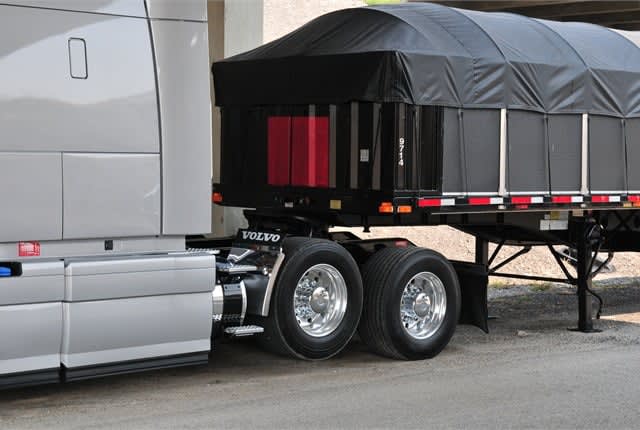
Adaptive Loading will also lift the trailer slightly so the driver will not have to crank so hard on the trailer landing gear. Photo by Jim Park.
nology can be combined with Volvo's XE fuel economy package as well as the XE Adaptive Gearing and Eco-Torque. Overall the Adaptive Loading spec is about 300 pounds lighter than a typical 6x4 powertrain.
Adaptive Loading went into limited production late last year, and will be in full production by January.
More Fuel Smarts

Detroit Opens Orders for EPA 2027 Engines
Detroit isn’t starting from scratch to meet EPA 2027 diesel emissions standards. Its Gen 6 DD13 and DD15 engines keep much of today’s platform while updating the fuel and aftertreatment systems.
Read More →
Zero-Emission Truck Corridor Planned for West Coast
California, Oregon, Washington, British Columbia and Baja California are coordinating plans for truck charging and hydrogen fueling from Canada to Mexico.
Read More →
A Closer Look at Kenworth’s Electric T880E Vocational Truck [Video]
Learn more about Kenworth's T880E battery-electric vocational truck at the Paccar Technical Center, including its range, applications, upfitting considerations, and PTO options, in this HDT Spotlight video.
Read More →
Kenworth T880E Brings EV Power to Vocational Trucks
A closer look at the Kenworth T880E’s range, charging, powertrain and upfit options — and where fleets are showing the most interest.
Read More →
Jennie Abarca Is Proving Electric Trucks Can Do the Job
HDT Truck Fleet Innovator Jennie Abarca is building confidence in fleet electrification one load at a time while openly sharing the challenges she encounters along the way as a small-fleet owner.
Read More →
Cummins Adjusts 2027 Engine Rollout After EPA Proposal
The engine maker will gradually introduce its new Model Year 2027 diesel engines while continuing to offer current models during the transition, citing the EPA's proposed emissions rule changes.
Read More →
EPA Proposal Could Ease 2027 Truck Costs and Buying Uncertainty
The proposal doesn't change the tougher NOx standard, but it would revise key implementation requirements that manufacturers say have driven up costs and complicated fleet purchasing decisions.
Read More →
Cummins, Paccar Ease DEF Derates After EPA Guidance
Updated diesel engine software gives truck operators more time to address emissions-system issues while staying compliant with EPA emissions standards.
Read More →
Maintenance in the Messy Middle Part 3: Biodiesel
Biodiesel can reduce emissions, improve fuel-system lubricity and use existing diesel infrastructure. But NACFE’s Messy Middle maintenance report says fleets must actively manage storage, cold-weather operation, filters and oil drain intervals to avoid problems.
Read More →
Enhance Fleet Performance with High-Efficiency Auxiliary Power Units
Drive sustainable cost savings while increasing driver comfort during short- and long-haul logistics operations.
Read More →