




Utility Makes ConMet Preset Plus Hubs Standard
ConMet’s Preset Plus wheel end hubs will be the standard base specification on all Utility Trailer models.

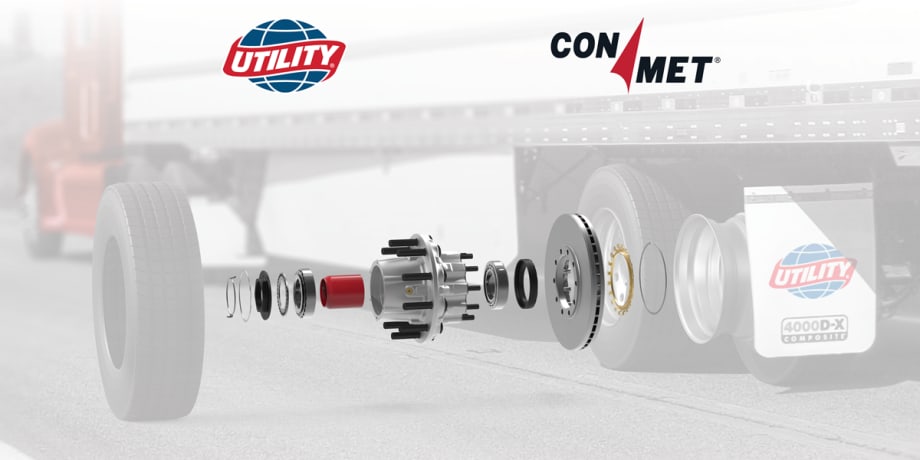
ConMet’s Preset Plus wheel end hubs will be the standard base specification on all Utility Trailer models.
Illustration: Utility
Utility Trailer Manufacturing Co. announced it is continuing efforts to upgrade its base specifications on it trailers to maximize performance. As part of the upgrade, ConMet’s Preset Plus wheel end hubs will be the standard base specification on all Utility Trailer models.
The ConMet Preset Plus will offer low maintenance and is designed for durability, Utility officials said in a press release.
The ConMet Preset Plus features an optimized bearing spacer, long-life bearings that are engineered to withstand demanding operating conditions, an integrated spindle nut that makes installation easier and improves wheel end clamp load to maintain proper endplay, precision machined casting, extended life seals, ABS tone ring, magnetic fill plug and easy access fill hole.
The hubs are available in aluminum and iron, drum and air-disc brake options for both TP and TN axle configurations.
“Our ConMet Preset Plus hubs are the standard position across all major truck OEMs. Recently, this technology has been gaining momentum in the trailer market with fleets focusing on reduced lifecycle costs and ease of installation and maintenance for trailers,’ Ken Kelly, ConMet’s vice president of trailer, fleet and service, and Tier 1 suppliers said. “Additionally, a common wheel end technology between truck and trailers simplifies service procedures and technician training.”
More Equipment

ZF Expands Commercial Vehicle Push in North America
ZF is expanding its North American commercial-vehicle presence with new transmission applications, electrification, trailer technology and autonomous-driving systems.
Read More →
Tesla Wants a Self-Driving Semi. Are Cameras Enough?
Could Tesla’s camera-only autonomous driving technology work on an 80,000-pound Semi? In this commentary, HDT's Deborah Lockridge takes a look at Tesla, Cybercab, and how autonomous trucks see the road.
Read More →
Kodiak: Driverless Long-Haul Truck Launch on Track for 2026
Kodiak AI says its driverless long-haul safety case is 93% complete and it remains on track to begin commercial operations by year-end 2026.
Read More →
What DOT’s Automated Vehicle Strategy Means for Trucking
The U.S. Department of Transportation issued a new automated-vehicle strategy that outlines plans for driverless-truck regulations, cross-state freight corridors, and federal safety standards.
Read More →
East Coast Port Launches $45M Electric Truck Push
The Port Authority of New York and New Jersey announced millions in incentives for zero-emission drayage trucks, yard tractors, and new charging hubs near the port.
Read More →
PlusAI Going Public to Fund Autonomous Truck Launch
A SPAC deal could provide PlusAI with up to $300 million as it works toward a 2027 commercial launch of factory-built autonomous trucks.
Read More →
NHTSA Moves to Rewrite Truck Fuel-Economy Rules
The National Highway Traffic Safety Administration says it lacks authority to regulate medium- and heavy-duty truck engines separately from complete vehicles, but the existing standards have not yet been eliminated.
Read More →
Detroit Opens Orders for EPA 2027 Engines
Detroit isn’t starting from scratch to meet EPA 2027 diesel emissions standards. Its Gen 6 DD13 and DD15 engines keep much of today’s platform while updating the fuel and aftertreatment systems.
Read More →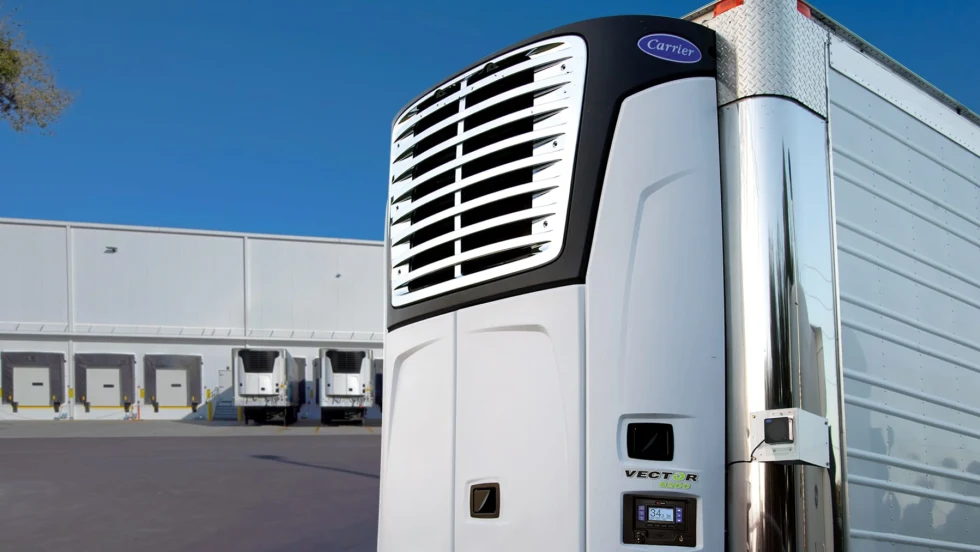
Carrier Transicold Adds All-Electric TRU for Stationary Cold Storage
Carrier Transicold’s new Vector 8200 all-electric transport refrigeration unit gives fleets a diesel-free option for temporary refrigerated and frozen trailer storage.
Read More →
A Closer Look at Kenworth’s Electric T880E Vocational Truck [Video]
Learn more about Kenworth's T880E battery-electric vocational truck at the Paccar Technical Center, including its range, applications, upfitting considerations, and PTO options, in this HDT Spotlight video.
Read More →