




UD Trucks Conducts Japan’s First Autonomous Truck Test on Public Roads
A UD truck equipped with a Level 4 autonomous control system has made Japan’s first-ever trip over public roads, delivering sugar beets to a refining mill on the northern island of Hokkaido.

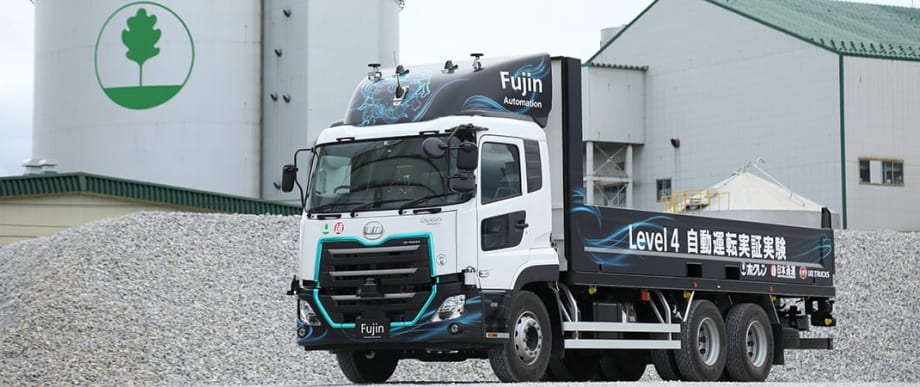
A test of a UD Truck equipped with a Level 4 autonomous control system included a brief run on a stretch of public road – a first in Japan.
Photo: UD Trucks
Japanese truck maker UD Trucks partnered with logistics firm Nippon Express and Hokkaido agriculture cooperative Hokuren to demonstrate advanced autonomous driving technology in the handling of farm produce at one of Hokkaido’s leading agriculture processing facilities.
UD Trucks said it's important initiative that can help address a shortage of truck drivers as the country’s work force contracts.
The demonstration took place at the Hokuren Sugar Refining Mill in Nakashari, Hokkaido. (Hokkaido is Japan’s northernmost large island.) In the trial, a Level 4 autonomous vehicle from UD Trucks simulated the transport of sugar beets through the facility and surroundings in an event attended by an estimated 150 key stakeholders. In a first for heavy-duty trucks in Japan, the trial included autonomous driving on a public road adjacent to the facility, a development made possible through the cooperation of relevant authorities.
"Japan’s growing labor shortage is a serious issue that must be addressed," UD Trucks President Takamitsu Sakamaki told attendees at the event. "By combining the expertise of commercial vehicle manufacturers, logistics companies and the agricultural sector, we believe that autonomous driving technology can play an essential role in finding the solutions we need."
In Japan, the shortage of truck drivers now poses a great risk to the stable supply of not only sugar beets, but also of broader agricultural and livestock products produced in Hokkaido, of which 3.5 million tons are shipped outside the prefecture every year, according to UD Trucks.
“We have high hopes that the introduction of autonomous driving will help secure transportation capacity needs in the near future.” said Hokuren Federation of Agricultural Cooperatives President Kazuyuki Uchida.
The trial program, which ran for several weeks in August, demonstrated how produce can be moved through the processing center with a specially adapted Level 4 heavy-duty Quon vehicle from UD Trucks. The truck operated on a typical delivery route from the entrance to the produce acceptance area, trhough interim storage and the final unloading area, at an average speed of 20 kph. The route included a distance of 200 meters on a public road (National Route 334).
The Quon vehicle also employed the RTK-GPS (Real Time Kinematic Global Positioning System), an advanced version of GPS that allows for a high localization accuracy. By combining Network-RTK with autonomous driving technology, UD Trucks said it is possible to achieve higher precision in vehicle operation even in bad weather or on poor road conditions.
“We are confident that L4 technology for heavy-duty trucks will make logistics smarter when it comes to repetitive work in confined areas including large scale farming, in-plant and port operations," said UD Trucks Senior Vice President of Technology Douglas Nakano. "Utilizing data collected from this trial, we will perfect our trucks to meet the most stringent demands for different types of operations, helping support more sustainable food production and the Japanese agricultural industry as a whole. We also aim to apply what we learn here today to larger-scale applications."
Widespread implementation of this technology is also a key area of focus for Nippon Express, which established its own Logistics Engineering Strategy Office in 2017. The company has been active across a broad range of areas, including truck platooning using automated driving technology, unmanned logistics centers that reduce labor costs, and logistics solutions that use artificial intelligence, drones and advanced tracking systems.
“We have been working hard, together with our customers, to improve the efficiency of logistics, but the shortage of drivers has become more and more serious," said Nippon Express Executive Vice President, Chief Operation Officer and Representative Director Hisao Taketsu. "If an automated truck can be used for repetitive tasks, such as transporting cargo along the same route, it will lead to labor-saving and higher efficiency.”
The trial has enjoyed the strong support of the prefectural government in Hokkaido. In 2016, it established the Hokkaido Automotive Safety Technology Study Group, bringing in experts from around the country to encourage research and development in autonomous transportation systems. Hokkaido hosts 28 autonomous driving test centers owned by a wide range of groups, including major automobile and parts manufacturers.
The trial was conducted under strict safety measures that met or exceeded the standards required for autonomous vehicles by the Ministry of Land, Infrastructure, Transport and Tourism. This included the closure of routes used for the trial, including the public road, and a safety driver who was in the truck cabin at all times to ensure the autonomous driving functions properly and take control of the vehicle in the event of an emergency.
The three companies involved in the trial reiterated that their goal was to demonstrate the feasibility of autonomous driving under controlled conditions and apply learnings to real-world applications. Each company will review the results of the trial in the hopes of improving agricultural transportation efficiency, helping solve the challenges facing the logistics industry while revitalizing areas that are predominantly rural and depend on farming.
More Fleet Management

Color Match Smarter: Tools That Restore & Perform
For fleet managers and collision repair professionals keeping heavy-duty trucks on the road, getting the color right the first time isn't just about appearance — it's about efficiency, turnaround time, and bottom-line results. Discover how today's digital color tools are transforming the repair process from guesswork to precision.
Read More →
FMCSA Pauses Biennial-Update Enforcement Amid Motus Transition
Carriers whose updates were due on or after June 1 have more time, while FMCSA works to stabilize its new registration system and warns of phishing sites impersonating its new carrier registration system, Motus.
Read More →
2026 Blueprint for Countering Smarter Supply Chain Theft
Cargo theft is no longer just the cost of doing business. It's a multi-billion-dollar criminal enterprise exploiting vulnerabilities across your fleet, drivers, and supply chain.
Read More →


How Telematics Improves Visibility, Control, and Performance in Refrigerated Fleets
Explore how telematics help refrigerated fleets improve visibility, uptime, efficiency, compliance, and cargo protection across connected cold chain operations.
Read More →
What the U.S.-Canada Trade War Means for Trucking
Escalating U.S.-Canada tariffs could disrupt cross-border freight, reduce truck volumes, raise costs, and create new uncertainty for carriers on both sides of the border.
Read More →
What Are Trucking’s Top Concerns for 2026?
The American Transportation Research Institute wants to know what's worrying trucking fleet managers, drivers, and other stakeholders in its annual Industry Issues survey.
Read More →
American Trucking Associations Looks for a New Leader
ATA President and CEO Chris Spear abruptly left his job at the association on August 21, at a pivotal time for the trucking industry.
Read More →
Public Wi-Fi Cybersecurity Risks: How Truck Drivers and Fleets Can Protect Their Data
Public Wi-Fi can expose truck drivers and fleets to credential theft, malware, and other cyber threats. Here’s how to reduce the risk on the road.
Read More →
For Nicky Cupp, Fleet Innovation Starts With Frustration
HDT Truck Fleet Innovator Nicky Cupp turns everyday pain points at Fraley & Schilling into opportunities for better technology and smarter processes.
Read More →
Adam Buttgenbach’s Approach to Electric Trucks: Start With Where They Fit
HDT Truck Fleet Innovator Adam Buttgenbach helped PepsiCo build one of North America’s largest EV fleets by focusing on where electric trucks make operational sense.
Read More →