




U.S. Reps. Introduce RNG Tax Credit Bill for Trucks
The Renewable Natural Gas Incentive Act of 2023 would provide $1 per gallon tax credit for dispensers of renewable natural gas used for commercial trucks and other motor vehicles.

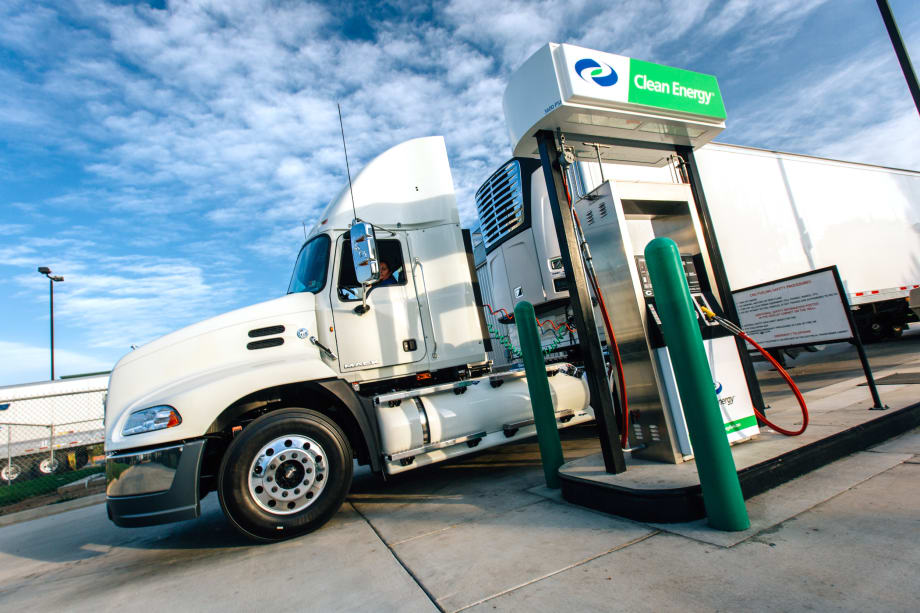
The Renewable Natural Gas Incentive Act of 2023 would provide $1 per gallon tax credit for dispensers of renewable natural gas used for commercial trucks.
Photo: Clean Energy
U.S. Reps. Linda Sanchez (D-California) and Brian Fitzpatrick (R-Pennsylvania) introduced a bill that if passed would provide $1 per gallon tax credit for dispensers of renewable natural gas used for commercial trucks and other motor vehicles for 10 years.
The Renewable Natural Gas Incentive Act of 2023 (H.R. 2448) updates legislation (H.R. 9396) introduced in the 117th Congress in 2022. It was created to encourage commercial truck and transit fleets to convert their vehicles from diesel to zero emission equivalent RNG, or biomethane.
The legislation is supported by the Moving Us Forward coalition, and was applauded by NGVAmerica, a national trade association of experts in the clean transportation.
“Transitioning to renewable natural gas will help us curb the impacts of climate change while providing a cleaner, more affordable fuel option for the industries that keep America moving,” said Congresswoman Sanchez in a press release. “This tax credit will allow transit agencies, school districts, freight haulers, and package delivery companies to replace aging fleets with sustainable alternatives, all without slowing production or increasing costs.”
The tax code currently provides a 50-cent credit for natural gas used in transportation including natural gas from renewable sources. This credit, however, is less than the credit for renewable biodiesel which has consistently benefited from a $1 a gallon tax credit and is currently only available through 2024, according to the press release.
More About Renewable Natural Gas (RNG) in Trucking
Captured above ground from organic material in agricultural, wastewater, landfill, or food waste, RNG can produce carbon-negative results when fueling on-road vehicles like short- and long-haul trucks, transit buses, and refuse and recycling collection vehicles.
California Air Resources Board data reports the average carbon intensity value of California’s bio-CNG (compressed natural gas) vehicle fuel portfolio in its Low Carbon Fuel Standard (LCFS) program is below zero at -111.7 gCO2e/MJ – the only carbon negative clean transportation fuel in the CA LCFS program, according to NGVAmerica.
In 2021, 64% of all on-road fuel used nationwide in natural gas vehicles was from a renewable source. That number is expected to rise to close to 70% for 2022, according to NGVAmerica.
More Fuel Smarts

How Fuel Delivery Shapes Engine Performance
Fuel delivery depends on more than what happens at the injector. For fleet, maintenance and technical professionals, looking at the full path from pump to injector can provide useful context for understanding engine performance.
Read More →
East Coast Port Launches $45M Electric Truck Push
The Port Authority of New York and New Jersey announced millions in incentives for zero-emission drayage trucks, yard tractors, and new charging hubs near the port.
Read More →
California Bill Could Shed Light on Electric Truck Prices
Why do battery-electric Class 8 trucks remain so expensive? A California bill headed to Gov. Gavin Newsom would give fleets and state agencies more visibility into what manufacturers charge.
Read More →

Detroit Opens Orders for EPA 2027 Engines
Detroit isn’t starting from scratch to meet EPA 2027 diesel emissions standards. Its Gen 6 DD13 and DD15 engines keep much of today’s platform while updating the fuel and aftertreatment systems.
Read More →
Zero-Emission Truck Corridor Planned for West Coast
California, Oregon, Washington, British Columbia and Baja California are coordinating plans for truck charging and hydrogen fueling from Canada to Mexico.
Read More →
A Closer Look at Kenworth’s Electric T880E Vocational Truck [Video]
Learn more about Kenworth's T880E battery-electric vocational truck at the Paccar Technical Center, including its range, applications, upfitting considerations, and PTO options, in this HDT Spotlight video.
Read More →
Kenworth T880E Brings EV Power to Vocational Trucks
A closer look at the Kenworth T880E’s range, charging, powertrain and upfit options — and where fleets are showing the most interest.
Read More →
Jennie Abarca Is Proving Electric Trucks Can Do the Job
HDT Truck Fleet Innovator Jennie Abarca is building confidence in fleet electrification one load at a time while openly sharing the challenges she encounters along the way as a small-fleet owner.
Read More →
Cummins Adjusts 2027 Engine Rollout After EPA Proposal
The engine maker will gradually introduce its new Model Year 2027 diesel engines while continuing to offer current models during the transition, citing the EPA's proposed emissions rule changes.
Read More →
EPA Proposal Could Ease 2027 Truck Costs and Buying Uncertainty
The proposal doesn't change the tougher NOx standard, but it would revise key implementation requirements that manufacturers say have driven up costs and complicated fleet purchasing decisions.
Read More →