




Truckload Linehaul, Intermodal Rates Growing Stronger
Newly released figures show the market for truckload freight shipments is improving and the intermodal sector has completed nearly a year of increasing rates while the outlook for both has improved.

Newly released figures show the market for truckload freight shipments is improving and the intermodal sector has completed nearly a year of increasing rates while the outlook for both has improved.
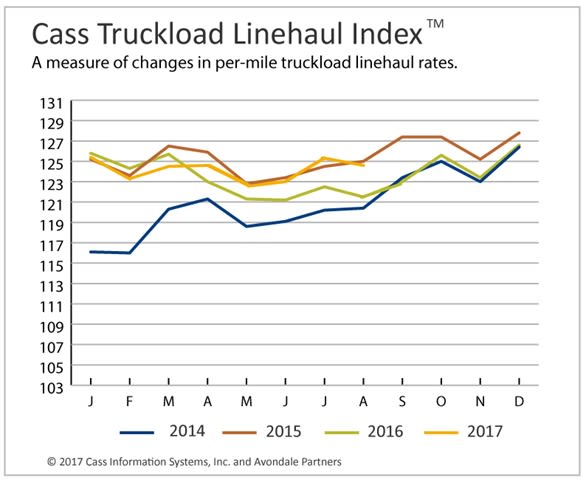
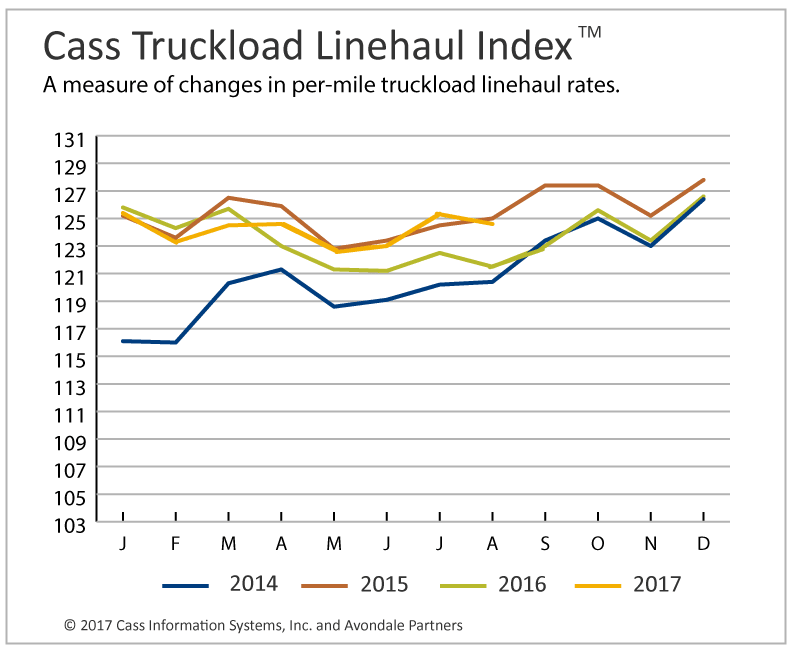
After being negative for 13 months in a row, the Cass Truckload Linehaul Index has not only been positive now for five straight months, but it is also increasing in magnitude, according to Analyst Donald Broughton with Broughton Capital.
The August index improved by 2.6% from the same time a year ago to a reading of 124.6. While this is 0.6% below the reading from the month before, there is a belief it will get better.
In just the last 60 days, Broughton's pricing forecast has improved for 2017, from a range of a 1% decline to 2% improvement, to a newly expected 1% to 3% increase. That’s because the current strength being reported in spot rates is leading him to believe contract pricing rates should keep truckload rates in positive territory through the end of the year.
The Cass Truckload Linehaul Index measures market fluctuations in per-mile truckload pricing that isolates the linehaul component of full truckload costs from others, such as fuel and accessorials, providing a reflection of trends in baseline truckload prices.
Intermodal Pricing Measure Posts Another Year-Over-Year Gain
Meantime, the Cass Intermodal Price Index rose 1.3% in August from the same time a year ago to 127.1, which was a slight improvement from July’s anemic 0.6% increase and is at its highest level since May.
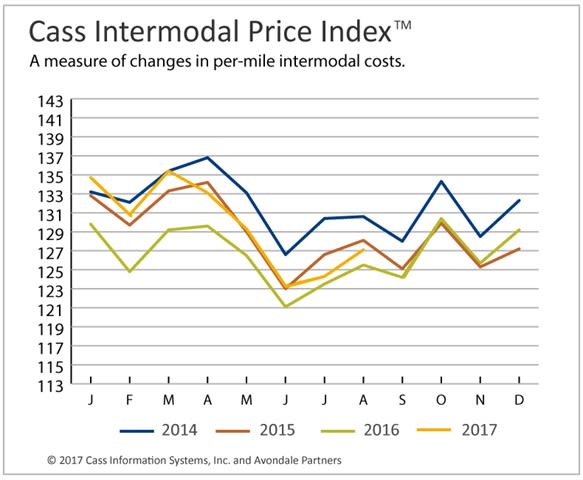
This marked the 11th consecutive month of year-over year increases; however, pricing momentum continues to be relatively muted, according to Broughton.
The absolute nominal value of the index established its most recent peak in March at 135.4, as the national average cost of diesel fuel flirted with $2.60 a gallon, and has sequentially trended lower since, as diesel has fallen back toward $2.50 a gallon.
As the price of oil has recovered from the oversold lows of February 2016 and established a price more consistent with the marginal cost of domestic production, Broughton expects intermodal rates to show better strength through the remainder of 2017 than was achieved in 2016.
The Cass Intermodal Price Index measures market fluctuations in per-mile U.S. domestic intermodal costs. It includes all costs associated with the move, such as linehaul, fuel and accessorials.
Data within both measures comes from actual freight invoices paid on behalf of clients of freight-payment processor Cass Information Services, which totals nearly $21 billion annually.
More Fleet Management

Why Private Fleets Are Taking More Freight
Private fleets are putting their own trucks on demanding customers and high-cost lanes as companies seek greater control over service, costs, and capacity.
Read More →
Color Match Smarter: Tools That Restore & Perform
For fleet managers and collision repair professionals keeping heavy-duty trucks on the road, getting the color right the first time isn't just about appearance — it's about efficiency, turnaround time, and bottom-line results. Discover how today's digital color tools are transforming the repair process from guesswork to precision.
Read More →
FMCSA Pauses Biennial-Update Enforcement Amid Motus Transition
Carriers whose updates were due on or after June 1 have more time, while FMCSA works to stabilize its new registration system and warns of phishing sites impersonating its new carrier registration system, Motus.
Read More →


2026 Blueprint for Countering Smarter Supply Chain Theft
Cargo theft is no longer just the cost of doing business. It's a multi-billion-dollar criminal enterprise exploiting vulnerabilities across your fleet, drivers, and supply chain.
Read More →
How Telematics Improves Visibility, Control, and Performance in Refrigerated Fleets
Explore how telematics help refrigerated fleets improve visibility, uptime, efficiency, compliance, and cargo protection across connected cold chain operations.
Read More →
What the U.S.-Canada Trade War Means for Trucking
Escalating U.S.-Canada tariffs could disrupt cross-border freight, reduce truck volumes, raise costs, and create new uncertainty for carriers on both sides of the border.
Read More →
What Are Trucking’s Top Concerns for 2026?
The American Transportation Research Institute wants to know what's worrying trucking fleet managers, drivers, and other stakeholders in its annual Industry Issues survey.
Read More →
American Trucking Associations Looks for a New Leader
ATA President and CEO Chris Spear abruptly left his job at the association on August 21, at a pivotal time for the trucking industry.
Read More →
Public Wi-Fi Cybersecurity Risks: How Truck Drivers and Fleets Can Protect Their Data
Public Wi-Fi can expose truck drivers and fleets to credential theft, malware, and other cyber threats. Here’s how to reduce the risk on the road.
Read More →
For Nicky Cupp, Fleet Innovation Starts With Frustration
HDT Truck Fleet Innovator Nicky Cupp turns everyday pain points at Fraley & Schilling into opportunities for better technology and smarter processes.
Read More →