




Trucking Alliance Pushes Congress to Tighten Truck Driver Drug Testing
The Alliance for Driver Safety & Security, also known as the Trucking Alliance, announced it will push for congressional passage of a new drug testing law to require anyone who applies for a safety-sensitive job in the trucking industry to verify no opioid addiction or illegal drug use for at least 30 days prior to employment.


J.B. Hunt found that opioid use was far more likely to be caught by hair testing than by the standard urinalysis. From The Trucking Alliance's UN presentation.
The Alliance for Driver Safety & Security, also known as the Trucking Alliance, announced it will push for congressional passage of a new drug testing law to require anyone who applies for a safety-sensitive job in the trucking industry to verify no opioid addiction or illegal drug use for at least 30 days prior to employment.
The Trucking Alliance announced its opioid test initiative at the United Nations, as part of an event entitled, “The Use of Technology to Promote Road Safety – The Brazilian Experience.” Brazil requires all commercial truck drivers to pass a hair test before renewing their license. More than 1 million Brazilian drivers have either failed the hair test or refused to renew their license since the law took effect two years ago.
The Alliance is a coalition of freight and logistics companies that support the adoption of technology and regulations to improve safety in trucking, such as mandatory truck speed limiters, mandatory electronic logging devices, improved driver training and screening, and advanced safety assistance systems.
“Current drug testing methods for truck drivers are failing,” said Lane Kidd, managing director of The Trucking Alliance. Kidd told UN attendees that in 2017, J.B. Hunt Transport identified 1,213 people who tested positive on their pre-employment hair test. Yet, 90% of the company’s truck driver applicants passed the government-mandated urinalysis. “Clearly, the U.S. Department of Transportation’s pre-employment drug test protocols are missing most lifestyle drug users and opioid addicts, and that’s a national problem for our industry,” said Kidd.
“We have an opioid problem in our nation, and from my experience, we have one in our industry, too,” said Dean Newell, vice president of safety and driver training at Maverick USA, headquartered in Little Rock, Arkansas. Newell also spoke at the United Nations meeting. “We [Maverick] started hair testing for opioids in 2014, and we’ve seen a steady increase [in opioid addiction] every year.”
Opioids are undetected in a person’s system after a few hours, allowing opioid addicts to avoid drugs before submitting to a urinalysis. However, a hair exam can detect drug use for up to 90 days.
According to The Alliance, opioids subject to drug abuse in the trucking industry include codeine, morphine pain killers branded under hundreds of names, hydrocodone, hydromorphone, oxycodone marketed under such names as OxyContin, Percoset, and Tylox, and the highly addictive opioids Methodone and Fentanyl. The U.S. Department of Transportation recently added four of these – hydrocodone, oxycodone, hydromorphone, and oxymorphone – to its pre-employment drug test protocols. But unless the applicant takes these opioids within a few hours of collection, a urinalysis drug test can miss their use, say hair testing proponents.
“We hope Congress will follow Brazil’s leadership and require a drug test that proves without a doubt that a truck driver job applicant hasn’t taken illegal drugs or abused opioids for at least 30 days,” said Kidd.
Kidd also said Congress might consider a new drug test law for all current truck drivers, requiring a hair test before they renew their commercial driver license, as Brazil requires. “Too many loopholes allow truck drivers to skip random drug testing, even after they’re involved in a serious large truck accident.”
Newell agreed that current regulations do not capture lifestyle drug users. “We’ve had 154 drivers at Maverick who failed their hair test after they passed a urine test. Those 154 drivers are working for another company,” explained Newell. “They’re running up and down the road with our families, and that is not acceptable.”
Kidd added that since 2006, J.B. Hunt Transport has refused to employ 5,060 job applicants who failed a hair test after passing their urinalysis. Most of those truck driver applicants found jobs at other transportation companies, because almost all U.S. carriers use only the minimum federally required urinalysis.
“Multiply J.B. Hunt Transport’s experience by the hundreds of thousands of truck driver applicants each year across the United States, and we have a major problem,” said Kidd.
Hair testing “will save lives and hair testing is the right thing to do,” said Newell. “Maverick wants to make sure the company is the safest it can be, and that all drivers are well trained and drug free. We have a moral obligation to our employees, but we also have a moral obligation to the public.”
Related: Seven GOP Lawmakers Signal Support for Hair-Testing Truckers (May 2017)
More Safety & Compliance

FMCSA Pauses Biennial-Update Enforcement Amid Motus Transition
Carriers whose updates were due on or after June 1 have more time, while FMCSA works to stabilize its new registration system and warns of phishing sites impersonating its new carrier registration system, Motus.
Read More →
ZF Expands Commercial Vehicle Push in North America
ZF is expanding its North American commercial-vehicle presence with new transmission applications, electrification, trailer technology and autonomous-driving systems.
Read More →
Truck Drivers Need More Than Another Alert
Fleets have more visibility into truck health, safety events, and driver activity than ever. The next challenge is turning all that information into useful guidance for the person who has to decide what to do next.
Read More →
Tesla Wants a Self-Driving Semi. Are Cameras Enough?
Could Tesla’s camera-only autonomous driving technology work on an 80,000-pound Semi? In this commentary, HDT's Deborah Lockridge takes a look at Tesla, Cybercab, and how autonomous trucks see the road.
Read More →
What DOT’s Automated Vehicle Strategy Means for Trucking
The U.S. Department of Transportation issued a new automated-vehicle strategy that outlines plans for driverless-truck regulations, cross-state freight corridors, and federal safety standards.
Read More →
NYC Expands Speed, Pedestrian Safety Tech Across Fleet
New York City is expanding intelligent speed assistance and pedestrian-alert systems across its municipal fleet, moving the technologies from pilot programs into vehicle procurement and retrofit requirements.
Read More →
FMCSA Removes 110 Truck Driver Training Schools from Certified ELDT List
Federal regulators also are targeting more than 160 additional training providers and launching a nationwide audit of third-party CDL skills testers as part of a broader crackdown on trucking fraud.
Read More →
Beyond DOT Compliance: What Makes a Trucking Fleet Truly Safe?
A trucking fleet can follow every rule and still make unsafe decisions. The real test comes when safety conflicts with freight, productivity, or cost.
Read More →
Hours of Service Pilot Programs: FMCSA Readies for 2027 Rollout
Two pilot programs could eventually reshape hours-of-service rules, giving truck drivers options to pause their 14-hour clock or use longer split sleeper rest periods.
Read More →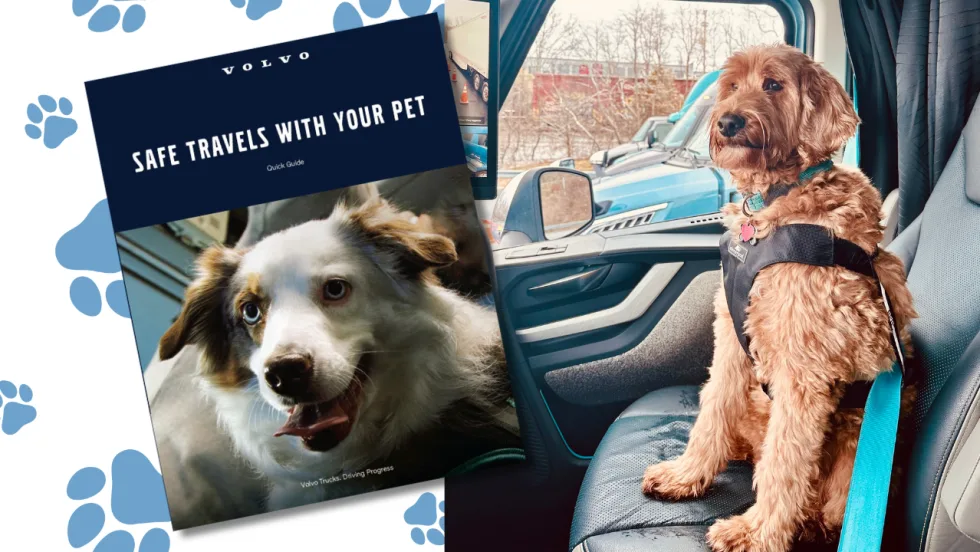
New Guide Offers Pet Safety Tips for Truck Drivers
Hundreds of thousands of pets travel in truck cabs. A new safety guide from Volvo Trucks and the Center for Pet Safety offers practical advice for truck drivers who bring dogs and cats along for the ride.
Read More →