




Truck Platooning System Offers Fuel Savings Potential
Peloton Technology, Menlo Park, Calif., demonstrated its two-truck platooning system May 8 along a stretch of I-80 just east of Reno. The technology makes use of a forward collision avoidance system and vehicle-to-vehicle communication to allow two trucks to travel closer together than would normally be safe.

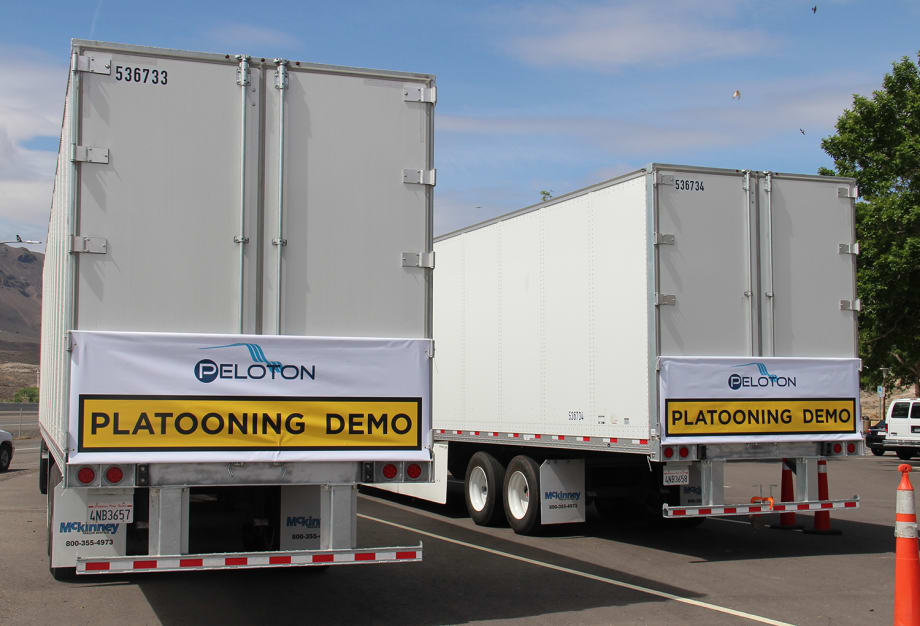
These two tractor trailer combinations were used to demonstrate platooning technology by Peloton Technology during an event outside Reno May 8. Photo: Jim Beach
Peloton Technology, Menlo Park, Calif., demonstrated its two-truck platooning system to representatives from three of Nevada’s primary transportation agencies May 8 along a stretch of I-80 just east of Reno.
The technology makes use of a forward collision avoidance system and vehicle-to-vehicle communication to allow two trucks to travel closer together than would normally be safe.
Josh Switkes, Peloton CEO, said the system combines forward-looking radar, intelligent braking and the V2V link to allow the trucks to travel close together, reducing drag and saving fuel in the process. Switkes said that in a test with C.R. England last year, they achieved a 10% improvement in fuel efficiency for the following truck and a 4.5% increase for the front truck.
Trucks can only be paired in a platoon if conditions warrant and then only through Peloton’s cloud-based platooning operations center.

Josh Switkes, CEO, Peloton Technology, speaks to a group of Nevada transportation officies during a truck platooning demonstration featuring Peloton's technologies. Photo: Jim Beach
Once the system is engaged, the active safety systems from both trucks are linked, extending their effectiveness. A display panel in the front truck can show what the following truck's forward-facing camera sees, while the following truck can see what the front truck's camera sees.
The key to the system is the response time of the forward collision avoidance system, which controls braking and acceleration. A truck driver needs 1 to 2 seconds to react when a vehicle in front of him slows. The Peloton system, on the other hand, reacts in a fraction of a second.
That detail was enough to convince Nevada Highway Patrol chief Dennis Osborne, who said that he had some concerns about the technology when he first heard about it.
"Now I feel comfortable," Osborne said. "There is a fraction of a second from when the lead vehicle starts to brake to when the rear vehicle starts to brake." He added that the NHP "is excited about the project."
Nevada Department of Motor Vehicles director Troy Dillard said that a team from the DMV had observed the technology and that "technology that makes our roadways safer is worth exploring" and that he believed "industry and government should work closely together" to enhance safety.
The technology combines wireless DSRC and cellular communications, sensors and active safety devices with the core function being to synchronize acceleration and braking between pairs of tractor/trailer combinations. During platooning, the drivers retain control of the system and the vehicle's steering.
When not platooning, the trucks still reap the benefits of the system, which includes collision avoidance, brake and tire diagnostics and video displays of blind spots.
These two tractor trailer combinations were used to demonstrate platooning technology by Peloton Technology during an event outside Reno May 8. Photo: Jim Beach
Switkes said the company's network operations center is being developed on a nationwide basis and will coordinate trucks seeking a platooning partner on the road — even trucks from different fleets. The center uses geo-fencing to limit platooning only to safe roads and under safe conditions and with safe drivers. The center also collects diagnostic and analytical data from the vehicles within the system.
The company said it is currently in talks with more than a dozen fleets for pilot deployments of the platooning and data/analytics functionality, with a deployment planned with Nashville-based TCW at the end of May.
Nevada Lt. Gov. Brian Krolicki noted that the technology was innovative and different and that Nevada was a great place to test and develop such technologies.
Related Stories:
More Fleet Management

Color Match Smarter: Tools That Restore & Perform
For fleet managers and collision repair professionals keeping heavy-duty trucks on the road, getting the color right the first time isn't just about appearance — it's about efficiency, turnaround time, and bottom-line results. Discover how today's digital color tools are transforming the repair process from guesswork to precision.
Read More →
FMCSA Pauses Biennial-Update Enforcement Amid Motus Transition
Carriers whose updates were due on or after June 1 have more time, while FMCSA works to stabilize its new registration system and warns of phishing sites impersonating its new carrier registration system, Motus.
Read More →
2026 Blueprint for Countering Smarter Supply Chain Theft
Cargo theft is no longer just the cost of doing business. It's a multi-billion-dollar criminal enterprise exploiting vulnerabilities across your fleet, drivers, and supply chain.
Read More →


How Telematics Improves Visibility, Control, and Performance in Refrigerated Fleets
Explore how telematics help refrigerated fleets improve visibility, uptime, efficiency, compliance, and cargo protection across connected cold chain operations.
Read More →
What the U.S.-Canada Trade War Means for Trucking
Escalating U.S.-Canada tariffs could disrupt cross-border freight, reduce truck volumes, raise costs, and create new uncertainty for carriers on both sides of the border.
Read More →
What Are Trucking’s Top Concerns for 2026?
The American Transportation Research Institute wants to know what's worrying trucking fleet managers, drivers, and other stakeholders in its annual Industry Issues survey.
Read More →
American Trucking Associations Looks for a New Leader
ATA President and CEO Chris Spear abruptly left his job at the association on August 21, at a pivotal time for the trucking industry.
Read More →
Public Wi-Fi Cybersecurity Risks: How Truck Drivers and Fleets Can Protect Their Data
Public Wi-Fi can expose truck drivers and fleets to credential theft, malware, and other cyber threats. Here’s how to reduce the risk on the road.
Read More →
For Nicky Cupp, Fleet Innovation Starts With Frustration
HDT Truck Fleet Innovator Nicky Cupp turns everyday pain points at Fraley & Schilling into opportunities for better technology and smarter processes.
Read More →
Adam Buttgenbach’s Approach to Electric Trucks: Start With Where They Fit
HDT Truck Fleet Innovator Adam Buttgenbach helped PepsiCo build one of North America’s largest EV fleets by focusing on where electric trucks make operational sense.
Read More →