




Truck Drivers, Techs Most Satisfied at Smaller Fleets
WorkHound’s mid-year report of driver feedback revealed that drivers, technicians and office workers at trucking companies prefer smaller companies where workers are accustomed to more frequent and personal communication.

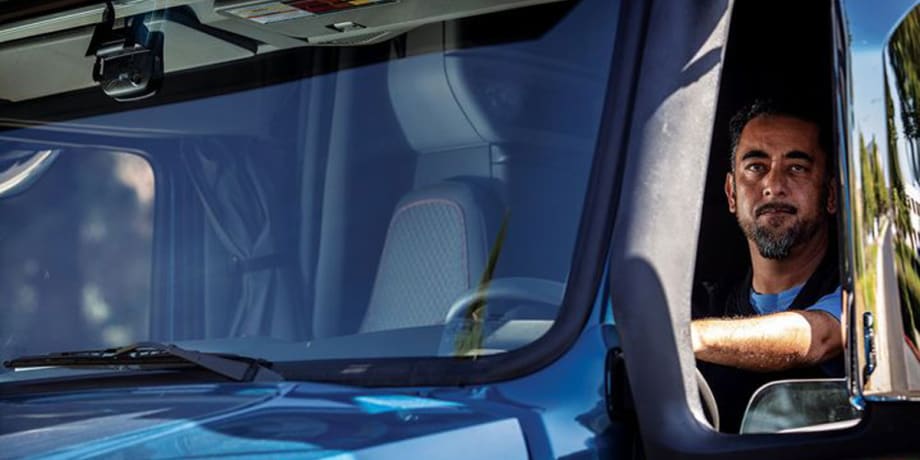
WorkHound’s mid-year report of driver feedback revealed that drivers, technicians and office workers at trucking companies prefer smaller companies.
File Photo: Lytx
Drivers, technicians and office workers in the trucking industry are more likely to be satisfied at small- or medium-sized companies, according to WorkHound’s mid-year report.
WorkHound’s mid-year report results, presented during a Truckload Carriers Association webinar on Aug. 31, outlines the trends in driver feedback so far in 2021. The feedback were gathered weekly through anonymous submissions from over 10,000 drivers, technicians and office staff from 77 trucking companies.
The report revealed that drivers tend to prefer smaller companies (under 500 workers), where drivers, techs and office workers reported more positive comments, more praise, and reported a higher satisfaction with their career
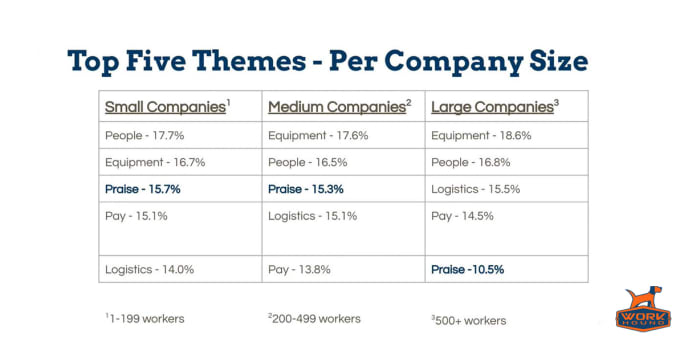
Praise was one of the top themes recorded in feedback by small, medium and large companies.
Graphic: WorkHound
Praise was one of the top themes recorded in feedback by small, medium and large companies. However, workers at large companies are less likely to share feedback that includes praise for their company and coworkers. Small companies received 50% more praise than large companies.
“Praise is a culture indicator,” said Max Farrell, CEO and co-founder of WorkHound, during the TCA webinar. “The substantial lack of praise at large companies is possibly a symptom of communication.”
At small companies, workers are accustomed to more frequent and personal communication, which suggests that workers at companies of all sizes may benefit from being contacted more frequently, Farrell said.
“When you’re trying to scale an operation, oftentimes what would be consider the ‘personal touch’ — the ability of people reaching out to other people — I think that gets diminished as you attempt to scale up,” explained Kim Daigel, vice president of human resources at P&S Logistics. “Oftentimes, [scaling up] means automating things, and creating systems in order to solve problems, instead of having that people aspect of solving problems. I think the people side of larger business gets lost beneath all that automation.”
How Can Large Fleets Maintain a “Small Village” Culture?
At P&S Logistics, Daigel says as they’ve grown into a large company they’ve been trying to maintain aspects of the culture that made them successful as a smaller business.
To do so, Daigel says P&S Logistics empowers driver managers to solve driver problems and make decisions, as well as aims to keep the number of drivers per driver manager lower.
“In some larger companies they get into a rut of not thinking of the driver, but thinking of the truck,” explains Daigle. “They almost make the person into a piece of equipment. I think that they do that so they can put more drivers with fewer office folks. It’s a point of growth difficulty, in that you have to keep adding more people as you’re adding more drivers. But by trying to solve that by increasing the number of drivers you have on a driver manager, is really where you end up losing that personal touch.”
More Drivers
Platform Science Adds Dispatch and Safety Tools
Four additions to PS Fleet help fleets monitor loads, manage driver coaching, share truck locations and adjust video system settings.
Read More →
When Language Stops the Truck: The Return of ELP Out-of-Service Orders
English language proficiency rules for commercial drivers aren’t new, but renewed out-of-service enforcement has raised the stakes. Here’s what carriers need to know before a driver reaches a roadside inspection.
Read More →
Samsara Launches Custom AI Agent Builder
Agent Studio lets fleets create AI tools for hours-of-service monitoring, reporting and driver support, including agents that communicate by phone.
Read More →
Trucker Path Expands Reserved Parking Network
Trucker Path has added close to 6,000 more truck parking spaces to its Trucker Path Reserved Parking Network with the addition of Safe Truck Parking.
Read More →
EEOC Sues Texas Trucking Company Over Driver Age Limits
The agency says Trancasa USA rejected applicants over 65 and applied tougher driving-record standards to those over 60.
Read More →
Nussbaum, Roehl Announce Second Driver Pay Increase This Year
This year has seen a swath of major truck driver pay increases as freight capacity has tightened.
Read More →
From One Generation to the Next: How Mentorship Builds Safer Truck Drivers
After three decades in trucking, Harold Perry shares what he's learned about driver safety, mentorship, and helping the next generation build confidence behind the wheel.
Read More →
Truck Drivers Need More Than Another Alert
Fleets have more visibility into truck health, safety events, and driver activity than ever. The next challenge is turning all that information into useful guidance for the person who has to decide what to do next.
Read More →
FMCSA Removes 110 Truck Driver Training Schools from Certified ELDT List
Federal regulators also are targeting more than 160 additional training providers and launching a nationwide audit of third-party CDL skills testers as part of a broader crackdown on trucking fraud.
Read More →
Hours of Service Pilot Programs: FMCSA Readies for 2027 Rollout
Two pilot programs could eventually reshape hours-of-service rules, giving truck drivers options to pause their 14-hour clock or use longer split sleeper rest periods.
Read More →