




TRIP: By Value, Trucks Moved 72% of Freight in 2022
E-commerce growth, drones, lower-emission vehicles, and sky-high logistics costs are among the trends examined in a new report by TRIP.

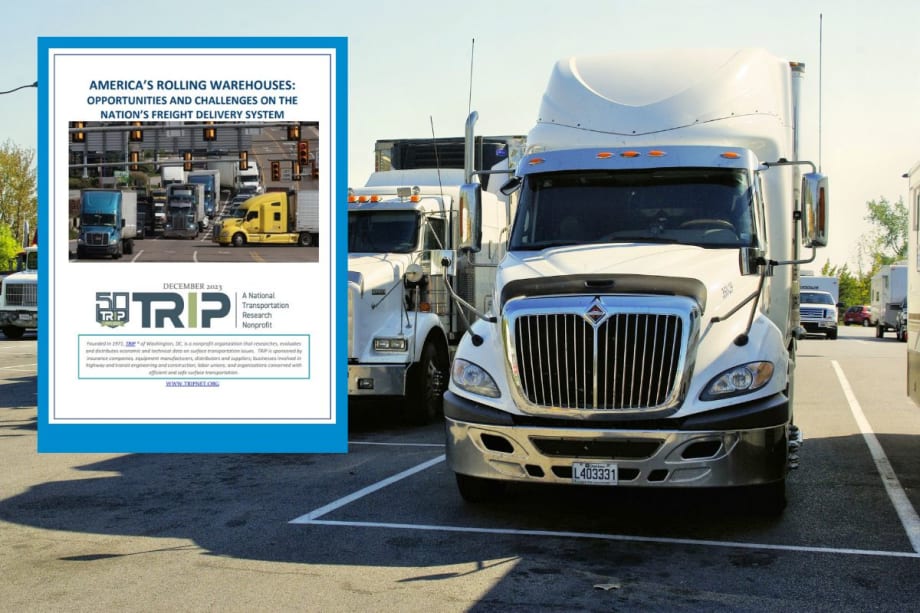
America’s Rolling Warehouses: Opportunities and Challenges with the Nation’s Freight Delivery System looks at the current and projected levels of freight movement in the U.S.
Photo: Canva/TRIP/HDT Illustration
E-commerce growth, drones, lower-emission vehicles, and sky-high logistics costs are among the trends examined in a new report by TRIP.
TRIP, a nonprofit organization that researches, evaluates, and distributes economic and technical data on surface transportation issues; released a 33-page report on the nation’s freight delivery system.
"America’s Rolling Warehouses: Opportunities and Challenges with the Nation’s Freight Delivery System" looks at the current and projected levels of freight movement in the U.S., large truck safety, and trends impacting overall freight movement within the United States.
Record High Logistics Costs
“The delivery of freight — merchandise or commodities that are moved by a mode of transportation either for a fee or by a private fleet — is expected to increase rapidly as a result of economic growth, increasing demand, changing business and retail models, and a significantly increased reliance on ecommerce by businesses and households,” TRIP noted in the report. “U.S. logistics costs as a share of GDP reached the highest level on record in 2022; some $2.3 trillion in 2022, representing 9.1% of U.S. GDP, which is the highest share ever.”
TRIP said that, in 2022 the U.S. freight system moved approximately 19.7 billion tons of freight valued at approximately $18.8 trillion, which equated a daily average of approximately 54 million tons of freight valued at approximately $52 billion.
Overall, trucking accounted for the largest modal share of freight movement in 2022, carrying 72% of freight by value and 64% by weight, TRIP noted.
Key Trends
The organization noted that key trends affecting the U.S. freight transportation sector now and in the future include:
The major growth in e-commerce. In the last decade, U.S. retail e-commerce sales increased nearly four and a half times, from $64 billion in the second quarter of 2013 to $278 billion in the second quarter of 2023. The COVID-19 pandemic rapidly accelerated the growth in retail e-commerce, with U.S. e-commerce sales increasing from $160 billion in the first quarter of 2020 to $278 billion in the second quarter of 2023 — a 73% increase.
The use of drones for last-mile deliveries is a potential innovation for what can be the most difficult and expensive aspect of the supply chain. While the use of drones for last-mile delivery will still need to clear several hurdles, including Federal Aviation Administration regulations, public perception, and the technology itself, many companies have been testing drone deliveries.
With medium and heavy-duty trucks accounting for nearly a quarter (23%) of U.S. transportation greenhouse gas emissions in 2021, a transition to lower carbon transportation fuels — including electric, biofuels, renewable natural gas, and hydrogen — will be critical in reducing the nation’s greenhouse gas emissions.
“The transition to greater large truck autonomy and lower-carbon transportation fuels should improve the safety and sustainability of freight movement but must be implemented in a way that does not reduce freight efficiency and minimizes economic disruption,” TRIP said in its report.
“Improving freight network safety will require additional improvements in roadway safety, particularly along highways and at major intersections,” the group added. “It will also require the provision of additional truck parking spaces to ensure safe, adequate, and timely rest for drivers.”
Freight by State
The TRIP report also noted the amount of freight shipped to or from sites in each state, by all modes and by trucks. The top 10 states for shipping by truck, when measured by value, are:
Texas
California
Illinois
New York
Ohio
Pennsylvania
Michigan
Georgia
Florida
New Jersey
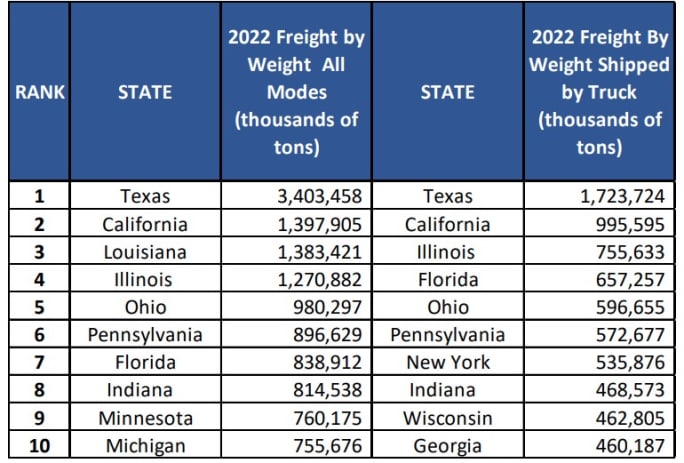
The TRIP report analyzes freight movement by weight.
Source: TRIP
The report also forecasts the growth of shipping by truck from 2022 to 2050. The 10 states expected to see the most growth, measured in terms of freight value, are:
Mississippi
Delaware
Louisiana
South Carolina
Tennessee
Colorado
Nebraska
California
Missouri
Ohio

The TRIP report analyzes freight movement by value.
Source: TRIP
Trucking Freight Growth
Overall, the report forecasts that from 2022 to 2050 freight moved by truck will increase by 91% when measured by value and 53% when considered by weight.
More Fleet Management

Color Match Smarter: Tools That Restore & Perform
For fleet managers and collision repair professionals keeping heavy-duty trucks on the road, getting the color right the first time isn't just about appearance — it's about efficiency, turnaround time, and bottom-line results. Discover how today's digital color tools are transforming the repair process from guesswork to precision.
Read More →
FMCSA Pauses Biennial-Update Enforcement Amid Motus Transition
Carriers whose updates were due on or after June 1 have more time, while FMCSA works to stabilize its new registration system and warns of phishing sites impersonating its new carrier registration system, Motus.
Read More →
2026 Blueprint for Countering Smarter Supply Chain Theft
Cargo theft is no longer just the cost of doing business. It's a multi-billion-dollar criminal enterprise exploiting vulnerabilities across your fleet, drivers, and supply chain.
Read More →


How Telematics Improves Visibility, Control, and Performance in Refrigerated Fleets
Explore how telematics help refrigerated fleets improve visibility, uptime, efficiency, compliance, and cargo protection across connected cold chain operations.
Read More →
What the U.S.-Canada Trade War Means for Trucking
Escalating U.S.-Canada tariffs could disrupt cross-border freight, reduce truck volumes, raise costs, and create new uncertainty for carriers on both sides of the border.
Read More →
What Are Trucking’s Top Concerns for 2026?
The American Transportation Research Institute wants to know what's worrying trucking fleet managers, drivers, and other stakeholders in its annual Industry Issues survey.
Read More →
American Trucking Associations Looks for a New Leader
ATA President and CEO Chris Spear abruptly left his job at the association on August 21, at a pivotal time for the trucking industry.
Read More →
Public Wi-Fi Cybersecurity Risks: How Truck Drivers and Fleets Can Protect Their Data
Public Wi-Fi can expose truck drivers and fleets to credential theft, malware, and other cyber threats. Here’s how to reduce the risk on the road.
Read More →
For Nicky Cupp, Fleet Innovation Starts With Frustration
HDT Truck Fleet Innovator Nicky Cupp turns everyday pain points at Fraley & Schilling into opportunities for better technology and smarter processes.
Read More →
Adam Buttgenbach’s Approach to Electric Trucks: Start With Where They Fit
HDT Truck Fleet Innovator Adam Buttgenbach helped PepsiCo build one of North America’s largest EV fleets by focusing on where electric trucks make operational sense.
Read More →