




Traton: Batteries Are the Future, Not Fuel Cells
Why does Traton believe that battery-electric trucks, not hydrogen fuel-cell electric, are the future of zero-emissions transport?

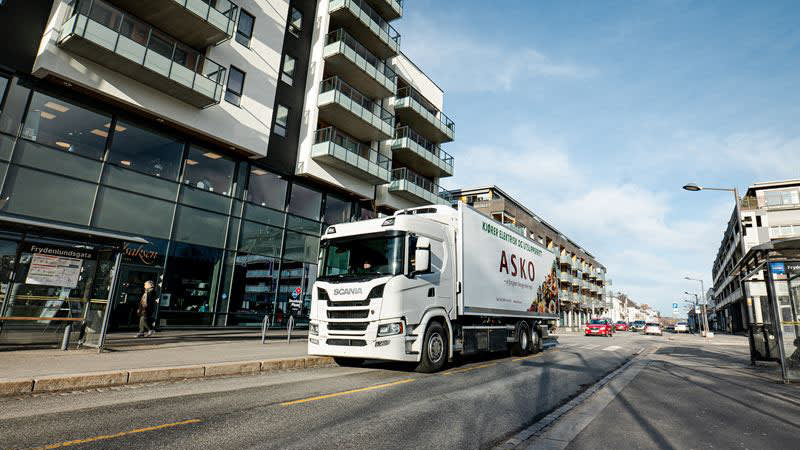
In Sweden, Scania and food wholesaler ASKO are testing battery-electric trucks.
Photo: Traton
The Traton Group is betting on battery-electric trucks, even for long-haul, saying hydrogen fuel cells aren’t as efficient. The truck maker says a new scientific analysis backs up its strategy.
The Fraunhofer Institute for Systems and Innovation Research ISI published a scientific article concluding that the battery-electric drive is superior to the fuel cell in the vast majority of regions and of commercial vehicle applications, including long-distance heavy-duty transport.
The article, “Hydrogen Unlikely to Play Major Role in Road Transport, Even for Heavy Trucks,” was published in the journal Nature Electronics.
“Hydrogen will play a vital role in industry, shipping and synthetic aviation fuels,” writes Patrick Plötz, coordinator of the energy economy business unit at the Fraunhofer Institute. “But for road transport, we cannot, I believe, wait for hydrogen technology to catch up, and our focus now should be on battery-electric vehicles in both passenger and freight transport.”
The current challenge for battery-electric vehicles is long-haul logistics operations and transport of very heavy goods, and this is the use case often discussed for hydrogen trucks. Several truck manufacturers, as well as fuel-cell and infrastructure providers, have joined forces and announced a target of 100,000 fuel-cell trucks on European roads by 2030.
Volvo, for instance, sees hydrogen as a key player in decarbonizing truck transport. Daimler Truck is keen on hydrogen fuel cells, as well, and the two companies formed a joint venture called cellcentric. The venture has plans to build one of Europe’s largest series production facilities for fuel-cell systems, with operations slated to begin in 2025.
However, Plötz pointed out that truck makers have said the earliest start date for the production of commercial series fuel-cell electric trucks is in 2027. "By that time, the second-generation battery electric vehicles will already be commercially available and in operation.”
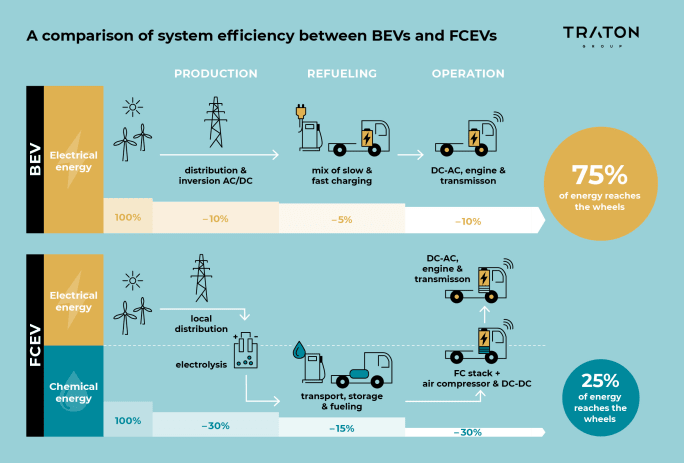
Fuel-cell-electric powertrains are not as efficiency as battery-electric, according to Traton.
Graphic: Traton
Traton officials were pleased, but not surprised, by the analysis.
“In truck traffic, especially on long-distance routes, pure e-trucks will in most cases be the cheaper and more environmentally friendly solution,” said Catharina Modahl-Nilsson, Traton chief technical officer, in a statement. “This is because hydrogen trucks have a decisive disadvantage: Only about a quarter of the output energy flows into the drive. Three-quarters is lost through conversion losses. With the e-truck, the ratio is reversed.”
In addition, the expected amount of green hydrogen is limited, even with large-scale imports, the Fraunhofer analysis pointed out. The demand from European industry alone, such as steel mills, massively exceeds the total green hydrogen production capacity currently planned for the EU for 2030.
While these comments reflect the situation in Europe, the new chief of Traton-owned Navistar made similar comments in a recent reporter roundtable. Mathias Carlbaum said that while there is a use case for hydrogen, such as for very long distances with irregular routes, “we believe that case will be closed over time with the advancement in battery technology.”
“Battery-electric long-distance trucks are coming, the technology is there, and the networks will go along with it," Modahl-Nilsson said. “What's needed now is political support to achieve massive CO2 savings quickly with this technology. That’s why the development of a high-performance charging network for e-trucks must be pushed forward promptly, and with government support.”
Traton expects that by 2030, as much as 50% of its new sales in long-haul transport could be battery-electric, provided the charging infrastructure is in place.
More Fuel Smarts

How Volvo Updated Its D13 for EPA 2027 [Watch]
Volvo’s updated D13 promises lower emissions without sacrificing performance or fuel economy. Take a closer look at what changed inside the engine in this HDT Spotlight video.
Read More →
Diesel Price Spike Shortens Payback for Natural Gas Trucks, Report Says
Energy Vision estimates fleets could recover the higher purchase price of an RNG-fueled Class 8 tractor in 1.3 to 2.8 years under current fuel-price scenarios.
Read More →
Calstart Becomes Catalyst Mobility, Reflecting Broader Focus
Calstart is now Catalyst Mobility, reflecting the nonprofit’s growing national role in clean transportation, including zero-emission trucks, infrastructure and incentive programs.
Read More →

Record Diesel Prices Squeeze Trucking Fleets
Average U.S. diesel prices have climbed to nearly $6 a gallon, surpassing the 2022 record as tight refinery capacity and Middle East disruptions keep fuel costs elevated.
Read More →
How Fuel Delivery Shapes Engine Performance
Fuel delivery depends on more than what happens at the injector. For fleet, maintenance and technical professionals, looking at the full path from pump to injector can provide useful context for understanding engine performance.
Read More →
East Coast Port Launches $45M Electric Truck Push
The Port Authority of New York and New Jersey announced millions in incentives for zero-emission drayage trucks, yard tractors, and new charging hubs near the port.
Read More →
California Bill Could Shed Light on Electric Truck Prices
Why do battery-electric Class 8 trucks remain so expensive? A California bill headed to Gov. Gavin Newsom would give fleets and state agencies more visibility into what manufacturers charge.
Read More →
Detroit Opens Orders for EPA 2027 Engines
Detroit isn’t starting from scratch to meet EPA 2027 diesel emissions standards. Its Gen 6 DD13 and DD15 engines keep much of today’s platform while updating the fuel and aftertreatment systems.
Read More →
Zero-Emission Truck Corridor Planned for West Coast
California, Oregon, Washington, British Columbia and Baja California are coordinating plans for truck charging and hydrogen fueling from Canada to Mexico.
Read More →
A Closer Look at Kenworth’s Electric T880E Vocational Truck [Video]
Learn more about Kenworth's T880E battery-electric vocational truck at the Paccar Technical Center, including its range, applications, upfitting considerations, and PTO options, in this HDT Spotlight video.
Read More →